Eighteen months out from a targeted exit, the operating partner faces a narrow decision window. The sell-side story is starting to firm up, the CFO is modeling the QoE case, and the question on the table is blunt: is the company presentable to a buyer’s diligence team, and if not, what gets fixed before the process starts? An exit readiness sprint exists to answer that question with evidence rather than optimism. It is a time-boxed diagnostic that produces a defensible view of where the asset will lose credibility under scrutiny, what the remediation costs, and which items are worth touching before a banker is engaged.
This guide is written for the person accountable for that call, the operating partner or the portfolio company executive standing up revenue operations and sell-side preparation. It assumes budget, a live timeline, and no need for definitions. The commercial stakes are direct: gaps found by a buyer become price adjustments and reps-and-warranties friction. Gaps found by the seller first become either quiet fixes or disclosed, priced, and controlled narratives.
1. Why the sprint exists and what it protects
Buyers discount uncertainty. Every unexplained revenue swing, undocumented process, or fragile system becomes a reason to shave the multiple or hold back purchase price. The sprint protects enterprise value by moving the discovery of those items from the buyer’s diligence room into the seller’s control, months earlier, when there is still time to remediate or to build a clean explanation.
The macro backdrop matters here. As Bain’s annual global private equity report has tracked across recent cycles, holding periods have stretched and exit windows have narrowed, which raises the cost of showing up to market with an asset that is not diligence-ready. PitchBook data on exit activity tells a similar story about selectivity. When the window is tight, a failed or repriced process is expensive, and the sprint is cheap insurance against that outcome.
2. Decide the scope before you scope the work
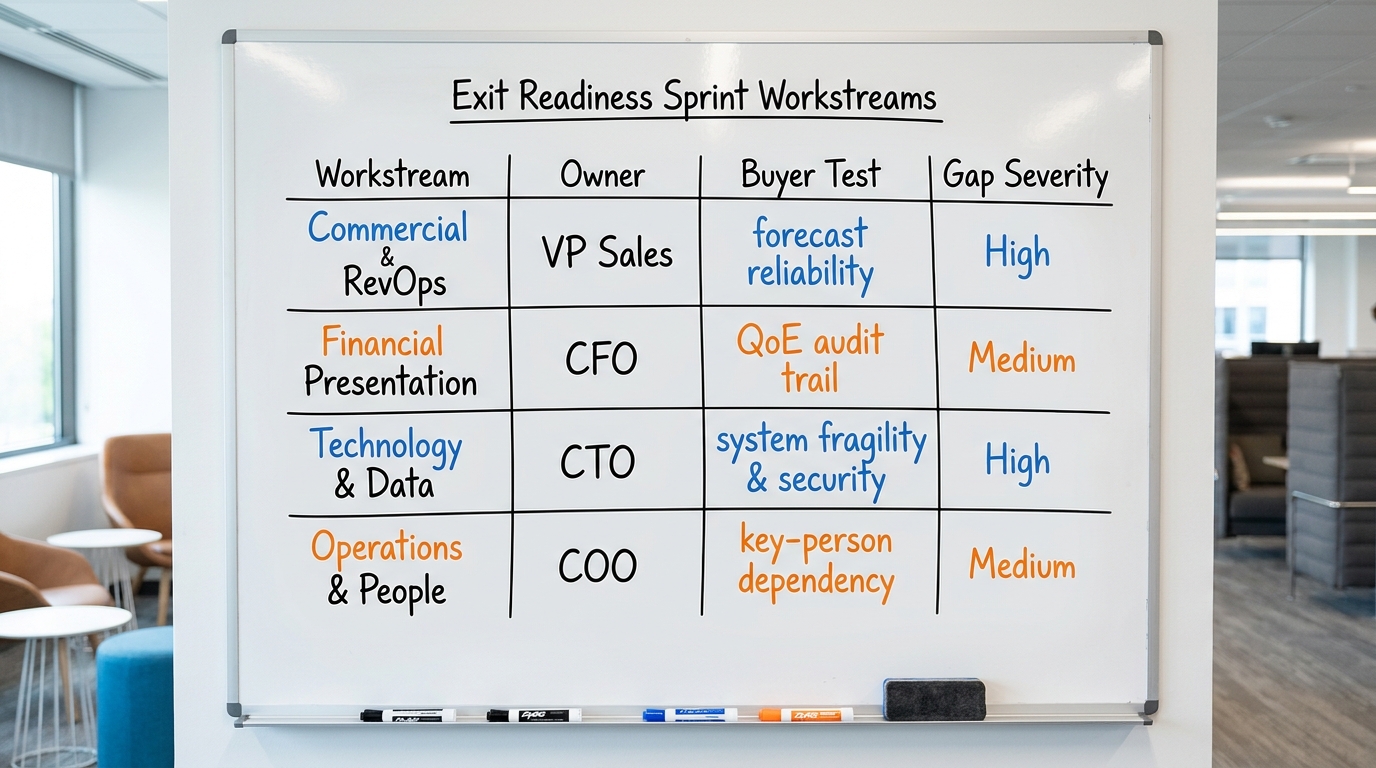
The first decision is what the sprint is allowed to cover. A sell-side readiness sprint is not a full-scope diligence exercise and should not pretend to be one. The operating partner sets boundaries across a small number of workstreams and assigns an owner to each:
- Commercial and revenue operations: pipeline integrity, customer concentration, churn, contract quality, and the reliability of the forecast a buyer will test.
- Financial presentation: the quality-of-earnings foundation, revenue recognition consistency, and the audit trail behind reported numbers.
- Technology and data: system fragility, integration debt, security posture, and whether management reporting can be trusted.
- Operations and people: key-person dependency, documented processes, and whether the business runs without the founder.
Scope is a decision, not a default. The operating partner decides which of these carry real exit risk for this specific asset and funds the sprint accordingly.
3. Set the baseline the way a buyer will
The sprint’s credibility rests on baselining against buyer standards, not internal comfort. That means asking, for each workstream, what a competent buyer’s advisers will request and whether the company can answer it inside a data room without scrambling. The AICPA & CIMA guidance on quality-of-earnings expectations is a useful reference point for what financial reviewers will probe. On governance and disclosure discipline, the Harvard Law School Forum on Corporate Governance publishes practitioner analysis that mirrors what sophisticated buyers now expect to see.
The output of this step is a baseline document: current state versus buyer-expected state, per workstream, with the gap named explicitly.
4. Judge the technology and data workstream honestly
Technology is where sellers most often overestimate readiness. A buyer’s technology due diligence team will look past the roadmap and at the plumbing: how brittle the systems are, how much integration debt sits under the reporting layer, and whether the numbers management presents can actually be reconstructed from the source systems. If the answer is no, the forecast is not defensible, and the buyer knows it.
Practical judgment points the sprint should force into the open include unsupported platforms, undocumented custom code, single points of failure in the data pipeline, and security gaps that will surface in a buyer’s review. For a fuller framing of how these decisions get made under a portfolio lens, the analysis of strategic IT sourcing in private equity and the companion piece on systems implementation for a portfolio company both map cleanly to what a readiness review has to test.
5. Make the revenue operations story hold up
For the sales-operations buyer, this is the center of the sprint. The revenue story is what commands or loses the multiple, and it is tested harder than any other workstream. The sprint has to judge whether the pipeline is real, whether the forecast method is repeatable, and whether reported growth can be tied to durable demand rather than a handful of accounts.
What to instrument before the process starts
- A single source of truth for pipeline and closed revenue, reconciled to finance.
- Documented forecast methodology that a buyer’s team can replicate.
- Cohort-level churn and retention, not a blended average that hides the problem accounts.
- Clear contract terms, renewal mechanics, and concentration exposure.
Where the data is scattered across tools, process automation for portfolio companies is often the fastest path to a reconciled, defensible revenue view before the room opens.
6. Price the remediation, then decide what to touch
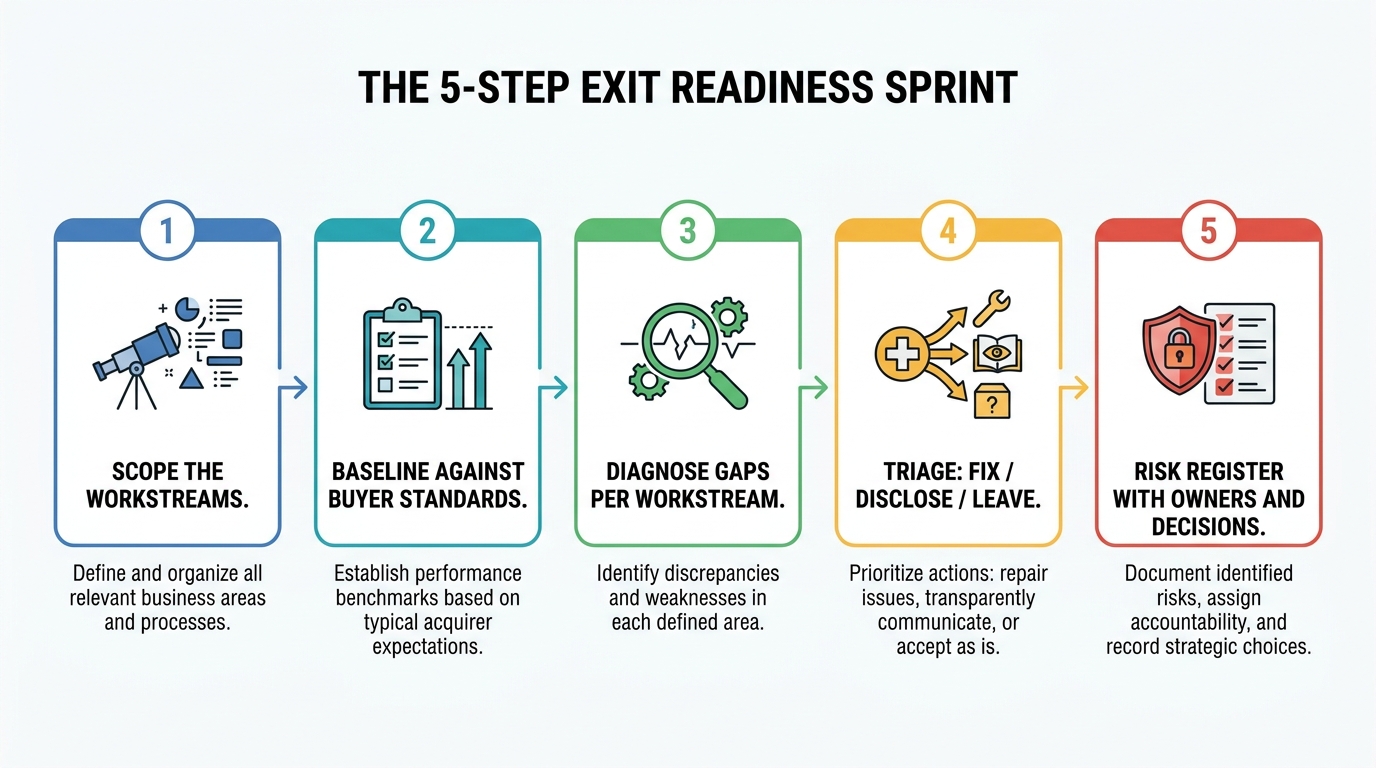
Not every gap is worth fixing before exit. The operating partner’s judgment call is triage: for each gap, estimate the cost to remediate, the time it takes, and the likely price impact if it is left for the buyer to find. Three buckets usually result:
- Fix before process: gaps cheap to close and expensive if discovered, such as a reconciliation break in the revenue data.
- Disclose and price: gaps too costly to fix in the window but manageable as a controlled, pre-explained disclosure.
- Leave alone: items a buyer will not weight, where remediation spend earns no return.
Research from McKinsey on value creation and from BCG on private equity operating discipline both point to the same principle: capital and attention spent late in the hold have to be justified by realized or protected value, not activity. The sprint should attach a rationale to every remediation dollar.
7. Assign decision rights and a risk register
A sprint without clear decision rights produces findings nobody acts on. Each workstream owner surfaces gaps; the operating partner holds the decision on remediation scope and budget. The output is a live risk register that survives past the sprint: each item carries a severity, an owner, a decision (fix, disclose, leave), and a status. This is the artifact that turns a diagnostic into a plan the board can track.
8. Sequence the remediation against the exit timeline
Remediation has to be sequenced backward from the process start date, not the close. Items that need to show a track record, a cleaned-up churn trend or a stabilized forecast method, have to start early enough to produce a few quarters of evidence before a buyer looks. Items that are point-in-time fixes, a security patch or a documented process, can land closer to the room opening.
This is where the discipline of a first 100 days plan is useful even late in the hold: the same sequencing logic, applied in reverse, keeps the remediation from bunching up in the final weeks before a banker is engaged.
9. Judge the quality of the sprint itself
The operating partner should hold the sprint to a standard, the same way a buyer holds the asset to one. A weak sprint reports activity. A strong one reports decisions and consequences. Signs the work is credible:
- Findings are tied to buyer tests, not internal preferences.
- Every gap has a priced remediation and a fix-or-disclose recommendation.
- The deliverable is a register the board can act on, not a slide deck.
- Technology and revenue findings are translated into value and risk terms, not engineering or tooling terms.
When evaluating an outside partner to run it, the same test applies as with any provider in this cluster. The guidance on choosing a partner and judging it on value rather than hours and the comparison in the West Monroe alternative analysis both frame the judgment well: buy the outcome and the artifact, not the hours logged.
10. When the sprint matters most
The sprint has natural triggers. The strongest is 12 to 18 months before a targeted process, with enough runway to build track record on remediated items. It also matters when a board first sets an exit timeline, when a buyer’s early interest forces the question ahead of schedule, or when a prior process stalled on diligence findings and the asset is being re-prepped. Disclosure discipline expectations, which the U.S. Securities and Exchange Commission and the Harvard Law School Forum on Corporate Governance both illuminate for regulated processes, only raise the bar for showing up clean.
11. The next-step checklist
Before commissioning an exit readiness sprint, the operating partner should be able to answer:
- What is the targeted process start date, and how much remediation runway remains?
- Which workstreams carry real exit risk for this specific asset?
- Who owns each workstream, and who holds the remediation decision?
- Is the deliverable a priced risk register, or just a report?
- Will technology and revenue findings arrive translated into value and risk, not activity?
- Which findings need a track record, and can they start early enough to build one?
If those answers are clear, the sprint will produce decisions. If they are not, the sprint will produce a document nobody uses.
12. Move from diagnostic to defensible
An exit readiness sprint earns its cost when it converts vague confidence into a priced, owned, sequenced plan that survives a buyer’s scrutiny. The commercial payoff is a process that starts on the seller’s terms, with the gaps already found, explained, or fixed. To scope a sprint against a specific asset and timeline, review the private equity operating support from DevriX and GrowthShuttle and take the exit readiness engagement to your next board discussion.