An operating partner inherits a software roadmap the day the deal closes, and rarely a team that can actually deliver it. The forecast assumes a new billing module ships in Q2, a self-serve flow lifts conversion by year-end, and the integration of an add-on’s platform happens without a customer-facing outage. The company has three engineers, a backlog, and a founder-CTO who is now reporting to a board. That gap between what the model promised and what the engineering org can execute is the reason a product engineering partner for private equity gets hired at all.
This guide is for the person standing up delivery inside a portfolio company: the operating partner who owns the value-creation plan, or the portfolio executive who has to make the roadmap real. It covers what to decide before signing, how to structure the engagement, and how to judge whether the partner is producing enterprise value or just producing activity.
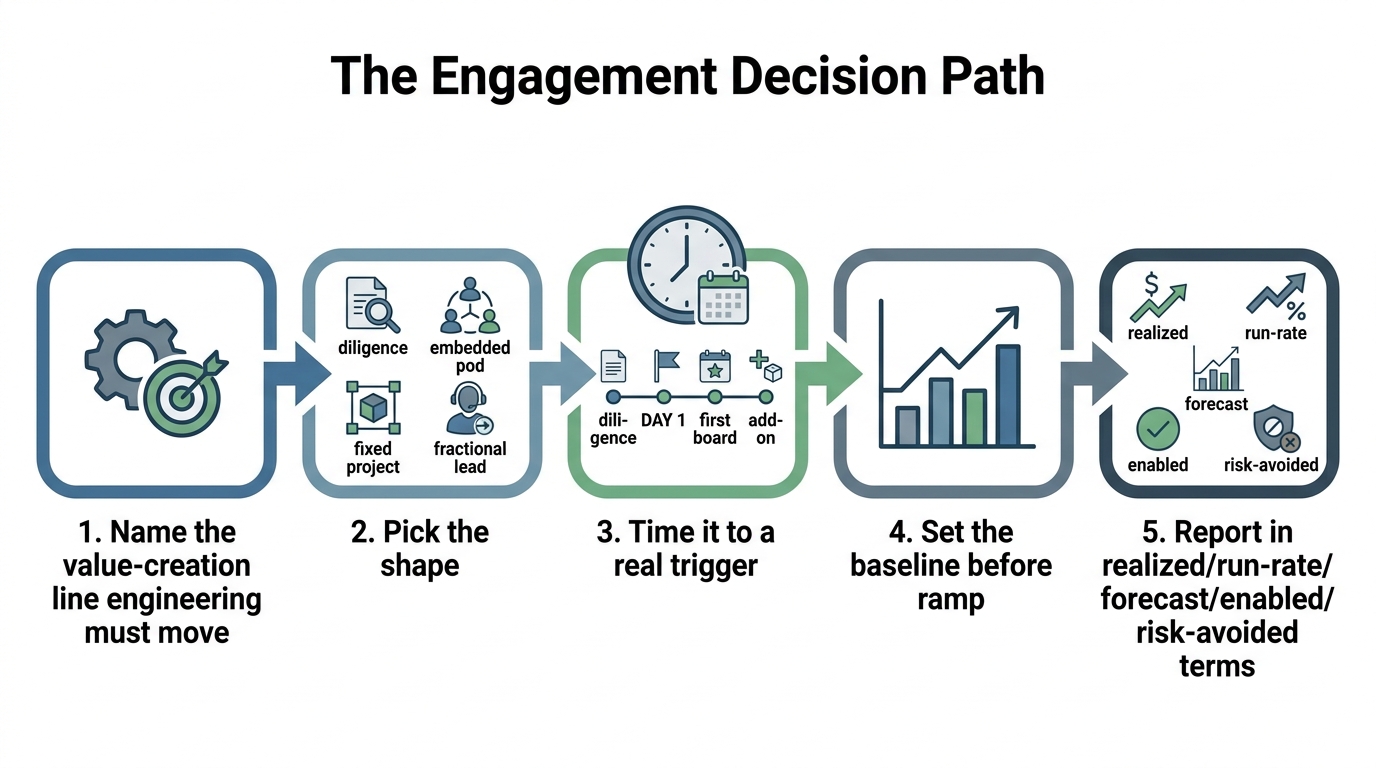
1. Name the commercial problem before you scope a vendor
The mistake is to start with “we need engineers.” Start with the line in the value-creation plan that engineering is supposed to move. Revenue growth blocked by a product gap. EBITDA expansion that depends on retiring a legacy system’s maintenance cost. A shorter integration path for an add-on. Faster forecast reliability because reporting is manual today.
Each of those is a different engagement. A partner brought in to reduce operating risk through application modernization is scoped and measured differently from one brought in to ship revenue-generating features. Write the commercial outcome first. The scope follows from it.
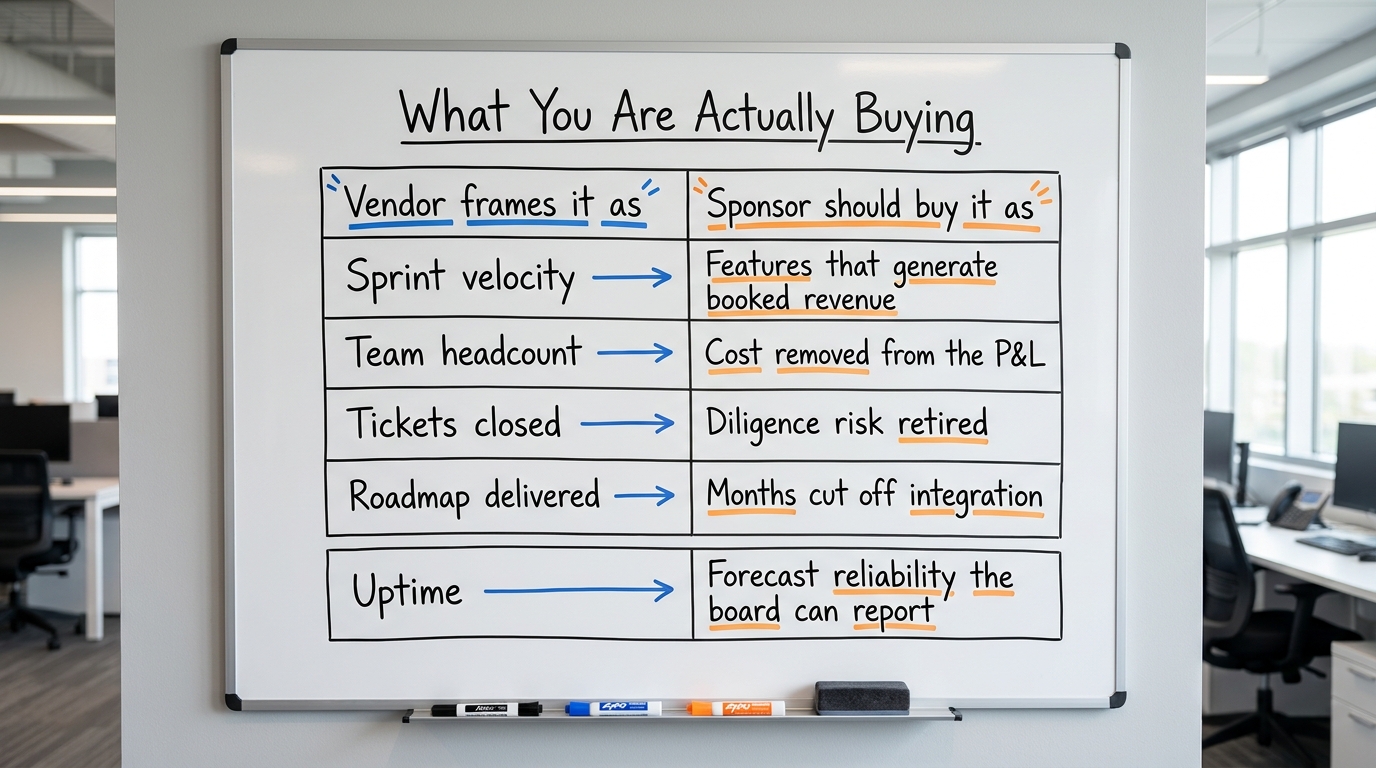
2. Decide what you are actually buying
A PE-backed buyer is not purchasing engineering capacity. It is purchasing measurable movement in enterprise value: revenue the product now generates, cost the modernization removes, risk a diligence flag no longer represents, or time cut off the integration. If a partner’s pitch describes team size, sprint velocity and ticket throughput, it is describing its own inputs. Those are the vendor’s costs, not the sponsor’s return.
Bain’s annual Global Private Equity Report has tracked for years how the industry’s returns increasingly come from operational improvement rather than multiple expansion or leverage. That shift is the whole reason embedded engineering matters to a sponsor: it is an operating lever, and it has to be underwritten like one.
3. Separate the four engagement shapes
Product engineering partners tend to come in one of four shapes. Confusing them is how budget gets wasted.
Diligence advisory
Assessment of the target’s stack, team, technical debt and delivery risk during the deal. This is technology due diligence, and it is scoped in weeks, not months. It informs the thesis and the price, not the build.
Embedded build team
A durable pod that owns delivery against the roadmap, usually on a retainer. This is where a company that needs sustained throughput against a value-creation plan lands. Typical monthly commitment runs from the mid five figures upward, because it is a standing capability, not a project.
Fixed-scope project
A defined migration, rebuild or integration with a start and an end. Right when the outcome is discrete and the internal team will own it afterward.
Fractional leadership
A senior technical operator who sets architecture and hiring direction without a full team. Useful when the company has engineers but no one who can translate roadmap into an EBITDA story the board will accept.
4. Time the decision to a real trigger
Engagements go sideways when they are timed to a vendor’s availability instead of a deal event. The four triggers that actually justify moving:
- Confirmatory diligence. A technical flag surfaced and needs a costed remediation plan before close.
- Day 1 to the first 100 days. The value-creation plan names a product deliverable and the internal team cannot start it.
- First board meeting. The roadmap has to be defensible with dates, owners and cost, and the current org cannot produce that.
- An add-on close. Two platforms have to converge, and the integration dependency sits on the critical path to synergy capture.
McKinsey’s private capital research has repeatedly documented how much of the deal’s value is won or lost in the early integration window. If the trigger is real, the timeline is short, and speed is itself part of what the partner is being paid for.
5. Insist on a baseline you can measure against
Before work starts, capture the actual state. Current delivery cadence. Defect and incident rate. Maintenance cost of the systems in scope. Revenue attributable to the products being touched. Without a baseline, “we shipped a lot” is unfalsifiable, and the board cannot tell realized value from motion.
This is the same discipline that separates a real sales-operations engagement from a busy one. The reasoning in how to hire a sales operations consultant without buying activity transfers directly: name the number first, then hire against it.
6. Classify every claimed impact honestly
When the partner reports progress, force the classification. Is the value realized (revenue booked, cost already out of the P&L), run-rate (in effect and annualizing), forecast (modeled but not yet earned), enabled (a capability now exists that the business can act on), or risk avoided (a failure mode closed)?
All five are legitimate. The failure is letting forecast or enabled value get reported to the board as realized. A partner that volunteers this distinction without being pushed is one that has worked inside a portfolio company before.
7. Judge the partner on evidence, not credentials
Logos and headcount are weak signals. Stronger ones:
- They ask about the exit. A partner that wants to know the hold period and thesis will build differently from one that just takes a backlog.
- They can name what they would not do. An honest partner will decline scope that does not move the plan.
- They translate engineering into the CFO’s language. Cash, covenant headroom, forecast reliability, EBITDA. A CTO who cannot do this will not survive the first board cycle.
- They stage cost against evidence. Full spend from week one, before a baseline exists, is a flag.
When comparing an embedded product-engineering firm against a large consultancy, the trade-offs are the same ones covered in this comparison of a West Monroe alternative: brand and bench depth on one side, embedded continuity and outcome accountability on the other.
8. Structure the retainer so incentives point at value
An embedded retainer, typically $15K to $50K a month and up depending on pod size, is the right structure for sustained delivery. Protect it with:
- A short diagnostic phase that produces the baseline before the full pod ramps.
- A named business owner inside the portfolio company who holds the decision rights, so the partner is not steering the roadmap by default.
- A monthly report framed in commercial terms, mapped to the value-creation plan, not a sprint burndown.
- A defined off-ramp: what internal ownership looks like when the retainer ends.
PitchBook’s research and data on holding periods is a useful reminder that these engagements live inside a finite clock. Structure for handoff from day one.
9. Watch the integration and adoption risk
Shipping software is not the same as capturing the synergy. When an add-on’s platform gets integrated, the revenue-operations layer usually breaks before the code does. The pattern in why post-merger RevOps integrations fail shows up constantly: the systems technically connect, but the pipeline, the reporting and the commercial process do not. A product engineering partner that ignores adoption and process is delivering half the outcome.
The same holds for less visible obligations. Accessibility compliance engineering is a good test case: a partner that never raises it during diligence may be leaving a risk on the register that surfaces at exit.
10. Build the internal capability the partner leaves behind
An embedded partner should raise the internal team’s ceiling, not create permanent dependence. That means documentation, knowledge transfer, and deliberate skill building inside the portfolio company. The engineering skills matter, and so do the ones around them; the balance covered in soft skills versus technical skills for modern teams applies to the people who inherit the codebase. A partner that treats enablement as part of the mandate is a partner planning for a clean exit.
11. A checklist before you sign
- The commercial outcome is written down and tied to a value-creation-plan line.
- The engagement shape matches the outcome (advisory, embedded pod, project, or fractional lead).
- The start is timed to a real trigger, not vendor availability.
- A baseline is captured before the full team ramps.
- A named internal owner holds the decision rights.
- Reporting is framed in realized / run-rate / forecast / enabled / risk-avoided terms.
- The partner translates engineering into cash and EBITDA without prompting.
- Adoption and process risk, not just code delivery, is in scope.
- Knowledge transfer and an off-ramp are defined at the start.
Governance research from the Harvard Law School Forum on Corporate Governance reinforces the point that sponsor oversight works best when accountability and decision rights are explicit. The same is true one layer down, inside the engagement itself.
12. Where this fits in the value-creation plan
A product engineering partner is one instrument in a portfolio company’s operating toolkit, alongside the sales-operations decisions covered in when to outsource sales operations in a PE-backed company. Both are judged the same way: not on the hours billed, but on the enterprise value moved and the multiple it supports at exit.
To match an embedded engineering pod to a specific value-creation thesis and see how it is scoped against the plan, review the private equity operating and delivery model at DevriX.