Somewhere between the signed LOI and the first board meeting, a portfolio company executive gets handed a technology mandate that reads like a wish list: modernize the stack, consolidate the systems, add AI, tighten security, and do it inside the hold period. Technology transformation for portfolio companies fails most often not because the work is hard, but because no one decided what the work is supposed to change on the P&L. The person standing up sales and revenue operations inside the asset is usually the one left to reconcile that gap, and the sponsor expects an answer before the next quarterly review.
This guide is for the operating partner or portfolio executive who owns that mandate and has budget to spend. It covers what to decide, in what order, and how to judge whether the money is buying enterprise value or just activity.
1. Start from the value creation plan, not the tech stack
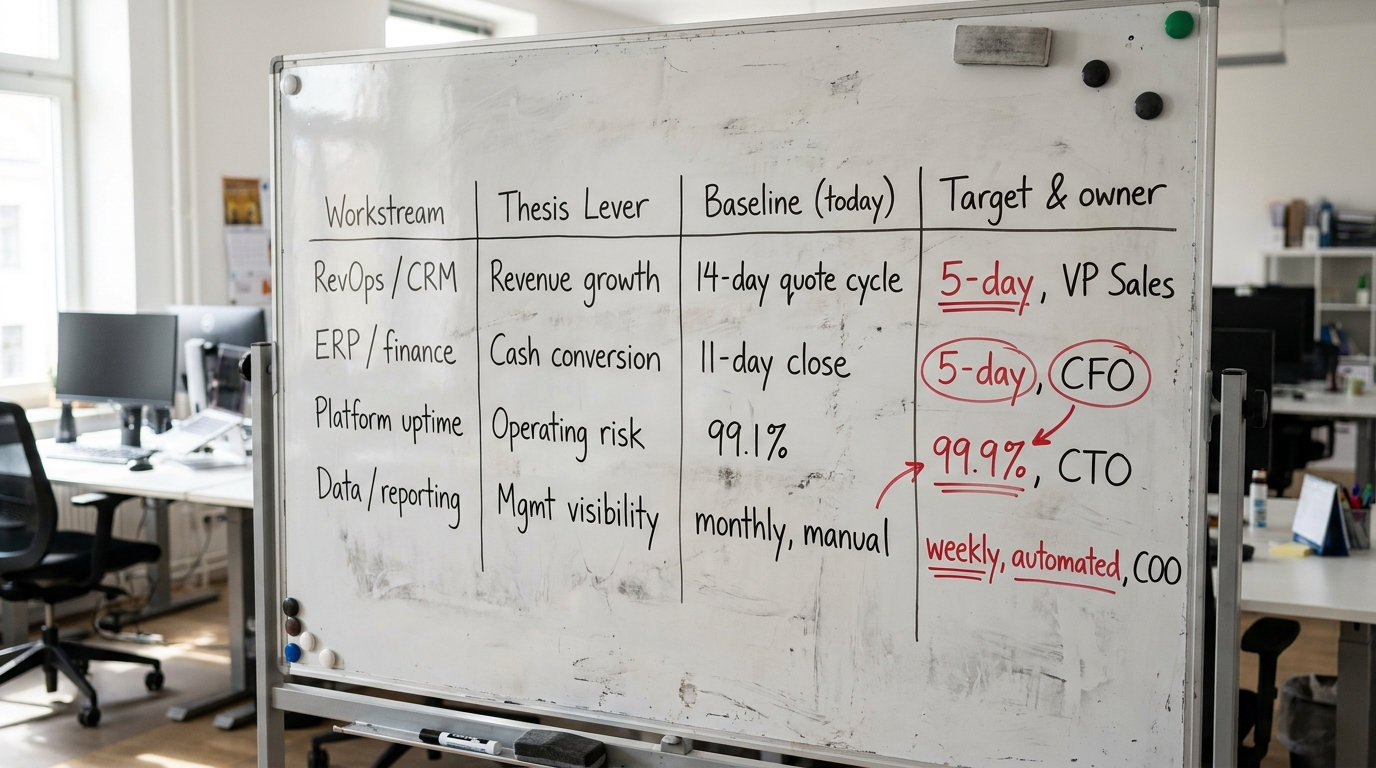
The transformation exists to move one or more levers in the investment thesis: revenue growth, EBITDA margin, cash conversion, or a cleaner story at exit. If the CTO cannot name which lever a given project serves, defer the project until someone can. Before scoping anything, write down the two or three thesis assumptions that depend on technology working, and the dollar figure attached to each.
Bain’s annual private equity report has tracked for years how value creation has shifted from financial engineering toward operational improvement, which puts real weight on the question of what technology actually changes. You can read the current edition in Bain’s Global Private Equity Report. The practical consequence is that every workstream needs an owner, a baseline, and a number it is meant to move.
2. Establish the baseline before anyone proposes a solution
You cannot judge improvement without knowing where the business starts. That means actual data: current revenue per rep, quote-to-cash cycle time, system uptime, the real cost of the finance close, and how many hours the team spends reconciling spreadsheets that a system should handle. If diligence produced a technology view, pull it forward; if it did not, the first weeks of ownership are when you build it.
Much of this overlaps with proper technology due diligence, and a thin diligence pass is a common reason transformation plans arrive untethered to reality. McKinsey’s private capital research, available through McKinsey, has documented how operational baselines separate the deals that hit plan from the ones that drift.
3. Sequence the work against the hold period, not the ideal roadmap
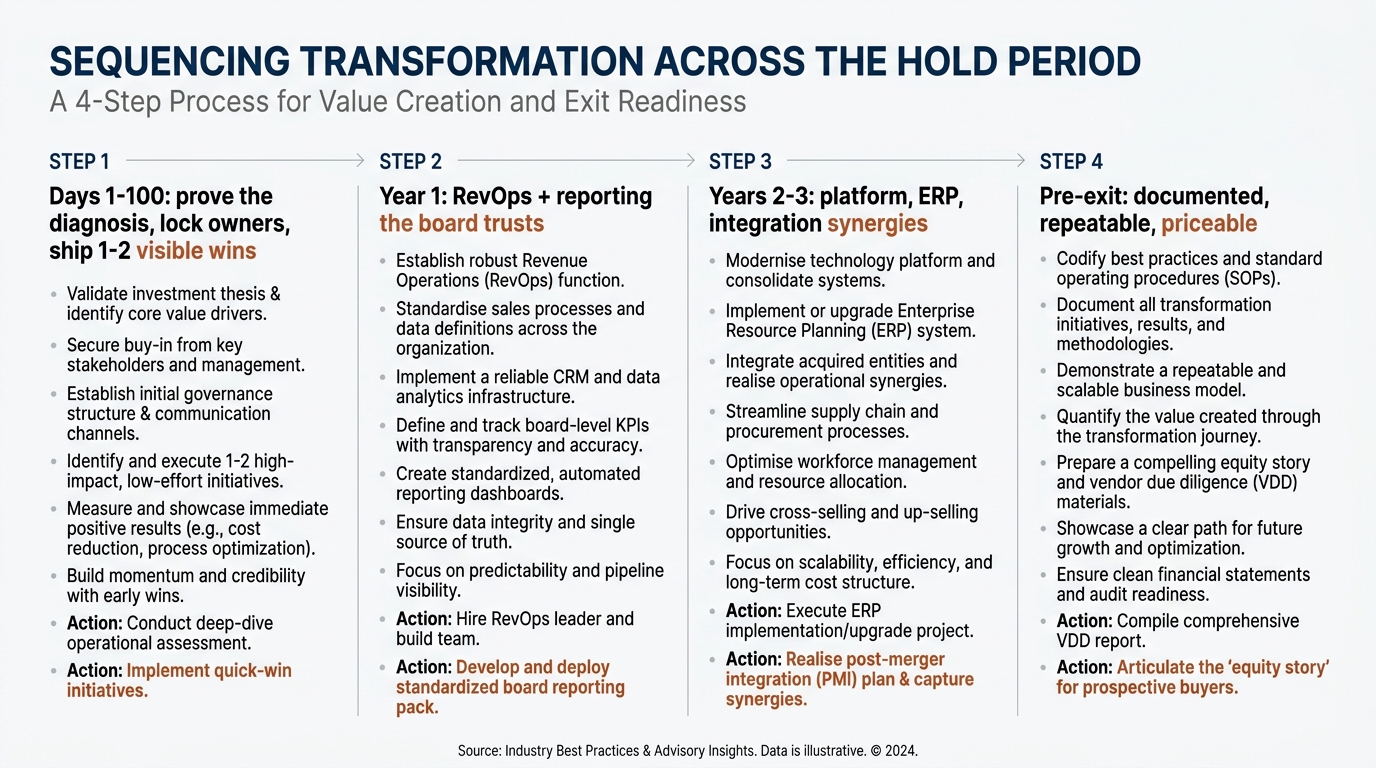
An engineer’s ideal roadmap assumes unlimited time. A portfolio company has a hold period, usually three to five years, and the transformation has to produce visible results well before exit so a buyer can price them. Put the projects with the fastest, most defensible payback first, and defer the elegant rebuilds that pay off in year six.
The first 100 days set the tone here. What matters in that window is proving the diagnosis, locking the owners, and shipping one or two changes that the board can see. For a deeper treatment of what that roadmap has to deliver, this site’s guide on what an IT roadmap for a portfolio company has to deliver is a useful companion.
4. Decide what revenue operations actually requires
For most mid-market assets, the revenue operations layer is where technology transformation produces the clearest EBITDA story, because it touches pipeline, conversion, and retention directly. The decision is not “buy a better CRM.” It is which parts of the revenue process are broken in a way that costs real money, and whether the fix is configuration, data, process, or headcount.
Standing up RevOps inside a portfolio company means deciding ownership of the pipeline forecast, the definition of a qualified lead, the data model behind renewals, and the reporting the board will actually trust. Make those decisions first, then choose the tooling that executes them. Buying software to paper over an undecided process is how portfolio companies end up with three CRMs and no forecast anyone believes.
5. Separate what you build, what you buy, and what you outsource
Every transformation involves a build-versus-buy call, and portfolio companies get it wrong in both directions: building commodity capabilities that should be bought, and buying bespoke needs that should be built. The test is whether the capability is a source of competitive advantage for this specific asset. If it is not, buy it or outsource it and move on.
Outsourcing product and engineering can compress timelines when internal capacity is thin, but it introduces its own risks around knowledge retention and integration. This site covers the structure in detail in how to structure outsourced product and engineering for a portfolio company, and the related question of building capacity in-house in how to build and judge an embedded engineering team for a PE-backed company.
6. Treat AI as a funded decision, not a mandate
Sponsors increasingly ask portfolio companies for an AI story, and portfolio executives feel pressure to produce one. The discipline is the same as any other workstream: name the lever, set the baseline, and fund the specific use case that moves it. Most genuine early wins are narrow, which is why the question of what to fund matters more than the ambition behind it.
This site’s guide on agentic AI for portfolio companies and how to decide what to fund walks through the funding call. BCG’s work on how principal investors apply AI, available through BCG, is a reasonable external reference for separating the use cases that pay back inside a hold period from the ones that do not.
7. Build the integration plan around data, not org charts
When an add-on arrives, the technology question is whether the two companies’ customer records, financial data, and reporting can be reconciled fast enough to show combined numbers. Integration dependencies that sit in the data layer are the ones that quietly delay synergy capture. Map them before close, and assign an owner to each one.
ERP consolidation is the project most likely to break a forecast if it is mismanaged, because it touches every transaction and every report. This site’s guide on how to judge an ERP implementation before it breaks the forecast is worth reading before any such project is approved.
8. Judge the partner by outcomes, not by activity
Whether the capability is internal or external, the reporting a transformation produces should lead with the number it is moving, not the hours logged, tickets closed, or features shipped. Activity reporting is the clearest sign a partner is managing you rather than the outcome. Ask any vendor to connect their work to revenue, margin, cash, or risk, and watch how quickly they can do it.
For the buyer-side view of selecting and judging these partners, this site covers both how to choose an embedded technology partner for portfolio companies and how to judge a technical value creation partner in private equity. The common thread is that a partner who cannot name the enterprise-value lever is a cost center wearing a strategy label.
9. Price the improvement the way a buyer will
Transformation only shows up at exit if it is documented and repeatable. A buyer’s diligence team will discount anything that looks like a one-off or depends on a single person. Keep a running record of each improvement, classified honestly: realized (already in the numbers), run-rate (annualized from recent actuals), forecast (expected but not yet earned), or enabled (the capability exists, the value does not yet). Do not let forecast value read as realized in a board deck, because a diligence team will find the difference and reprice it.
S&P Global Market Intelligence and PitchBook, through S&P Global and PitchBook, both publish data on how operational value is scrutinized in exits, which is a useful calibration for how much documentation a buyer expects.
10. A checklist before you approve the spend
- Every workstream names the thesis lever it moves and the dollar figure attached to it.
- A baseline exists for each target, built from actuals rather than estimates.
- Each workstream has a single named owner with the decision right to execute.
- The sequence front-loads defensible payback and defers elegant rebuilds.
- Build, buy, and outsource calls are made on competitive advantage, not preference.
- Any AI spend is tied to a specific, baselined use case.
- Integration dependencies are mapped at the data layer, each with an owner.
- Partner reporting leads with the number moved, not activity.
- Every improvement is classified as realized, run-rate, forecast, or enabled.
- The transformation is documented so a buyer can price it without the current team in the room.
11. Where this fits in the broader value-creation program
Technology transformation is one workstream inside a wider operating plan, and it connects to commercial, finance, and integration work that a sponsor runs in parallel. For the full picture of how these pieces are structured across a hold period, DevriX’s private equity practice covers the embedded model, and this site’s guide on what to buy when you buy digital value creation services in private equity maps the specific capabilities to the levers they serve.
If the mandate on your desk includes technology transformation and you need an embedded team that reports against enterprise value rather than hours, see how DevriX and GrowthShuttle structure that work for portfolio companies at the DevriX private equity practice.