By the time a deal team reaches confirmatory diligence, most of the attention sits on the quality of earnings and the debt package. The data and AI readiness of the target usually gets a half-page in the IT appendix and a line item in the risk register. That is where forecasts break later. The operating partner standing up revenue and sales operations after close inherits whatever diligence either caught or missed, and the cost of a miss shows up at the first board meeting.
This guide is for the operating partner or portfolio company executive who has budget and a decision to make during middle market private equity due diligence. It covers what to decide about data and commercial systems before the workstreams close, who owns each call, and how to judge the evidence you are handed.
1. Why data readiness belongs in the deal, not the first 100 days
A PE-backed buyer is not purchasing a CRM, a data warehouse, or a set of dashboards. It is purchasing a forecast it can underwrite and an integration it can execute on schedule. When the sales operations backbone is weaker than the information memorandum implied, the value creation plan slips, and the slip is rarely recoverable inside the hold period.
Bain’s annual private equity report has tracked how much of the return now depends on operational improvement rather than multiple expansion, which puts the burden on the systems that generate revenue visibility. You can review the latest edition through the Bain & Company Global Private Equity Report. The practical consequence for diligence is simple to state: if you cannot trust the pipeline data, you cannot trust the growth case built on top of it.
2. Decide what the data actually has to support
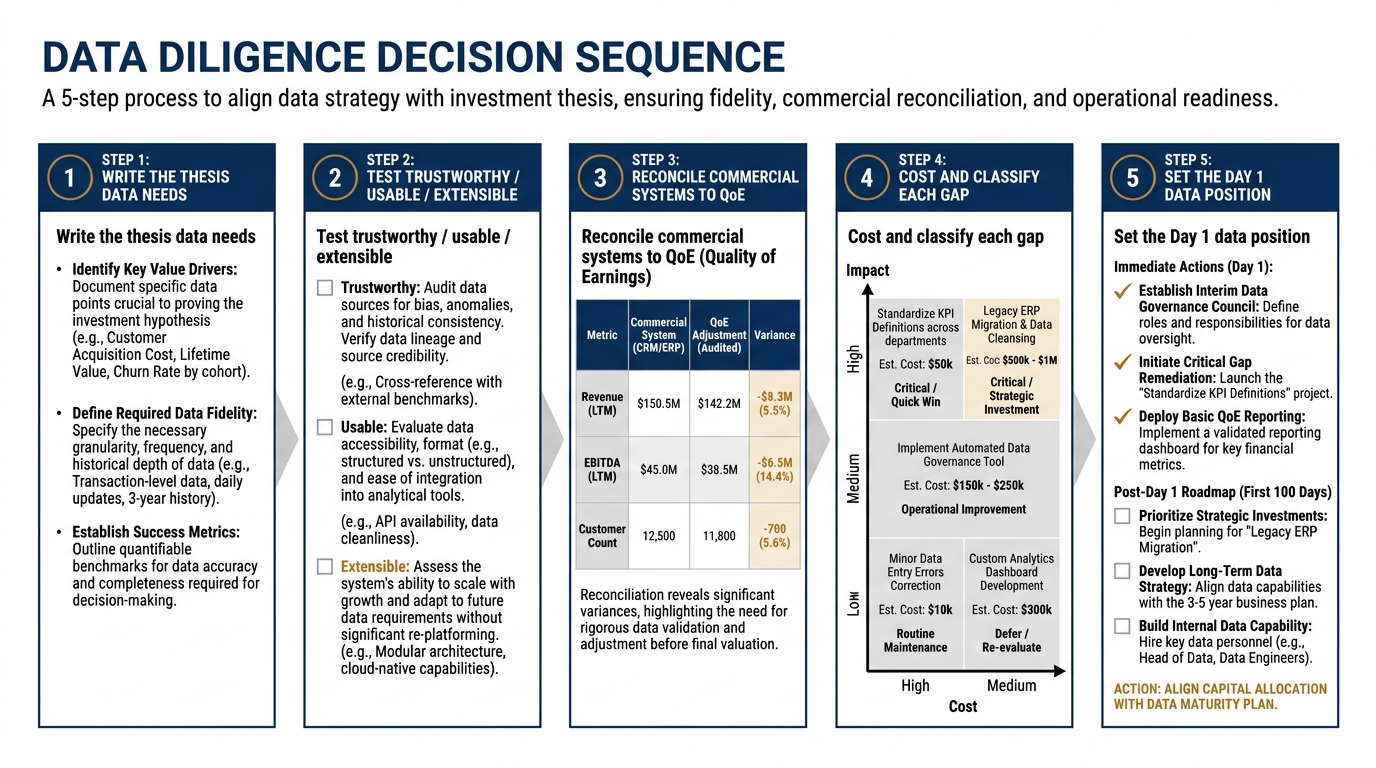
The deal team should write down what the value creation thesis requires the data to do before anyone evaluates the tech stack. A roll-up thesis needs customer and product records that can be merged across targets. An organic growth thesis needs clean attribution from marketing spend to closed revenue. A margin thesis needs cost and usage data at the account level.
This is a commercial decision owned by the deal partner and the incoming operating partner, not a technical one. The technical diligence then tests whether the current systems can deliver that, or what it costs to get there. Reversing the order, letting a vendor scope a stack before the thesis is explicit, produces activity reports instead of a readiness judgment.
3. Separate the three questions diligence has to answer
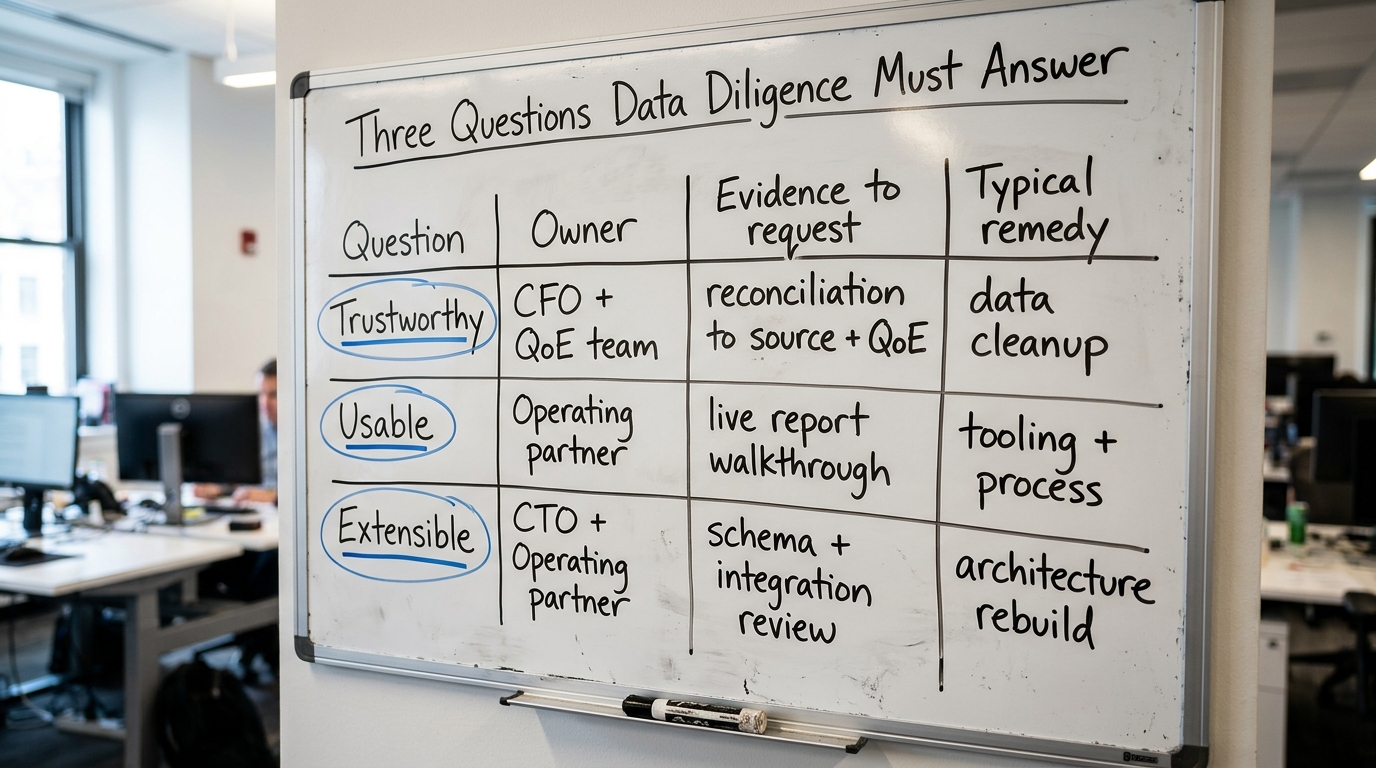
Data readiness diligence tends to collapse three distinct questions into one vague conclusion. Keep them apart, because each has a different owner and a different remedy.
- Is the data trustworthy? Can the reported revenue, pipeline, and retention numbers be reconciled to source systems and to the quality of earnings work.
- Is the data usable? Can the business act on it with the people and tooling it has, or does every report require a one-off export and a manual spreadsheet.
- Is the data extensible? Can it support the integration, the add-ons, and the reporting the deal team wrote into the thesis, without a rebuild.
A target can pass the first and fail the third. That pattern is common in founder-led middle market companies where the numbers are honest but the architecture was never built for a buyer’s reporting cadence.
4. Judge the commercial systems the way the QoE judges the numbers
The quality of earnings process reconciles reported earnings to reality. Apply the same discipline to the systems that produce commercial data. Ask to see a real pipeline report generated live, not a cleaned export prepared for the data room. Ask how long it took to produce, who produced it, and how often the business actually uses it to make decisions.
When a sales operations function depends on one analyst and a set of personal spreadsheets, that is a key-person risk in the revenue engine, and it belongs in the risk register with an owner and a remediation cost. The work of translating that technical finding into an EBITDA and integration risk is covered in more depth in this guide on how to judge a technical value creation partner in private equity.
5. Scope technology diligence to the thesis, not to a checklist
Generic technology diligence returns a long inventory of versions, licenses, and vulnerabilities. Useful technology diligence returns a judgment on whether the systems can carry the deal. Those are different deliverables, and the deal team should specify which one it is buying.
Proper technology due diligence ties each finding to a commercial consequence: this integration dependency delays the first add-on by a quarter, this data gap makes the attribution claim in the model unverifiable, this platform limit caps the self-serve revenue line. For high-traffic or platform-heavy targets, the engineering judgment carries real valuation weight, which is set out in this analysis of what high-traffic platform engineering is worth in a private equity deal.
6. Put a number on the remediation, and say what kind of number it is
Every readiness gap diligence finds should carry an estimated cost to close and a classification. A buyer makes different decisions depending on whether a finding is a realized problem costing money today, a run-rate drag, or a risk that may or may not materialize. Blending them into one scary total is how diligence loses the room.
Be explicit that remediation cost is forecast, not realized, and that the growth it enables is enabled value until the systems actually deliver it. McKinsey’s research on private capital value creation, available through McKinsey, consistently separates what the deal team projects in the model from what a portfolio company has banked. Diligence should hold the same line, because a board that cannot tell the two apart will manage to the wrong number.
7. Decide the Day 1 data position before you sign
Confirmatory diligence is the last point at which the buyer can shape what the business looks like on Day 1 without paying a premium for it. Decide now which systems carry forward, which get frozen, and which need a migration plan in the first 100 days. A migration that is discovered after close becomes an unbudgeted project competing with the growth agenda.
If the integration plan assumes a single source of customer truth across the platform and two add-ons, confirm during diligence that the records can actually be reconciled. The cost and timeline belong in the model. Harvard Law School Forum on Corporate Governance publishes practitioner work on integration planning at the Harvard Law School Forum on Corporate Governance.
8. Assign owners and decision rights now, not after close
Each readiness finding needs a named owner and a clear decision right before the deal closes. The CFO owns the reconciliation to the quality of earnings. The operating partner owns whether a gap is remediated with internal hires, a build, or an embedded partner. The CTO or an external reviewer owns the architecture verdict. When those rights are unassigned, findings sit in the risk register without anyone moving them, and the first board meeting becomes a discovery session.
For the build-versus-partner call on engineering capacity, the trade-offs are laid out in this guide on how to build and judge an embedded engineering team for a PE-backed company, and the broader selection question in how to choose an embedded technology partner for portfolio companies.
9. Judge the evidence, not the deck
A vendor or management team can produce a confident data readiness summary that turns out to be a list of activity: hours spent, tools deployed, tickets closed, and dashboards built. The buyer should insist on evidence tied to a baseline: here is what the reporting produced before, here is what it produces now, here is the method.
PitchBook and S&P Global Market Intelligence both publish deal and operating data that can sanity-check the growth assumptions a target presents, available through PitchBook and S&P Global Market Intelligence. If the target’s reported performance sits far outside what comparable deals show, diligence should explain why before the model relies on it.
10. A diligence checklist for the data and commercial workstream
Before the data and AI readiness workstream closes, the operating partner should be able to answer each of the following with evidence.
- The value creation thesis states explicitly what the data has to support, and the deal partner has signed off on it.
- Reported revenue, pipeline, and retention reconcile to source systems and to the quality of earnings work.
- A live, unassisted pipeline report has been produced and timed, with the dependency on any single analyst documented.
- Each readiness gap has an estimated cost to close, classified as realized, run-rate, forecast, enabled, or risk avoided.
- The Day 1 data position is decided: what carries forward, what freezes, what migrates.
- Every finding has a named owner and a decision right assigned before close.
- Integration dependencies that affect add-on timing belong in the model and in the risk register.
If any of these is still open when the workstream is called complete, the gap transfers to the first 100 days at a worse price. The full operating context for these calls sits in the DevriX private equity practice, and related reading on scoping digital spend is in what to buy when you buy digital value creation services in private equity.
11. Where to take this next
If you are heading into confirmatory diligence or standing up revenue operations in the first 100 days and want the data and commercial systems judged against the thesis rather than a generic checklist, work through a Value Creation Diagnostic with the DevriX private equity team and set the Day 1 data position before the workstreams close.