An operating partner reviewing a portfolio company’s budget in the first 100 days will now find a line for agentic AI, usually attached to a number the company cannot defend. The pitch arrives from a vendor, a new CTO, or a board member who read a McKinsey note on the plane. The decision the operating partner actually has to make is whether this company, with its current data, processes and people, can turn a specific agent into measurable EBITDA before the hold period runs out.
This guide is written for the person setting up sales and revenue operations inside a portfolio company, and for the operating partner who signs off on the spend. It treats agentic AI for portfolio companies as a value-creation decision with a baseline, an owner, and a measurable outcome.
1. Start with the commercial question, not the model
Agentic AI differs from the chat tools most teams have already touched because an agent takes actions across systems: it drafts and sends, updates a CRM record, triggers a workflow, escalates an exception. That capability is real, and it is also the reason the risk profile is different. An agent that acts wrongly at scale creates cost and reputational exposure that a chatbot answering a question does not.
So the first question in a diligence or first-100-days setting is not “which model.” It is “what commercial outcome are we buying, and what would it be worth if it worked.” Revenue growth, gross margin, cash conversion, reduced cost to serve, or a shorter integration are the only reasons a PE-backed buyer funds any of this. Bain’s annual private equity report has documented how value creation has shifted toward operational improvement rather than multiple expansion, which is exactly where an honest agentic case has to land. You can read Bain’s coverage in its Global Private Equity Report.
2. Name the workflow before you name the tool
Most failed agentic projects fail because someone bought a platform and then went looking for a problem. Reverse it. Pick one workflow with high volume, clear rules, and a measurable output. In sales operations, common candidates are lead qualification and routing, quote generation, renewal outreach, and CRM hygiene. Each has a countable baseline: leads worked per rep per day, quote turnaround time, renewal contact rate, percentage of records with clean data.
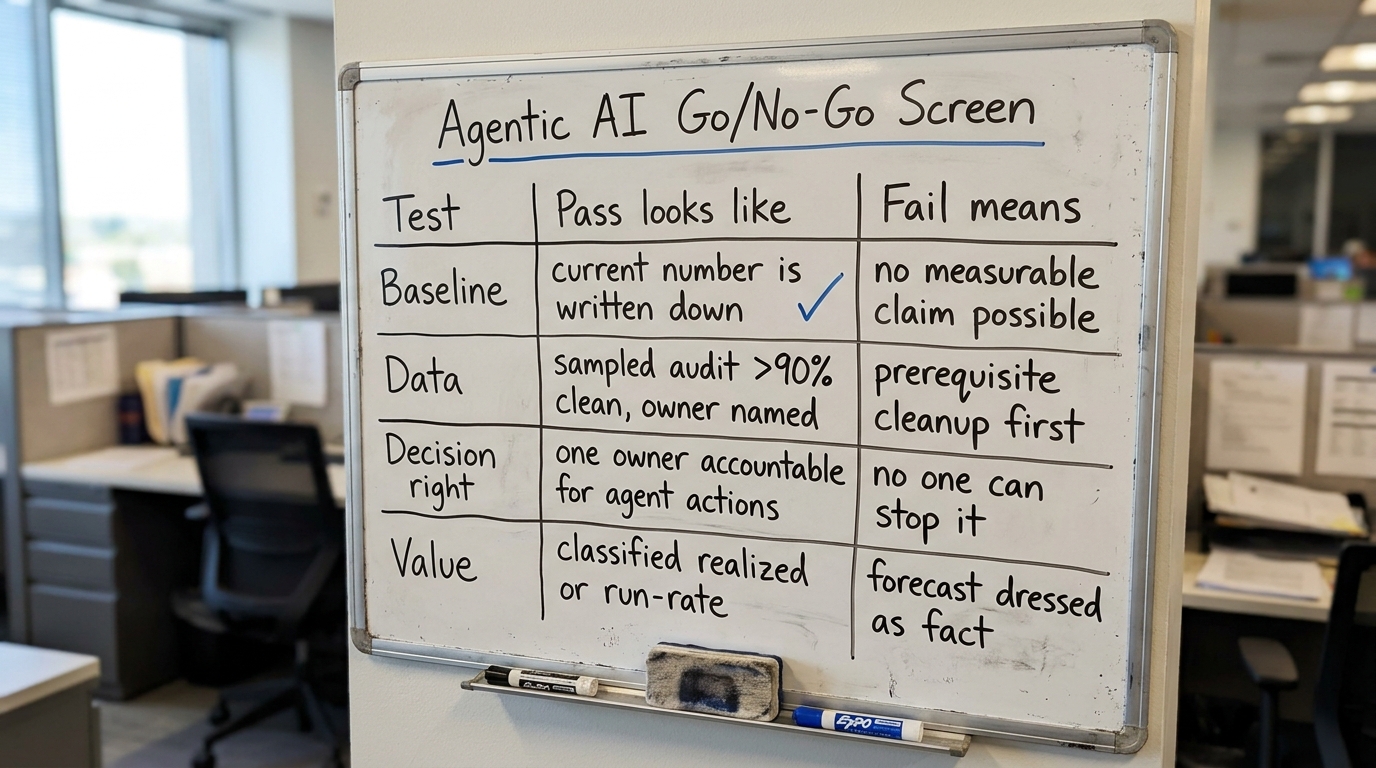
Write the baseline down before the vendor demo. If a company cannot state the current number, it cannot claim an improvement, and any post-implementation win will be an opinion. This is the same discipline that separates a defensible digital value creation purchase from a vendor invoice.
3. Judge data readiness honestly
An agent is only as good as the systems it reads from and writes to. If the CRM is 40 percent incomplete, if product data lives in three spreadsheets, or if the same customer appears under four spellings, an agent will act on garbage faster than a human would. Data readiness is the single most common reason an agentic pilot stalls, and it rarely shows up in the sales deck.
Before funding an agent, the company should be able to answer three things: where the source-of-truth data lives, how clean it is against a sampled audit, and who owns fixing it. McKinsey’s private capital and technology research has repeatedly tied AI returns to data foundations rather than model choice; their material is at McKinsey. Treat weak data as a prerequisite workstream with its own cost, not as something the agent will magically resolve.
4. Decide who owns the agent’s actions
An agent that sends emails, edits records, or approves discounts is taking actions a person used to take, which means someone has to own the outcome of those actions. The decision right cannot sit with the vendor. Name the internal owner, define what the agent is allowed to do without human review, and set the threshold above which a human must approve.
This matters most at Day 1 of an integration, when systems are in flux and an agent trained on the pre-close process can quietly corrupt the post-close one. The same governance logic that applies to any embedded team applies here, which is covered in how to build and judge an embedded engineering team.
5. Scope the pilot to something you can kill
Fund a pilot narrow enough that failure costs weeks, not quarters. One workflow, one team, a fixed window (six to eight weeks is usually enough to see whether the numbers move), and a pre-agreed kill criterion. The point of a pilot is to produce evidence, so the design should make a clear yes-or-no answer possible.
What the pilot must produce
- The baseline metric, measured before the agent went live.
- The same metric during the pilot, measured the same way.
- The error rate: how often the agent acted wrongly, and what it cost.
- The human hours saved or reallocated, stated as a number.
- The all-in run cost, including licenses, integration, and oversight.
6. Separate the four kinds of value the vendor is claiming
Vendors blur value categories, and operating partners pay for the blur. Force each claim into one of four buckets. Realized value is money that has already moved. Run-rate value is a proven per-period effect you can annualize. Forecast value is a projection that has not happened. Enabled value is capacity created that still needs a decision to convert. A quote that turns “could save 30 percent of SDR time” into a realized EBITDA line is the most common way these projects overstate themselves.
Hold forecast and enabled value at arm’s length in any board number. BCG’s principal investors work makes a similar point about disciplined value tracking; see BCG.
7. Cost the whole thing, not the license
The subscription is the smallest number. Real cost includes integration into the CRM and other systems, the data cleanup the agent depends on, ongoing human oversight, model or usage fees that scale with volume, and the internal time to maintain prompts and rules as the business changes. A pilot that looks cheap on the license line can carry a five-figure monthly total once oversight and integration are counted.
Price it the way any material platform spend gets priced in an IT roadmap for a portfolio company, with the full cost of ownership on the page, not just the headline.
8. Check the fit against the hold period
An agent that pays back in 30 months is a poor fit for a company two years from exit and a reasonable one for a platform at the start of a five-year hold. Match the payback horizon to the plan. Where the thesis leans on faster integration of add-ons, an agent that standardizes a repeated process across acquisitions can compound, which is worth more than a one-time efficiency in a single business.
9. Fold it into diligence and exit narratives
During confirmatory diligence, a well-run agent with clean data and named ownership is evidence of an operationally mature company. A sprawl of half-configured agents with no owner is a risk register item. This is standard technology due diligence territory, and it belongs in the same assessment as platform architecture and security.
On the sell side, buyers will discount claims they cannot verify. An agent’s contribution should be documented the way any go-to-market improvement is before a sale, which is the discipline behind the go-to-market exit readiness assessment.
10. Watch the common failure modes
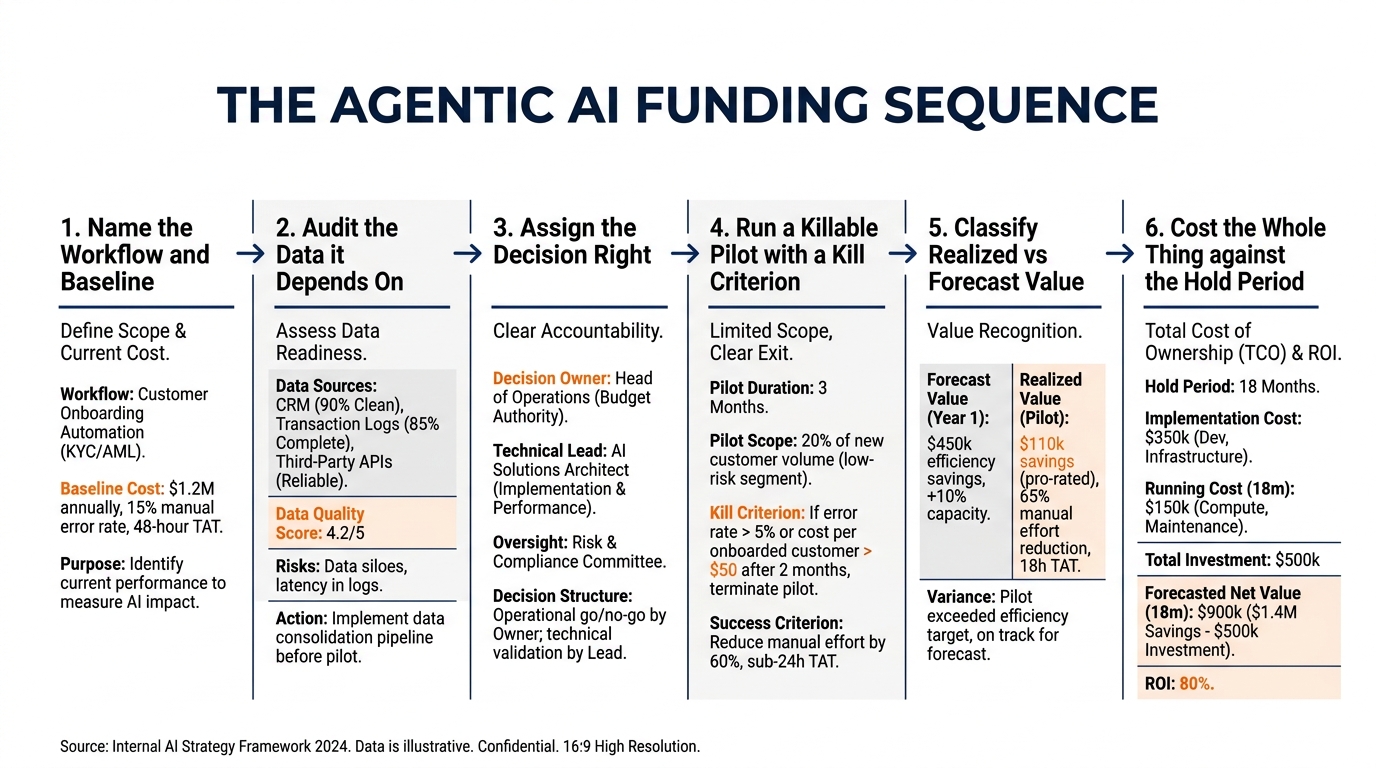
Three patterns recur across portfolio companies. The first is buying a platform before naming a workflow, which produces a tool nobody uses. The second is treating an agent as a headcount replacement on the org chart before it has proven it can carry the volume, which leaves a gap when it cannot. The third is letting the vendor own the metrics, so the reported win is the vendor’s number rather than the company’s baseline.
Regulatory attention is also increasing. The U.S. Securities and Exchange Commission has issued guidance on AI-related disclosure practices, which matters for how an agent’s role is described to a buyer or the market; that material sits at the SEC. Overstating an agent’s capability in a sale process is a documentation problem worth avoiding early.
11. A decision checklist before you sign
- Is there a named workflow with a written baseline number?
- Has the underlying data been audited, with an owner for cleanup?
- Is there one internal owner accountable for the agent’s actions?
- Is the pilot narrow, time-boxed, and killable, with a stated kill criterion?
- Are the four value categories separated, with forecast held apart from realized?
- The full cost of ownership belongs on the page: license, infrastructure, training, audit trail storage, and ongoing maintenance.
- Does the payback horizon fit the remaining hold period?
- Would the current setup read as an asset or a risk in diligence?
If a company cannot answer these, run a diagnostic before a purchase. The same buyer discipline applies to any embedded technology partner a company brings in to run this work, and to how you judge a technical value creation partner.
12. Where this connects to the wider value creation plan
Agentic AI is one line in an AI and data readiness plan, and it works best when the platform underneath it is sound. If the CRM, data pipelines, and reporting are weak, fixing those usually returns more than any agent will, which is why the sequencing in the first 100 days matters. Set the data and ownership foundations first, then let the agent sit on top of something worth automating.
Broader private equity value creation and platform-engineering questions, including what high-traffic platform engineering is worth in a deal, sit alongside this decision rather than beneath it. PitchBook’s research and data, available at PitchBook, is a reasonable place to sanity-check how peers are actually spending before committing a number.
13. Next steps
Before funding an agent, run a short diagnostic: pick one workflow, write its baseline, audit the data it depends on, name the owner, and price the full cost against the hold period. That work turns a vendor pitch into a decision an operating partner can defend to a board.
If you want that diagnostic run against a specific portfolio company, with a defensible baseline and a value classification you can put in front of investors, work through the DevriX private equity value creation program to scope it as a diagnostic or an embedded retainer.