Six months before a sale process opens, the sell-side story is usually written around EBITDA and a growth chart. Then a buyer’s commercial diligence team asks how much of that growth came from repeatable go-to-market motion versus a handful of heroic reps, a founder’s relationships, or price increases that cannot recur. If the portfolio company cannot answer with evidence, the growth narrative gets discounted, the multiple compresses, and the operating partner spends the process defending numbers instead of commanding them.
A go-to-market exit readiness assessment exists to close that gap before a buyer opens it. It is not a marketing audit and not a pipeline review. It is a structured judgment about whether the company’s revenue engine is legible, transferable, and durable enough to survive third-party scrutiny at the valuation the deal team wants.
Why go-to-market is where exit stories break
Financial diligence confirms the numbers happened. Commercial diligence asks whether they will keep happening under new ownership. That second question is where a lot of value leaks out. A concentrated customer base, an undocumented sales process, a marketing function that cannot attribute pipeline, or a revenue operations stack held together by spreadsheets all read the same way to a buyer: execution risk priced into a lower offer.
Bain’s annual private equity report has repeatedly framed commercial due diligence as central to how buyers underwrite growth assumptions. If the seller has not stress-tested its own go-to-market before the process, the buyer runs that test first, and the seller learns the answer at the worst possible time. You can review the recurring themes in the Bain & Company Global Private Equity Report.
What the assessment decides and who acts on it
The assessment is not an academic exercise. It produces a small set of decisions the operating partner and portfolio company executive can act on:
- Which parts of the growth story are defensible with evidence, and which are assertion.
- Where revenue depends on people or relationships that do not transfer with the deal.
- What can be fixed in the runway before a process opens, and what has to be disclosed and discounted.
- How much investment the fixes require, and whether the return justifies delaying the process.
Everything below serves those four decisions. The output is a scored picture plus a prioritized remediation list, not a slide deck of best practices.
The four tiers of the assessment framework
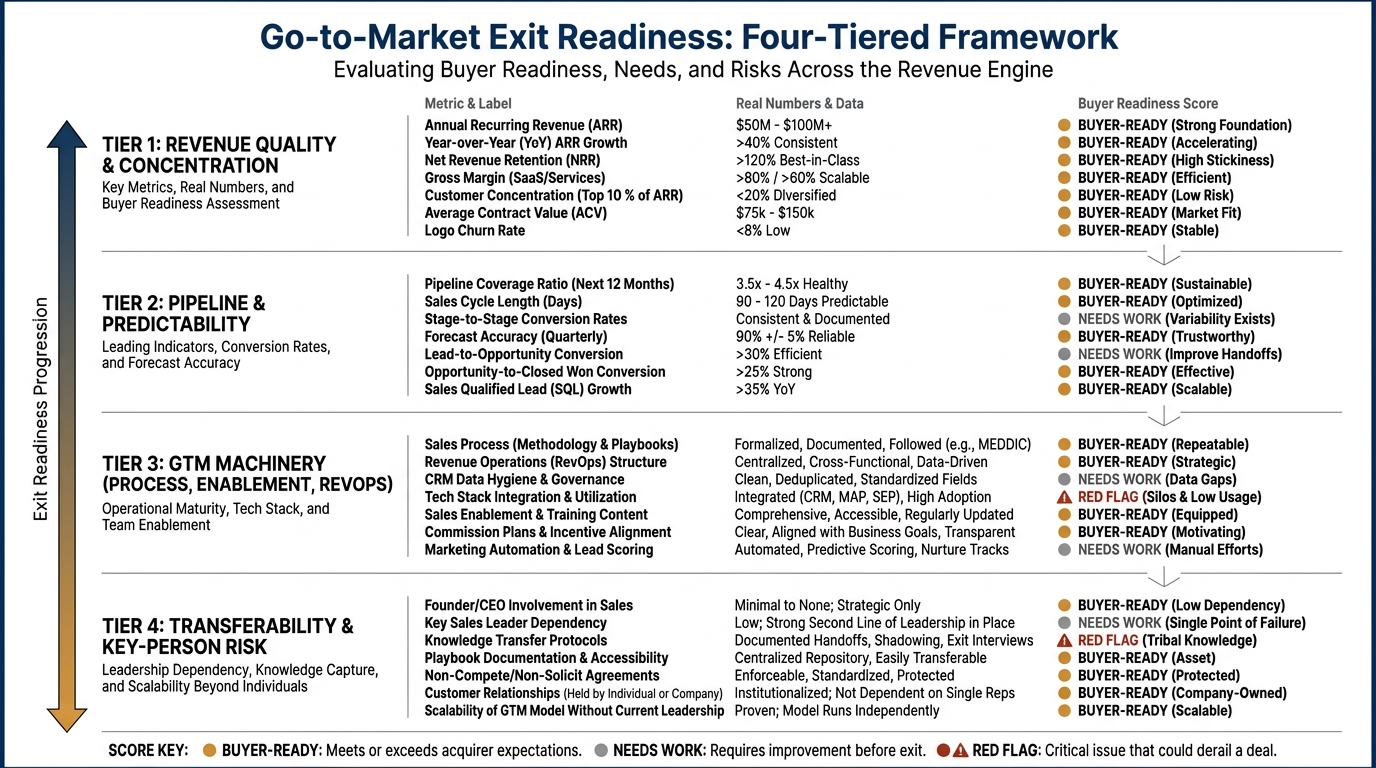
Run the assessment across four tiers, in order. Each tier answers a harder question than the one before it, and a weakness in an early tier undermines every claim above it. Score each dimension on a simple three-band scale: buyer-ready, needs work, red flag.
Tier 1: Revenue quality and concentration
Recurring versus one-time revenue, net and gross retention, customer and channel concentration, contract length, and pricing durability. This tier decides whether the top line is a stream or a sequence of events.
Tier 2: Pipeline and predictability
Whether the company can show a documented pipeline that converts at stable rates, forecast accuracy against actuals over the last four to eight quarters, and win/loss discipline. A buyer trusts a forecast that has been right before.
Tier 3: Go-to-market machinery
The repeatable mechanics: a documented sales process, onboarding and enablement that ramp new reps to quota in a known window, marketing that can attribute sourced pipeline, and a revenue operations stack that produces the same number twice.
Tier 4: Transferability and key-person risk
How much of the revenue engine lives in individual heads. A founder who is the top closer, a single rep carrying a quarter of quota, or tribal knowledge with no documentation all sit here. This tier is often the difference between a clean handoff and an earn-out.
Does the revenue survive a discount test
Start with concentration because it caps everything else. If one customer is 30 percent of revenue, no amount of process maturity fixes the risk a buyer will price in. Pull revenue by customer, by product, and by channel, then model what happens to the growth rate if the top three accounts churn.
Retention is the other lever. Net revenue retention above one tells a buyer the base grows on its own; below one means the company runs to stand still. Document both gross and net so the buyer cannot recompute a worse number than the one you disclosed. McKinsey’s private capital research consistently points to durable, recurring revenue as a core value driver; see the body of work at McKinsey.
Forecast accuracy is the trust test
Buyers do not reward optimistic forecasts. They reward forecasts that matched reality. The single most useful artifact this tier produces is a table of forecast versus actual by quarter, with the variance explained. A company that forecast within a tight band for six quarters earns credibility that a hockey-stick projection never will.
Where forecast accuracy is poor, the fix is usually not better spreadsheets but disciplined pipeline stages and consistent data entry. If revenue operations cannot pull a clean number on demand, that is a machinery problem in Tier 3, and it should be tagged as a dependency, not a separate issue.
Is the machine documented or improvised
This is the tier most directly inside a sales and revenue operations remit, and it is where enablement work compounds. The question is whether a new leader could run the go-to-market motion from documentation rather than from the departing team’s memory.
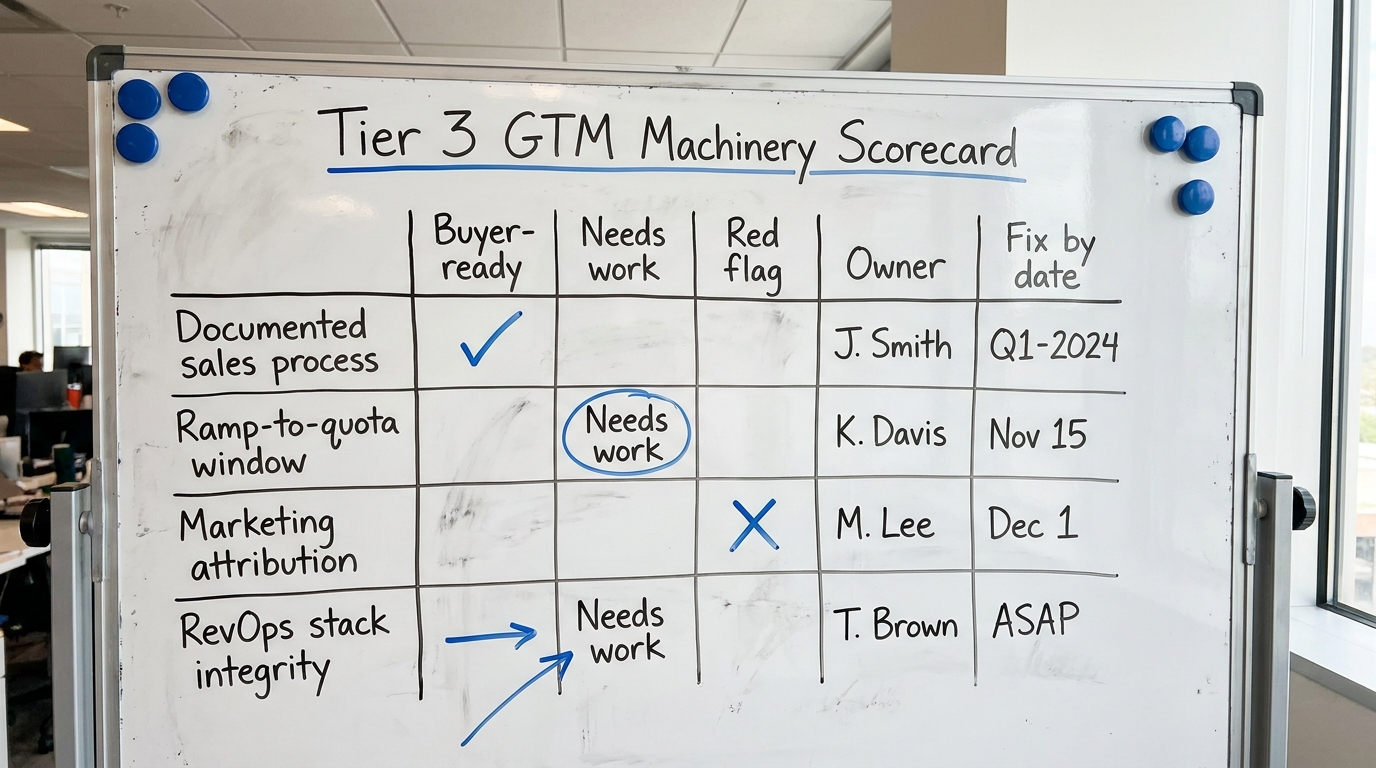
Assess four things: a written sales process tied to CRM stages, an onboarding and enablement path with a measured ramp-to-quota window, marketing attribution that a buyer can audit, and a clean revenue operations stack. Where the stack is fragile or manual, process automation for portfolio companies and disciplined systems implementation often move a red flag to buyer-ready inside the hold period.
Underneath the machinery sits data and tooling. A CRM full of stale records or a reporting layer that nobody trusts is a diligence liability, which is why a lightweight technology due diligence pass on the revenue stack belongs inside this tier rather than as an afterthought.
What walks out the door
Key-person risk is quiet until it is not. Map every material revenue relationship and every critical process to a named person, then ask what happens to the number if that person leaves. A founder-led sales motion is the classic example: buyers love the traction and discount the transferability in the same breath.
The remediation is rarely fast, which is why this tier gets assessed early. Hiring and ramping a second senior seller, documenting the founder’s playbook, and shifting relationships to the company rather than the individual are hold-period projects, not process-week fixes. The first 100 days discipline that new owners apply post-close is the same discipline a seller should apply to itself before the sale.
Scoring the assessment and turning it into a plan
Once every dimension carries a band, the picture drives sequencing. Red flags in Tier 1 or Tier 4 usually decide timing: if revenue concentration or key-person dependence is severe, the honest answer may be to fix before you sell, not to sell and hope diligence is gentle.
Needs-work items in Tier 2 and Tier 3 are the productive middle. They are the reason a go-to-market exit readiness assessment carries real return: forecast discipline, documented process, and clean attribution are achievable inside a runway and directly change how a buyer underwrites growth. Buyer-ready dimensions become proof points for the sell-side narrative.
An illustrative walk-through
Consider an illustrative scenario, not a real client. A software services company scores buyer-ready on retention and pricing, needs-work on forecast accuracy, and red-flag on transferability because the two founders close most large deals. The assessment sequences the plan: document the deal process, hire and ramp two enterprise sellers, and clean the CRM so forecast versus actual holds within a defensible band.
Eighteen months later, forecast accuracy is provable, a professional sales team is closing at published rates, and founder dependence has dropped. The growth story is now the company’s, not two people’s, and it survives commercial diligence without a discount for execution risk. The framing of activity versus outcome that matters in a value-not-hours engagement applies here too: the work only counts if it moves what a buyer pays for.
When to run it, and who owns it
Run the full assessment 12 to 18 months before an intended process, then re-score two quarters out to confirm the remediation held. The operating partner owns the decision; a portfolio company revenue leader owns the data; and where machinery gaps run deep, an outside team owns the remediation.
Choosing that outside team matters, because a generalist will produce a report and a specialist will produce a plan you can execute against a deadline. The considerations in how to choose an exit readiness consultant for a portfolio company apply directly. PitchBook and S&P Global Market Intelligence both publish deal-environment data worth checking before you set process timing; see PitchBook and S&P Global Market Intelligence.
The next-step checklist
- Pull revenue by customer, product, and channel; model the top-three churn scenario.
- Build the forecast-versus-actual table for the last six to eight quarters.
- Confirm the sales process is documented and tied to CRM stages.
- Measure ramp-to-quota and audit marketing attribution.
- Map every material relationship and critical process to a named person.
- Score every dimension buyer-ready, needs work, or red flag.
- Sequence remediation by timing impact, and assign an owner and a fix-by date to each item.
Underneath the revenue engine, resolve the quieter liabilities that diligence surfaces too: unaddressed technical debt and undisciplined IT sourcing both show up as risk premiums when a buyer starts asking.
If the assessment surfaces gaps you intend to close before a process, a team that runs revenue-operations remediation and exit readiness as an execution engagement rather than a report can turn the scorecard into a plan with owners and dates. Review the private equity exit readiness offer to scope the work against your process timeline.