An ERP replacement inside a portfolio company is one of the few transformation projects that can move EBITDA in the wrong direction for a full year before anyone on the deal team sees it in the numbers. By the time a missed go-live shows up as revenue slippage, unbilled receivables, or a warehouse that cannot ship, the confirmatory diligence assumptions that supported the value-creation plan are already stale. An ERP implementation for a portfolio company is not the CIO’s problem to run alone, and the operating partner who treats it that way usually finds out too late. This guide is written for the person who has to approve the budget, own the decision rights, and defend the timeline at the next board meeting.
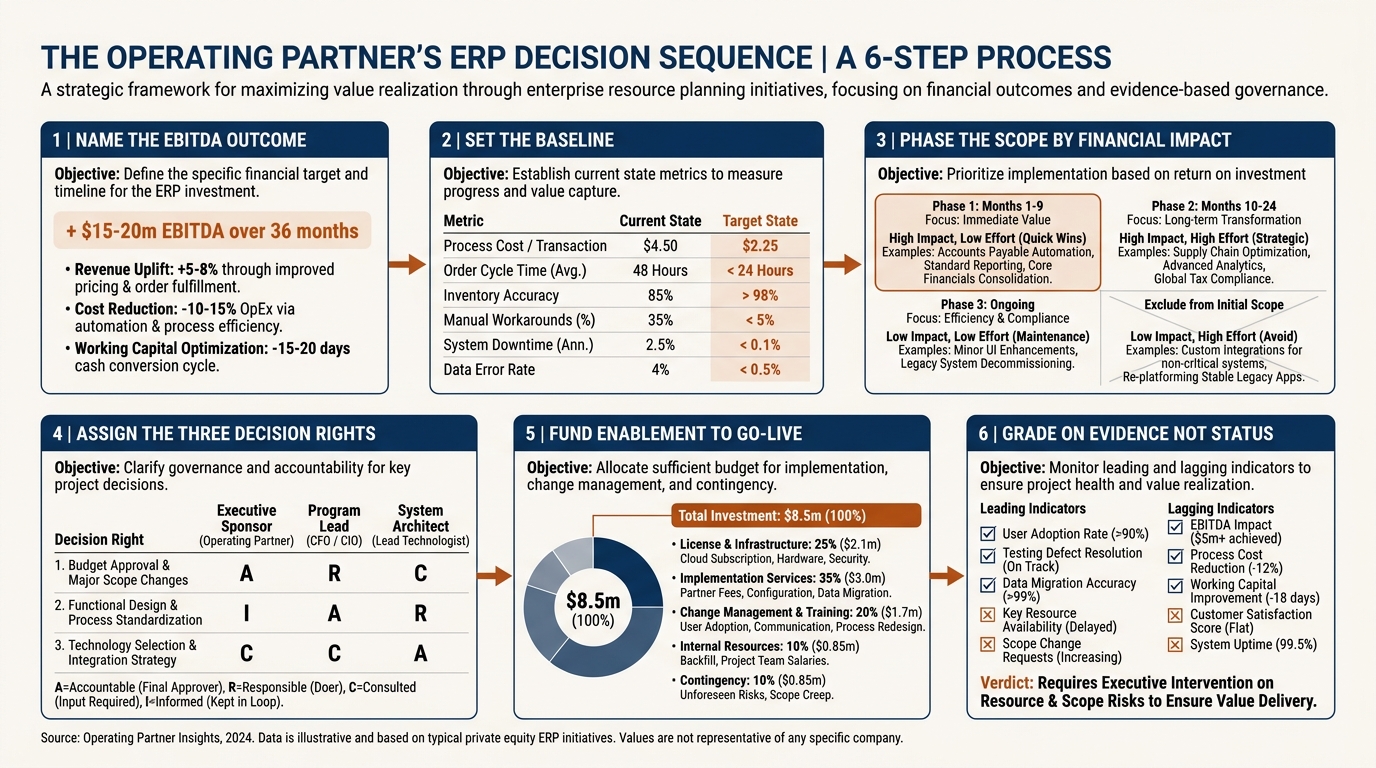
1. Decide why the ERP project exists before you approve it
The first question is which enterprise-value problem the project is supposed to solve, stated in terms the CFO would recognize. Most ERP proposals arrive framed as an IT modernization, which is the wrong frame for a capital-allocation decision.
Tie the project to one outcome you can defend: faster monthly close, cleaner revenue recognition ahead of a quality-of-earnings review, working-capital release from better inventory data, or the integration of an add-on that runs on an incompatible system. If the sponsor cannot name the outcome and roughly size it, the project is not ready for approval, and no vendor demo will fix that.
2. Separate the real trigger from the vendor’s timeline
ERP replacements get triggered by real events, and the trigger determines how much risk you can accept. A platform company preparing to absorb three add-ons has a different tolerance than a company sixteen months from a planned exit. Bain’s annual private equity work has consistently pointed to integration execution as a top driver of deal returns, and ERP sits directly on the critical path of most integrations.
Read the trigger honestly. If the current system is functional but ageing, a rushed rip-and-replace before exit usually destroys more value than it creates, because the disruption lands in the exact quarters the bankers will scrutinize. The exit readiness sprint decisions an operating partner has to make often include deliberately deferring an ERP change for valid commercial reasons.
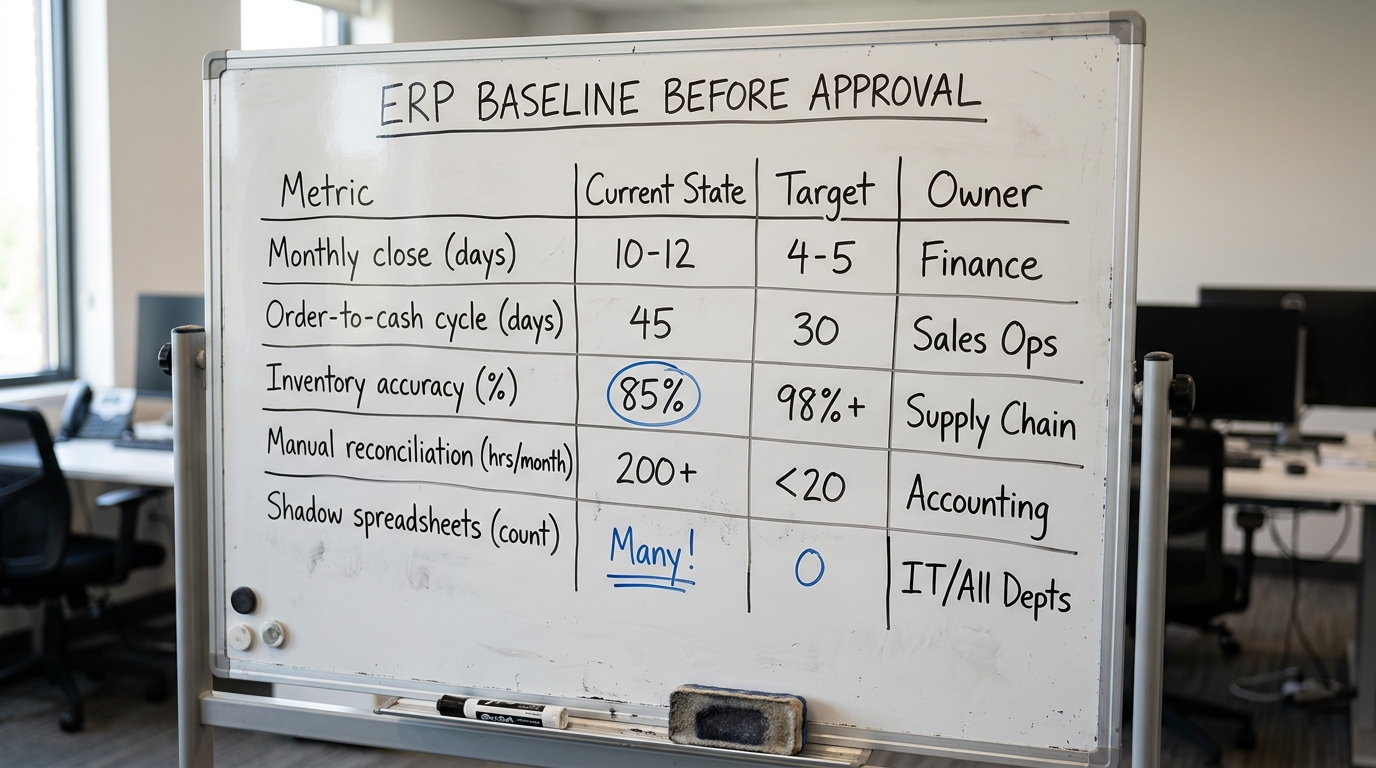
3. Establish the baseline you will measure against
Before anyone configures a single module, document the current-state baseline: days to close, order-to-cash cycle time, inventory accuracy, manual reconciliation hours, and the count of standalone spreadsheets holding the business together. Without this baseline, you cannot tell realized improvement from vendor narrative twelve months later.
This is the same discipline the exit readiness technology assessment applies, and it should be run by someone independent of the implementation team. The people building the system should not be the only people grading it.
4. Choose scope like a portfolio owner, not a perfectionist
The largest single cause of ERP failure in mid-market companies is scope, not software. A full-suite implementation across finance, supply chain, HR, and CRM in one program is where timelines double and budgets triple. McKinsey’s research on large technology programs has repeatedly documented cost and schedule overruns on complex transformations, and ERP is a textbook example.
Sequence by financial consequence
Prioritize the modules that touch the value-creation thesis first. If the thesis rests on working-capital release, start with finance and supply chain, and defer everything that does not move a number this year. A phased path lets you show the board an actual-versus-plan result on the first phase before you commit the rest of the capital.
5. Pick the deployment model against the hold, not the trend
Cloud-first is the default for good reasons, but the decision should be made against the hold period and the exit story. A cloud ERP that a buyer can diligence quickly and scale without a data-center dependency generally improves the technology posture that surfaces during technology due diligence. An on-premise migration that leaves the company carrying infrastructure risk usually does the opposite.
Weigh the total cost of ownership across the remaining hold, not the headline license price. A three-year subscription looks expensive next to a perpetual license until you add the implementation, hosting, and maintenance the perpetual license hides.
6. Assign decision rights before the project starts
ERP programs stall on unowned decisions. Someone has to have the authority to freeze scope, approve process changes that override how a department has always worked, and say no to the customization requests that arrive weekly once configuration begins.
The operating partner should hold three decision rights explicitly: the go-live gate, the budget-change threshold, and the arbitration of process-versus-software conflicts. Everything else can sit with a portfolio-company steering committee, but those three, delegated blindly, are where cost overruns hide until the next board review.
7. Build the risk register the deal team will actually read
An ERP risk register tells the board, before Day 1 of go-live, which failure modes have owners and which do not. The entries that matter are the ones with a commercial consequence attached.
- Data migration quality, because a bad master-data conversion breaks billing and shipping on the first live day.
- Cutover timing, because going live at fiscal quarter-end multiplies the reporting damage of any error.
- Key-person dependency, because most portfolio companies have one person who understands the legacy system and no backup.
- Integration dependencies with the CRM and any add-on systems, which is where process automation across the portfolio company either compounds the ERP value or exposes gaps in it.
8. Fund the enablement, not only the software
The line item that gets cut first and costs the most is user adoption. An ERP that finance has learned to work around is worse than the spreadsheet it replaced, because now the workaround is invisible to the reporting the board relies on.
Budget for role-based enablement of the sales, finance, and operations teams that will live in the system daily, and schedule it so training lands close to go-live rather than months before. Sales operations in particular tends to be under-served in ERP rollouts, and a quote-to-cash process that the revenue team does not trust will show up as forecast noise long before it shows up as a fixed problem.
9. Decide the build-versus-partner question honestly
Very few portfolio companies carry the internal capacity to run an ERP program, keep the business running, and enable the users at the same time. The realistic choice is which parts to run internally and which to bring in an embedded partner for, judged on delivered outcomes rather than billed hours.
The criteria for choosing an engineering partner and judging it on value rather than hours apply directly here, as does the discipline of strategic IT sourcing in a portfolio setting. A partner who cannot describe the go-live gate and the rollback plan in the sales meeting is not the partner you want owning your migration weekend.
10. Judge the implementation on evidence, not status decks
Status is green until it is not. The operating partner should ask for evidence, not colors: the count of test cases passed against total, the migration dry-run reconciliation results, the number of open critical defects, and the actual-versus-plan on the first live phase. These are the numbers a buyer’s diligence team will eventually ask for, so building them early makes both the project and the eventual exit stronger.
PitchBook and S&P Global market data both point to buyers scrutinizing operating systems more closely in recent diligence, which means the quality of your ERP evidence trail is itself a value-creation input, not just a project-management nicety.
11. Time the go-live against the calendar that matters
The single cheapest risk reduction available is choosing when to go live. Avoid quarter-end, avoid peak season, and avoid the weeks around any planned board meeting or lender reporting deadline. A go-live that fails quietly in a slow month is recoverable; the same failure at fiscal year-end becomes a restatement conversation.
If the ERP change sits inside a broader value-creation program, sequence it against the first 100 days plan so it does not compete with the other early wins for the same management attention. And well before any sale process, run it through the go-to-market exit readiness assessment operating partners should run before the bankers show up.
12. The approval checklist
Before the operating partner signs off on an ERP implementation for a portfolio company, these should all be answered in writing:
- The enterprise-value outcome is named and roughly sized, in CFO terms.
- The trigger justifies the timing, and the exit calendar has been checked against go-live.
- A current-state baseline exists and is owned by someone independent of the build.
- Scope is phased by financial consequence, with a measurable first phase.
- The three operating-partner decision rights are documented and delegated deliberately.
- The risk register has owners on data migration, cutover, key-person, and integration dependencies.
- Enablement is funded and scheduled to land near go-live, including sales operations.
- The partner-versus-internal split is decided, with the partner graded on outcomes.
- The evidence trail the project will produce matches what future diligence will demand.
For the broader picture of how this connects to the value-creation plan and eventual exit, the surrounding decisions on technical debt elimination and the full private equity operating approach set the context an ERP decision should sit inside. Bain’s Global Private Equity Report, McKinsey’s private capital research, and PitchBook are worth reading before you frame the business case, because the pattern they describe is consistent: operational execution, not the entry multiple, is where returns are increasingly won or lost.
If you are approving an ERP implementation inside a portfolio company and want an embedded team that will own the migration risk and the evidence trail rather than bill you for hours, review the DevriX private equity operating offer and bring the specific deal, trigger, and hold period into the first conversation.