A portfolio company CFO forwards a proposal for an AI initiative with a seven-figure budget and a promise of margin expansion, and the operating partner has to decide whether it belongs in the value creation plan or in the parking lot. That decision is now routine across most portfolios, and it is where generative AI value creation in private equity either produces enterprise value or quietly consumes management attention and cash. The problem is not whether the technology works. It is whether a given use of it moves a line the deal was underwritten against, and whether the sponsor can tell the difference before the next board meeting.
This guide is written for the operating partner or portfolio company executive who has to approve, sequence, and later defend AI spend, not for someone learning the field. It walks through what to decide, in what order, and how to judge the result against actuals.
1. Start from the value creation plan, not the technology
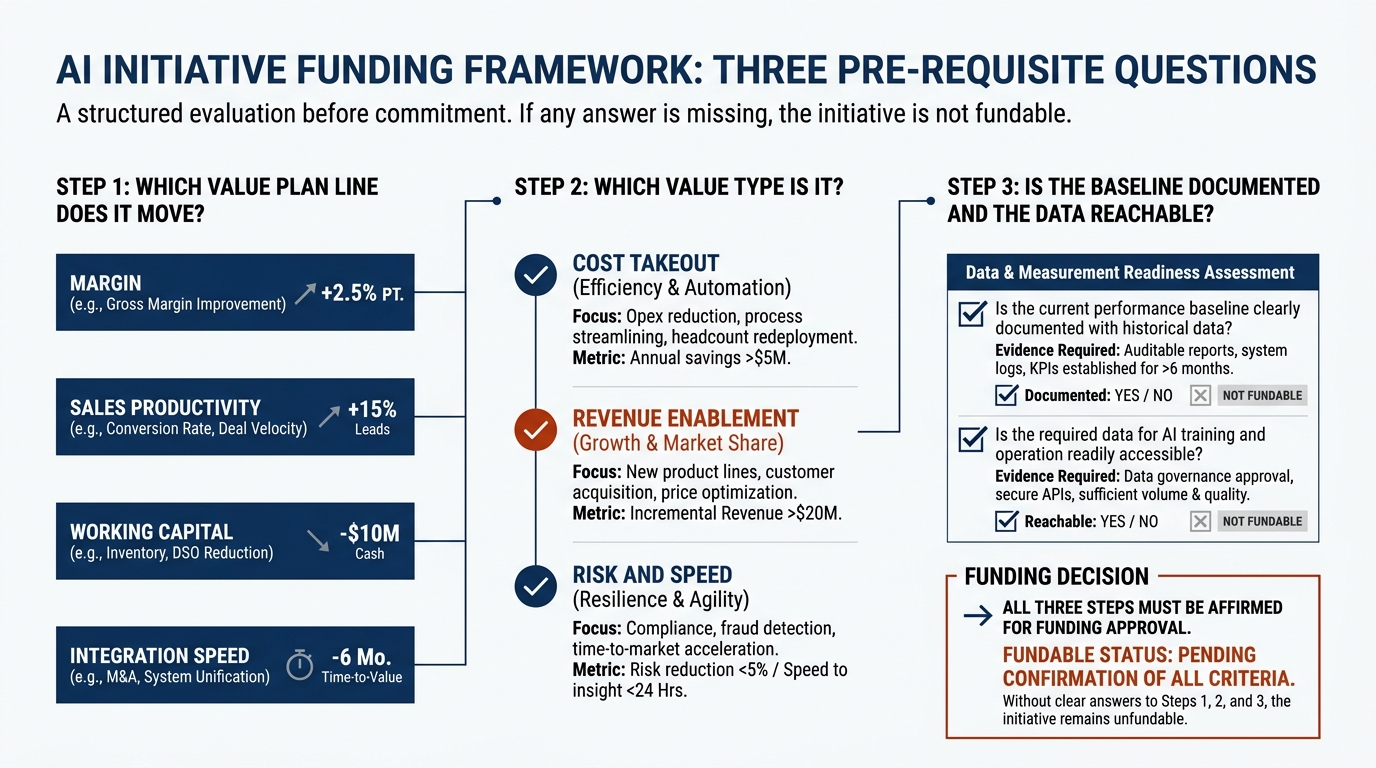
Generative AI does not create value on its own. It changes the unit economics of a specific process, and only some of those processes sit on the critical path to the thesis. Before any tool selection, the operating partner should tie a proposed AI initiative to a line already in the value creation plan: gross margin, sales productivity, working capital, headcount growth avoided, or time to close on an add-on integration.
If a proposal cannot name the line it moves, it is a science project. Bain’s annual private equity report has tracked how sponsors increasingly separate value creation levers from general operational improvement, and that discipline applies here directly. Read the current thinking in Bain’s Global Private Equity Report before you let a vendor frame the conversation.
2. Decide which of three value types you are actually buying
Most AI proposals in a portfolio company fall into one of three categories, and each carries a different burden of proof.
- Cost takeout. The AI reduces labor hours or vendor spend on a repeatable process (support tickets, first-draft content, contract review, coding assistance). This is the easiest to measure and the easiest to overclaim.
- Revenue enablement. The AI raises sales rep productivity, shortens sales cycles, or improves win rates. Harder to attribute, because pipeline moves for many reasons at once.
- Risk and speed. The AI compresses the time to integrate an acquisition, close the books, or produce management reporting. This shows up in the exit story more than in a single quarter.
Naming the type forces the right evidence standard. A cost takeout claim needs a baseline of current cost per unit; a revenue claim needs a cohort comparison with controls and a before-and-after measure.
3. Establish the baseline before the pilot, not after
The single most common failure is starting a pilot without recording what the process cost and produced beforehand. Once the tool is live, no one can separate the AI effect from the ordinary variance of the business. The operating partner should require a documented baseline as a condition of funding: current hours, current cost, current cycle time, current error rate, whatever the claimed improvement will be measured against.
This is the same discipline a serious buyer applies during technology due diligence, where an asserted capability means little without evidence of the state it started from. The rule does not change once the company is owned.
4. Judge the data readiness honestly
Generative AI performs against the data it can reach. In a portfolio company that grew by acquisition, that data usually sits in disconnected systems with inconsistent definitions, and the AI use case that looked cheap becomes an integration project with a long tail. The operating partner should ask where the training or grounding data lives, who owns its accuracy, and whether the answer changes the timeline the vendor quoted.
This is often the moment a proposal quietly grows. The AI layer is a few weeks; the data plumbing under it is two quarters. Judging that gap is closely related to how you evaluate a technical value creation partner in private equity, because the partner who cannot describe the data dependency is the partner who will bill for it later.
5. Assign a single owner and a decision right
AI initiatives fail on ownership more than on technology. The operating partner should name one accountable owner inside the company, usually a function head rather than IT, and give that person the decision right to stop the initiative if the leading indicators miss. Vendors and internal champions both have an incentive to keep a program alive past the point it has earned; a clear owner with the authority to kill it is the control that prevents slow bleed.
The owner also carries adoption. A tool that half the sales team uses returns roughly half the case, and adoption is a management problem that requires enforcement and accountability.
6. Set leading indicators with a kill date
Enterprise value moves on trailing outcomes. The operating partner still needs leading indicators to steer between board meetings. For a cost takeout case, those indicators are hours saved per week and adoption rate. For a revenue case, they are activity quality and stage conversion measured against historical norms. Each indicator gets a threshold and a date by which it must be met, and missing the threshold triggers a review.
McKinsey’s ongoing work on generative AI adoption across enterprises is a useful external reference point for how few deployments reach measurable impact without this kind of discipline; their research on the topic is worth reading against your own program’s assumptions.
7. Separate realized value from forecast value in reporting
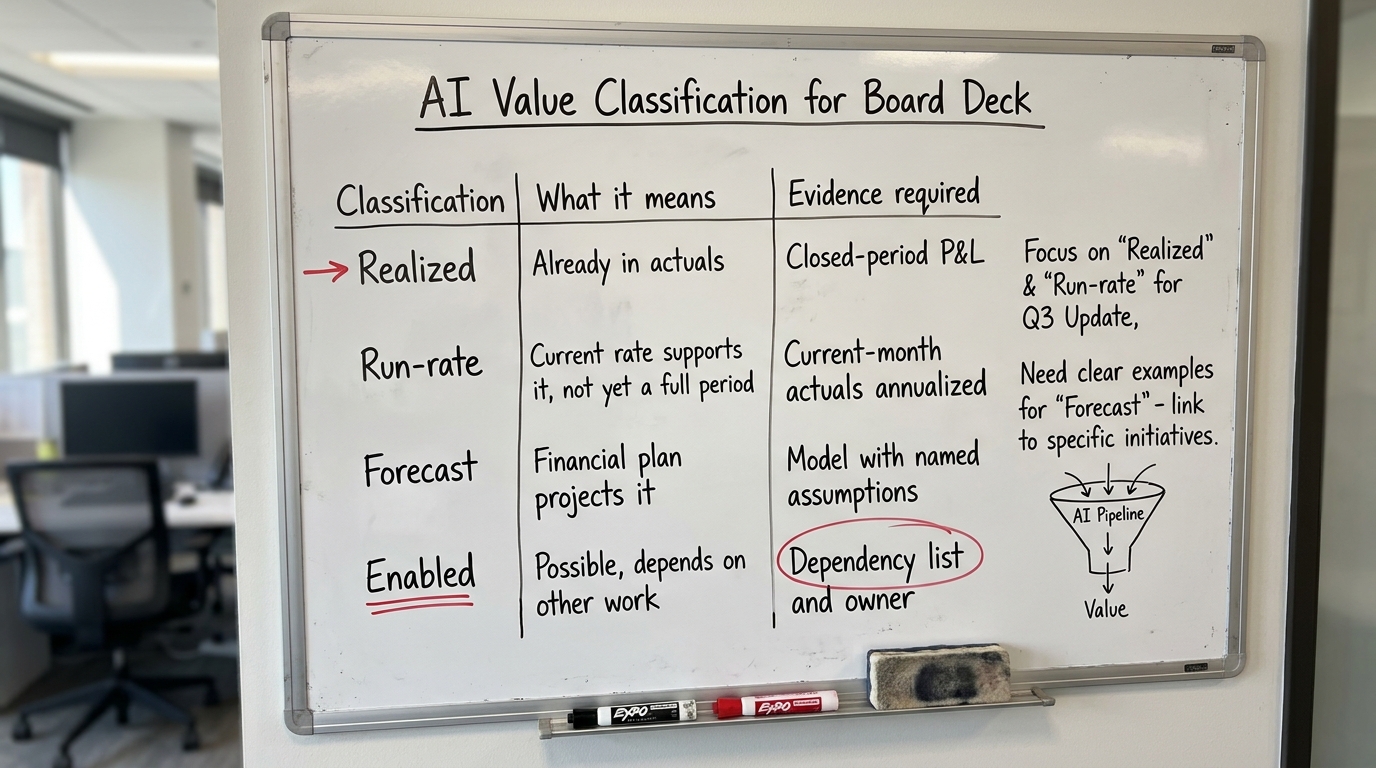
When the initiative reaches the board deck, the operating partner should insist that the number be classified honestly. The classification system distinguishes four levels: realized value has already shown up in actuals, run-rate value is supported by the current run-rate but has not yet flowed through a full period, forecast value appears in the financial plan, and enabled value is made possible by the AI but depends on other work completing first.
Mixing these is how a portfolio ends up reporting AI-driven EBITDA that never appears in the QoE at exit. Keeping them separate protects the sponsor’s credibility with the next buyer, which is the point of the go-to-market exit readiness work an operating partner runs before the bankers arrive.
8. Time the initiative against the hold period
An AI initiative that pays back in three years is a different decision in year one of a hold than in year four. Early in the hold, a data-heavy program that compounds can be worth the patience. Close to exit, the operating partner should favor initiatives that produce a clean, defensible number inside the current owner’s period, because a half-finished AI program raises questions in diligence and consumes management attention that could go to closing.
This sequencing question is the same one that governs a portfolio company’s IT roadmap, and AI belongs inside that roadmap rather than beside it.
9. Decide build, buy, or embed
Three delivery models cover most AI initiatives, and the operating partner is really choosing who carries the risk.
Buy a packaged product
Fastest to stand up, lowest control, best where the use case is generic (support deflection, meeting notes, coding assistants). Judge it on adoption and net cost after accounting for the time it saves.
Build internally
Highest control, highest execution risk, only sensible where the use case is core to the thesis and the company has genuine engineering depth. Most portfolio companies overestimate this depth.
Embed an external partner
The middle path, where an outside team stands up the capability inside the company and transfers it. This is where the choice of partner matters most, and the criteria overlap heavily with how you would choose an embedded technology partner for portfolio companies and how you would structure outsourced product and engineering so the capability stays after the invoices stop.
10. Watch the failure modes that survive good intentions
A few patterns recur often enough to name in advance. The pilot that never ends because no one set a kill date. The adoption number quoted as licenses sold rather than active weekly users. The cost saving that reappears as vendor spend. The revenue lift attributed to AI in a quarter when three other things also changed. Each of these passes a casual board review and fails a real one.
BCG’s work on principal investors and value creation covers how sponsors are building repeatable operating playbooks around these controls; their private equity practice publishes usefully on the operating-partner side of the question.
11. Connect it to the first 100 days when it belongs there
For a newly acquired company, the operating partner should decide whether any AI initiative belongs in the first 100 days or waits until the business is stabilized. In most cases it waits, because the early window is better spent on baselines, data hygiene, and the reporting spine that any later AI work will depend on. Standing up AI on top of unreliable data early in the hold is how a sponsor buys a second problem before fixing the first.
12. A checklist before you approve the spend
- The initiative names the specific value creation plan line it moves.
- The value type (cost, revenue, or risk and speed) is stated, with the matching evidence standard.
- A documented baseline exists before the pilot starts.
- The data the AI depends on is identified, owned, and reachable, with any integration cost surfaced.
- One accountable owner holds the decision right, including the right to stop.
- Leading indicators have thresholds and a kill date.
- Board reporting separates realized, run-rate, forecast, and enabled value.
- The payback timing fits where the asset sits in the hold period.
- The build, buy, or embed choice matches the use case and the company’s real capability.
An initiative that clears all nine is fundable. One that clears six or seven usually needs its scope cut. This same evidence-first posture distinguishes a real digital program from one that reads well in slides, which is the subject of what to buy when you buy digital value creation services in private equity.
13. Where this sits in the broader portfolio operating model
Generative AI is one lever inside a portfolio company’s operating model. It reports into the same value creation plan, the same board cadence, and the same exit narrative as every other private equity value initiative. Treating it as exceptional is how sponsors end up with a line of AI spend that no one can tie to the thesis. Treating it as one more lever, held to the same evidence standard as an ERP implementation, is how it earns a place in the plan and survives diligence.
If you want a structured way to pressure-test a portfolio company’s AI initiatives against the value creation plan, or to stand up the baseline and reporting spine an operating partner needs before approving the spend, work through the DevriX private equity value creation program and bring your live proposal to the diagnostic.