By the time a sell-side process opens, most portfolio companies discover their data will not survive a buyer’s diligence in the state it is in. Customer records disagree across systems, revenue cannot be tied cleanly to cohorts, and the numbers in the board deck cannot be reproduced from source tables in under a week. That gap does not lower the asking price at the last minute so much as it drags the whole timeline, forces concessions, and hands the buyer a reason to reprice. Data readiness for an exit portfolio company is a value-creation workstream, and the operating partner who treats it as an IT chore usually pays for that framing in the QoE.
This guide is for the operating partner or portfolio executive who has to decide, this year or next, whether the asset’s data can carry a clean, fast confirmatory process. It covers what to decide, in what order, and how to judge whether the work is actually done.
1. Why data readiness moves the exit, not just the diligence
A buyer’s confirmatory diligence rests on evidence, and evidence lives in data. When the seller cannot produce a clean, reconcilable data room on customers, revenue, retention, and unit economics, the buyer models the uncertainty as risk and prices it in. Bain’s annual private equity report has tracked how holding periods have stretched and how buyers have grown more demanding on quality of evidence, which raises the cost of a messy data estate at exit. You can read the recurring findings in Bain & Company’s Global Private Equity Report.
The commercial consequence is concrete. A gap in data lineage does not just slow the process, it becomes a negotiating lever the buyer uses on price, on escrow, and on reps and warranties.
2. The decision the operating partner actually owns
The decision is not “should we clean up the data.” It is a sequence of narrower calls with owners and dates attached. Which metrics will the buyer test, and can each one be reproduced from source? Which systems hold the authoritative version of a given record? What will the company assert about data quality in the process, and can it defend that assertion under scrutiny?
Those are commercial decisions with a technical substrate, which is why they belong to the deal and operating team rather than to the CIO alone. The same logic that governs technology due diligence on the buy side applies in reverse when you are the one being examined.
3. Start with the metrics a buyer will test
Work backward from the buyer’s model. A financial or strategic acquirer will rebuild revenue by cohort, gross and net retention, customer acquisition cost, gross margin by segment, and pipeline conversion. Each of those needs a defensible path from a headline number back to the rows that produce it.
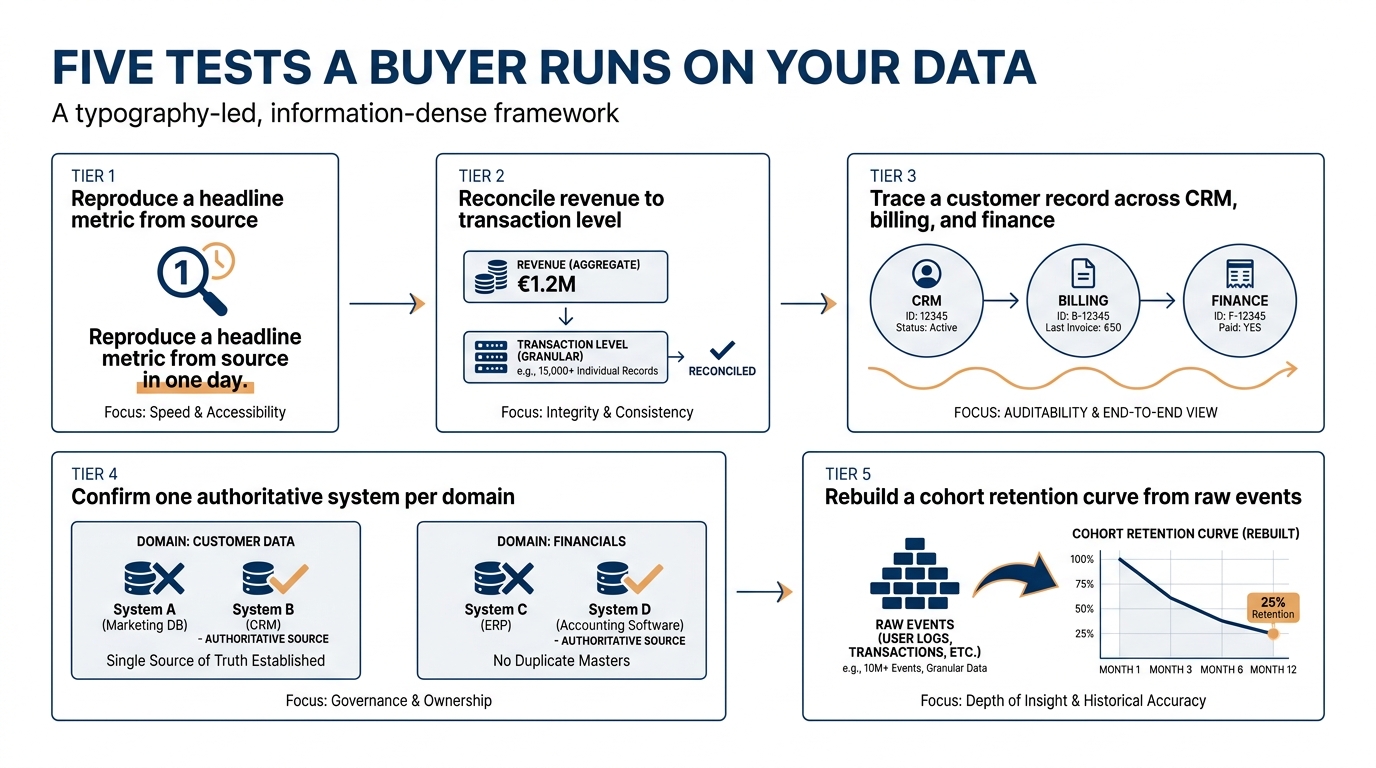
Make a short list of the ten to fifteen metrics that will decide the valuation, then test whether the company can reproduce each one, unassisted, inside a day. The metrics that fail that test are your first workstream. The go-to-market exit readiness assessment is a useful companion here, because most of the contested numbers in a sell-side process are revenue numbers.
4. Establish the system of record before you touch the data
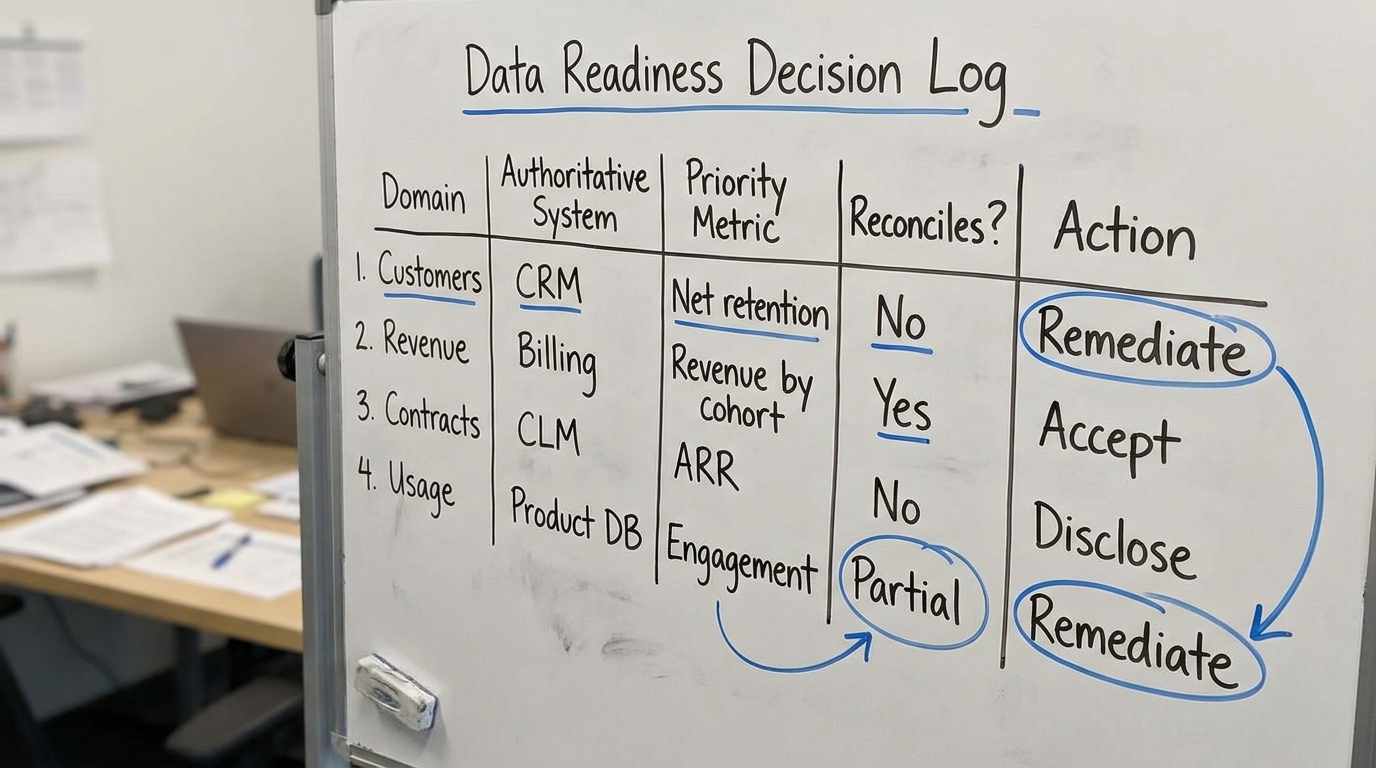
Most data disputes at exit come from two systems that both claim to hold the truth about the same customer or the same deal. The CRM says one thing, the billing system says another, and the finance export reconciles to neither. Before any cleanup, decide which system is authoritative for each domain: customers, contracts, revenue, usage, and support.
Write that down as a documented map with an owner for each domain. Everything downstream, from dashboards to the data room, has to draw from that decision or the reconciliation problem simply reappears later under time pressure.
When this matters
This decision is cheapest in the first 100 days after acquisition and most expensive the week the bankers arrive. The groundwork you lay during the first 100 days is what makes the exit data room assemble in weeks rather than quarters.
5. Judge data quality by reconciliation, not by dashboards
A clean dashboard proves nothing about the data underneath it, because a dashboard can average away the errors that a buyer’s analyst will find by pulling the raw extract. The test that matters is reconciliation. Take the headline revenue number, decompose it to the transaction level, and confirm the pieces sum back to the total that finance reports.
Do the same for customer counts, for retention, and for margin. Where the pieces do not reconcile, you have found the work. McKinsey’s private capital research repeatedly points to data and analytics maturity as a driver of value creation, and the readiness view of that maturity is whether numbers reconcile end to end. You can browse the relevant research through McKinsey.
6. Fix data lineage so a number has a paper trail
Lineage is the ability to point at any number in the data room and show, step by step, how it was produced from source. Buyers ask for it constantly during confirmatory diligence, and a seller who cannot supply it spends the process manually recreating derivations under deadline.
Document the transformations for your priority metrics: which tables feed the calculation, which filters and exclusions apply, and who signs off. This is unglamorous work, and it is the difference between a data room that answers questions and one that generates new ones.
7. Decide what to remediate and what to disclose
Not every data problem gets fixed before a process, and pretending otherwise wastes the timeline. Some issues are worth remediating because they touch a valuation metric directly. Others are better disclosed cleanly, with a known scope and a documented workaround, so the buyer prices a bounded issue rather than an open-ended one.
Draw that line deliberately. The operating partner’s job is to sort every material data defect into remediate, disclose, or accept, with a rationale that holds up when the buyer’s team pushes on it. An honest, scoped disclosure costs less than a surprise found in the data room.
8. Staff it with capacity that can actually finish
Data readiness usually stalls when the portfolio company’s own team is already running the business, and pulling them onto a remediation sprint slows both the cleanup and the operation. Deciding how to resource this is the same decision covered in building and judging an embedded engineering team for a PE-backed company, and the trade-offs around outside help mirror those in structuring outsourced product and engineering for a portfolio company.
Whoever owns the work needs a named accountability, a fixed scope tied to the priority metrics, and a deadline that lands well before a banker walks in. Open-ended data projects rarely reach the finish line under their own momentum.
9. Judge the partner by the artifacts they leave behind
If you bring in outside help, judge it on evidence rather than activity. A credible partner leaves you a documented system-of-record map, reconciliation results for your priority metrics, a lineage trail for each headline number, and a defect log sorted into remediate, disclose, and accept. Hours and ticket counts tell you nothing about exit readiness.
The criteria for evaluating that kind of work are laid out in more depth in how to judge a technical value creation partner in private equity. The same standard applies whether the partner is internal, a systems integrator, or an embedded firm.
10. Tie readiness to the exit timeline, not the wish list
Sequence the work against the process calendar. If a sale is eighteen months out, you can remediate the deep issues and rebuild lineage properly. If it is six months out, you triage: fix what touches valuation, disclose what is bounded, and stop chasing perfection on data the buyer will not test.
PitchBook and S&P Global both publish deal and process data that help you calibrate how long confirmatory diligence tends to run in your sector, which is worth checking against your own timeline. See PitchBook and S&P Global Market Intelligence for that context.
11. A readiness checklist for the operating partner
- The ten to fifteen metrics the buyer will test are listed, with a named owner for each.
- Every priority metric can be reproduced from source, unassisted, in under a day.
- One authoritative system is documented for each data domain, and downstream reporting draws from it.
- Headline revenue, customer counts, retention, and margin reconcile to the transaction level.
- Each priority number has a documented lineage trail with a sign-off owner.
- Every material defect is sorted into remediate, disclose, or accept, with a rationale.
- The remediation work has fixed scope, named accountability, and a deadline ahead of the process.
- The plan is sequenced against the actual exit calendar.
12. Where this fits in the broader value-creation plan
Data readiness rarely stands alone. It usually sits alongside an IT roadmap for the portfolio company and, where the underlying systems are the constraint, an ERP implementation you have to judge before it breaks the forecast. The point of connecting them is to make sure the readiness work reinforces enterprise value rather than becoming a parallel cleanup nobody reads at exit.
The broader case for treating this as a private equity value-creation discipline, rather than a diligence formality, is that the buyer is paying for measurable, defensible improvement, and clean, reconcilable data is what lets them see it.
13. Next steps before the process opens
Run the reconciliation test on your priority metrics this quarter, well before a banker is engaged. Document the system-of-record map, build the defect log, and sequence the remediation against a realistic timeline. If the company cannot reproduce a headline number from source in a day, that is the first thing to fix, and it is worth fixing before anyone starts drafting a teaser.
If you want an external read on where the asset’s data actually stands and what it will cost to make it exit-ready, route the diagnostic to the DevriX and GrowthShuttle private equity practice and scope a value-creation diagnostic against your exit timeline.