An operating partner who inherits a software or tech-enabled business at close usually has a short list of problems that will not wait for a permanent hire. The product roadmap is stalled, the data does not reconcile with the model, and the CTO who was supposed to carry integration left three weeks after the deal signed. Hiring a full engineering leadership bench takes two quarters the value-creation plan does not have. This is the moment most sponsors decide whether to bring in an embedded technology partner for portfolio companies, and the decision is worth getting right because the wrong choice adds cost without changing the exit.
This guide is for the person standing up sales, revenue, and technology operations inside a portfolio company: what to decide, in what order, and how to judge the partner you are considering.
1. What the term actually means in a portfolio context
An embedded technology partner works inside the portfolio company on the sponsor’s timeline, not on a fixed statement of work that ends when a website ships. The partner takes a workstream, owns a defined outcome such as release velocity or system consolidation, and reports against actual versus plan the way an internal team would. That accountability for outcomes tied to the value-creation plan separates an embedded partner from a vendor who sells hours and tickets.
Bain’s annual private equity report has tracked how much of the return now depends on operational improvement rather than multiple expansion, which is the reason sponsors are willing to fund embedded capacity at all. You can read the current edition through Bain & Company’s Global Private Equity Report hub.
2. Decide what the partner owns before you shop for one
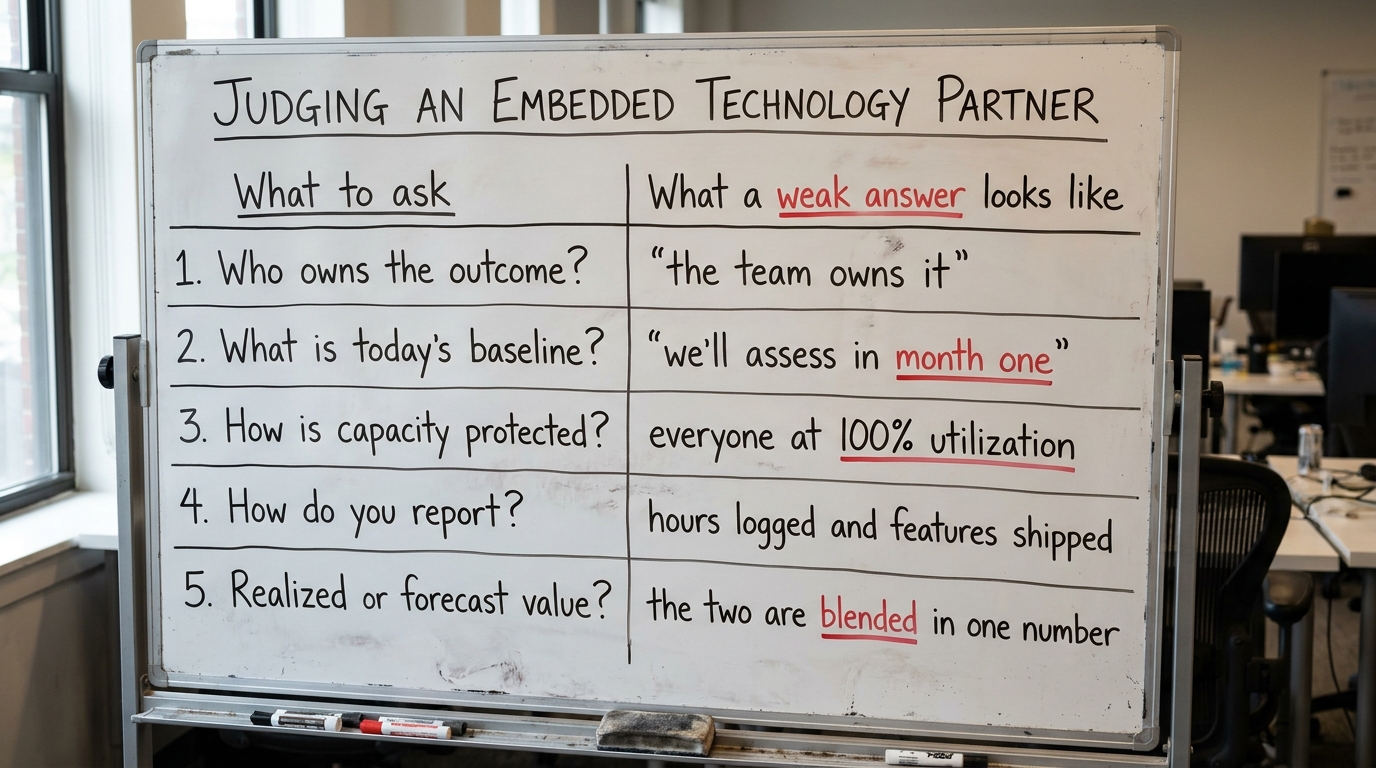
The most common mistake is selecting a partner and then negotiating scope. Reverse it. Name the two or three outcomes in the value-creation plan that a technology team can move: revenue system reliability, product delivery speed, integration of an add-on’s stack, or the reporting layer that feeds the board pack. Each of those is a workstream with an owner, a baseline, and a decision right.
If you cannot state the baseline today, that gap is itself a finding. It usually means the diligence-stage technology due diligence under-scoped the operational side and the real condition of the estate is unknown. Fix that before you sign a retainer, because you are otherwise paying a partner to discover what you should have priced into the deal.
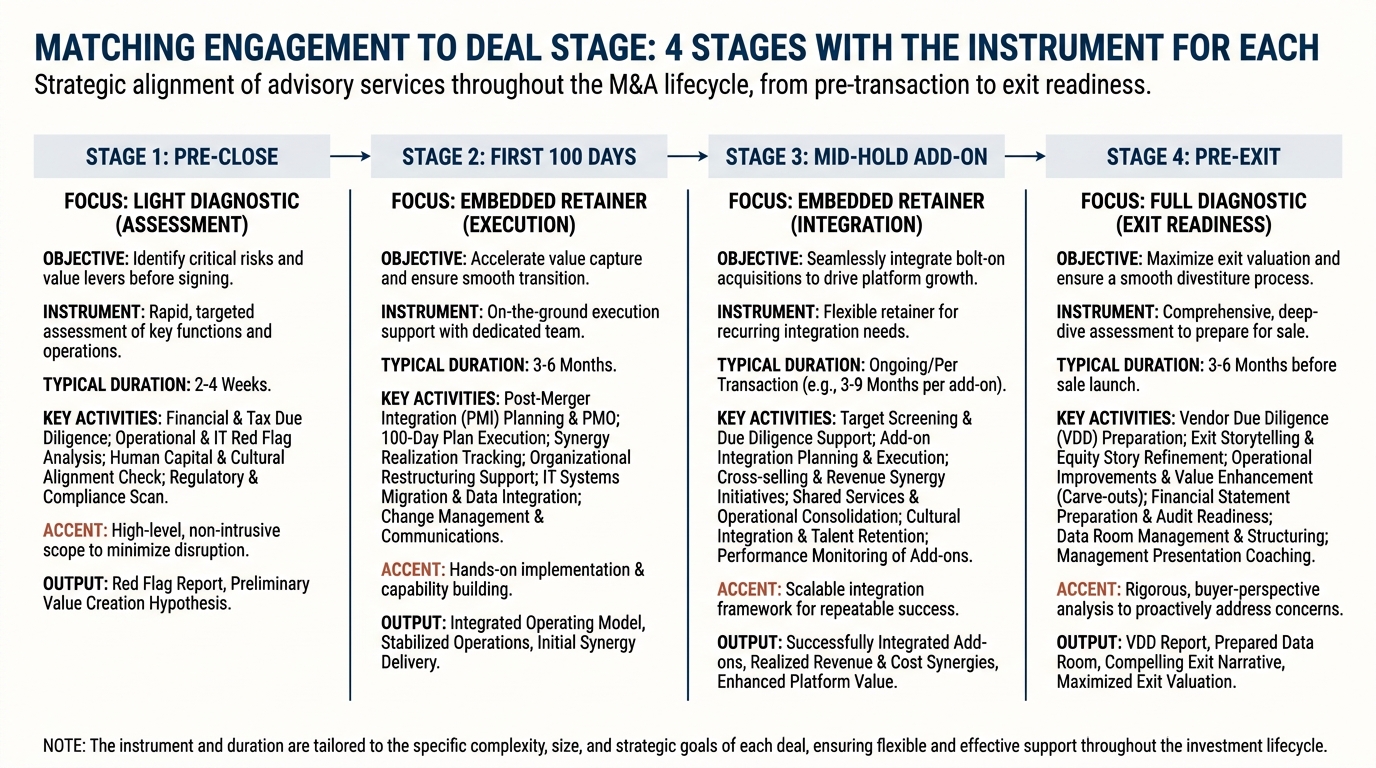
3. Match the engagement to the deal stage
The right shape of the engagement depends on where the deal sits.
Confirmatory diligence and pre-close
Here the work is assessment: what is the real state of the code, the data, the vendor contracts, and the team, and what does remediation cost against the plan. A light diagnostic fits this stage.
The first 100 days
This is where embedded capacity earns its keep, because the decisions that shape the hold are made early. The sponsor’s first 100 days plan should already name the technology workstreams, and the partner slots into them rather than proposing a fresh agenda. A useful companion here is the site’s guide on what an IT roadmap for a portfolio company has to deliver, which frames the roadmap as a value document rather than a technical one.
Mid-hold and add-ons
When an add-on closes, integration dependency becomes the constraint. Two billing systems, two CRMs, and two data models do not merge on the org chart alone. This is where the site’s breakdown of how to judge an ERP implementation before it breaks the forecast is worth reading closely, because a botched system migration is one of the few technology events that shows up directly in a missed quarter.
4. Judge capacity honestly, not the pitch deck
A partner that promises a named senior engineer and then staffs the account with rotating juniors is the failure pattern to watch for. Ask for the specific people, their real monthly capacity in hours, and how that capacity is protected when another client escalates. A partner running every consultant at full utilization has no slack, which means your escalation waits behind someone else’s.
This is not a soft consideration. McKinsey’s private capital research has documented how thin operating talent limits the pace of value creation across portfolios, and the same constraint applies to the partners sponsors hire to supplement it. Their work is collected on McKinsey’s site.
5. Insist on the reporting cadence a board will accept
The partner’s output has to arrive in a form the board meeting can use. That means actual versus plan on the named workstreams, a live risk register, and a clear statement of what is realized versus what is still forecast. A partner that reports hours logged and features shipped is giving you the vendor register, and the first board meeting will expose it.
Classify every claimed impact before it reaches the deck. Enterprise value that has actually landed reads differently from value that is enabled but not yet booked, and letting the two blur together is how a partner loses credibility with the deal team in one meeting.
6. Separate technical delivery from commercial outcome
A partner can be excellent at engineering and still fail the mandate if nobody connects the work to revenue, EBITDA, or exit multiple. The buyer is not purchasing engineering capacity; the buyer is purchasing measurable enterprise-value improvement that engineering happens to produce. Two of this site’s guides draw that line well: one on judging a technical value creation partner and one on judging a digital value creation partner. Read both if the partner you are evaluating claims to span technology and go-to-market, because those are different competencies and few firms hold them equally.
7. Price it against the plan, not against market rate
An embedded retainer typically runs from the mid five figures per month upward depending on the number of workstreams and the seniority required. A diagnostic is a smaller, bounded spend that scales with depth. Judge the rate against the value at stake: a retainer that costs a fraction of a single quarter’s revenue system downtime is cheap, while the same retainer on a workstream that does not move the plan is waste at any price.
PitchBook’s data on operating spend across holds gives a reference point for what sponsors are willing to fund; their research hub is PitchBook.
8. Tie the engagement to exit from day one
The technology work done in the hold is only worth what a buyer will pay for it at exit. A partner that understands this builds toward a clean diligence file rather than toward a tidy codebase for its own sake. The site’s exit readiness technology assessment and its guide on what an operating partner actually has to decide in an exit readiness sprint both frame the technology estate as something a future buyer inspects. Bringing that lens forward into the first 100 days is what separates a partner who improves the asset from one who merely maintains it.
9. A short checklist before you sign
- The two or three outcomes the partner will own are named, with a baseline for each. If the baseline is unknown, that is scoped as the first deliverable, not left implicit.
- The specific people staffing the account are named, with their real monthly capacity and an escalation path that does not depend on their goodwill.
- The reporting cadence produces actual versus plan on the named workstreams, plus a risk register, in a format the board pack can absorb.
- Every impact claim is classified as realized, run-rate, forecast, enabled, or risk avoided, and the categories are not blended.
- The engagement shape matches the deal stage: diagnostic pre-close, retainer through the first 100 days and mid-hold, diagnostic again before exit.
- The scope connects to revenue, EBITDA, integration speed, or exit multiple, not to a list of technical tasks.
For sponsors running a broader technology and value-creation motion across the portfolio, the wider set of guides sits under private equity and covers diligence through exit.
10. Where to go next
If you are scoping an embedded technology partner for portfolio companies right now, the sequence is straightforward: confirm the baseline, name the outcomes, then evaluate partners against the checklist above rather than against the pitch. For firms tracking how operating capacity affects hold-period returns, the reporting from BCG’s principal investors and private equity practice and the governance discussion on the Harvard Law School Forum on Corporate Governance are both worth following.
When you are ready to move from evaluation to engagement, review the DevriX embedded retainer and value creation diagnostic options built for portfolio companies through the DevriX private equity practice, and start with a scoped diagnostic if the baseline is not yet established.