Roughly twelve to eighteen months out from a sale process, an operating partner faces a specific problem: the technology stack that ran the business well enough to grow it is now a line item a buyer’s diligence team will price. What looked adequate to the current owner becomes a discount, a retrade, or a condition to close once a sophisticated acquirer’s advisors start pulling threads. The gap between “it works” and “it survives confirmatory diligence” is where enterprise value leaks, and it leaks quietly until the data room is open and there is no time left to fix anything.
An exit readiness technology assessment exists to close that gap on the sell side, before a buyer finds it first. This article lays out a framework for what an operating partner or portfolio company executive actually needs to decide, what evidence to demand, and how to judge whether the systems, the data, and the engineering organization will support the target multiple or erode it. This is written for a buyer with a budget and a live timeline, not for someone learning the field.
1. Why the sell-side assessment is a different exercise than buy-side diligence
Buy-side technology due diligence asks whether a target is safe to own. A sell-side exit readiness technology assessment asks a harder question: will the story the seller tells about this business survive a hostile read of the same evidence? The audience is inverted. Instead of protecting your own thesis, you are stress-testing it against the diligence team that will try to find reasons to pay less.
Bain’s annual Global Private Equity Report has tracked how much longer hold periods and tighter exit windows have raised the bar on value creation evidence at sale. Buyers now expect a defensible narrative, not just a working product. The assessment’s job is to convert “our systems are fine” into documented, buyer-legible proof, or to surface the items that need remediation while there is still runway to fix them.
2. The four things a buyer’s team will actually price
Sophisticated acquirers do not evaluate technology as a monolith. They price four distinct risks, and each maps to a specific give in the negotiation.
- Scalability of the platform. Can revenue double without a rewrite? If the architecture caps growth, the growth case in the model is discounted.
- Concentration and key-person risk. Does the whole system live in one contractor’s head or one undocumented codebase? That becomes a retention escrow or a purchase-price adjustment.
- Security, data governance, and compliance posture. Unpatched exposure and weak data controls become indemnities or a hold-back.
- Cost and technical debt. Deferred maintenance is a future capital call the buyer will subtract from their offer today.
McKinsey’s private capital research has repeatedly made the point that operational and technology value creation, not multiple arbitrage, drives an increasing share of PE returns. Sell-side assessment is where the seller either documents that value or hands the buyer the ammunition to reprice it.
3. The exit readiness technology assessment framework in four tiers
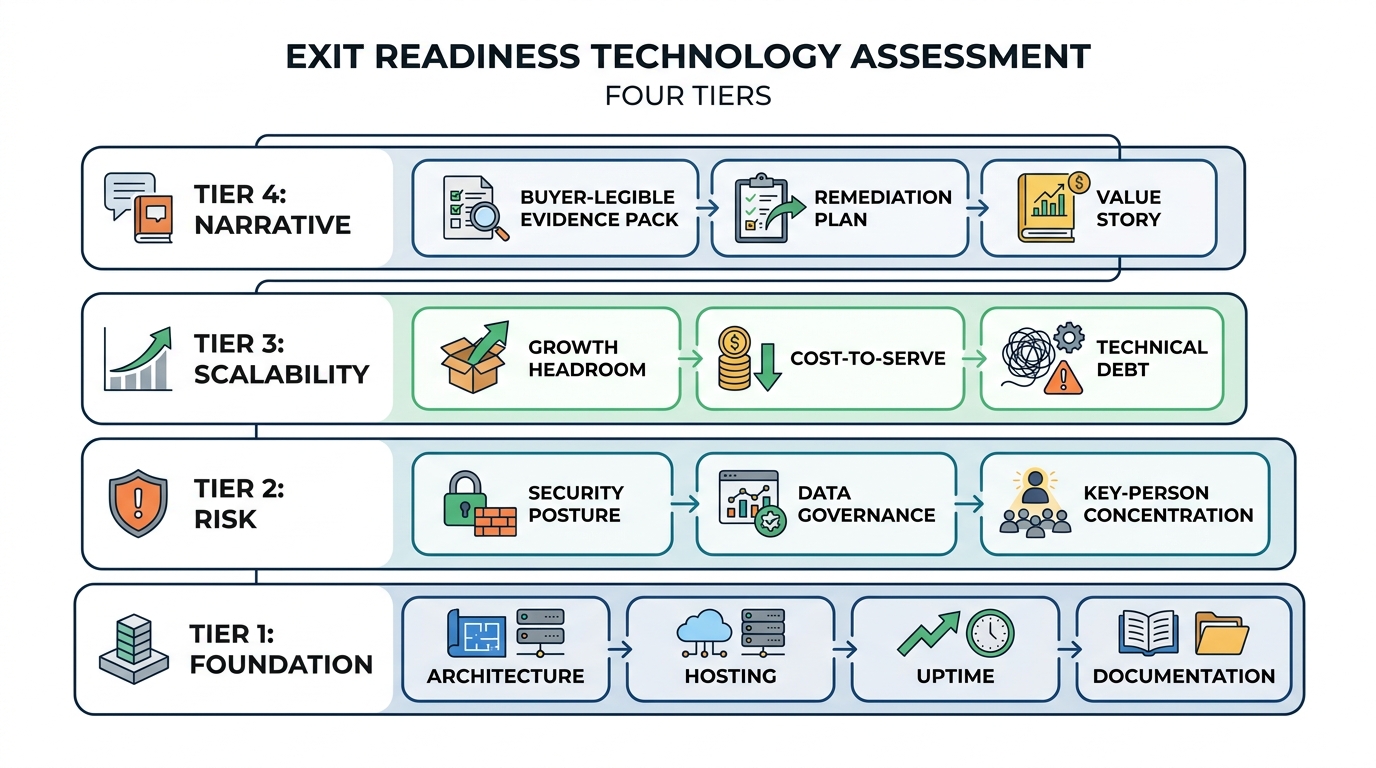
The framework has four tiers. Each tier answers a decision the operating partner owns, produces evidence a buyer will accept, and carries a remediation window. Work them in order, because a weakness in a lower tier undermines any claim you make in a higher one.
Tier 1, Foundation
Architecture, hosting, uptime history, and documentation. This is the baseline a buyer’s team confirms first. If the system diagram lives only in someone’s memory and there is no runbook, nothing above this tier is credible. Documentation gaps here are the cheapest to fix and the most expensive to leave.
Tier 2, Risk
Security posture, data governance, and concentration risk. This tier produces the items most likely to become indemnities, escrows, or price adjustments. Weak access controls, no incident history, unclear data ownership, and single points of failure all get named and priced here.
Tier 3, Scalability
Growth headroom, cost-to-serve, and technical debt load. This tier directly defends or undermines the growth case in the sale model. If cost-to-serve rises linearly with revenue, the margin expansion story does not hold. Technical debt elimination in private equity is usually the most consequential Tier 3 workstream, because it converts a future buyer objection into a completed line of work.
Tier 4, Narrative
The buyer-legible evidence pack: the story, the proof, and the remediation plan for anything still open. This is what actually goes into the data room. A well-built Tier 4 turns three tiers of operational reality into a document that reduces a buyer’s perceived risk rather than raising it.
4. What “buyer-legible evidence” actually means
Evidence a buyer accepts is not a slide that says “enterprise-grade.” It is artifacts a diligence team can verify: architecture diagrams that match the running system, uptime and incident logs, a dependency and license inventory, access-control records, a data-flow map, and a technical debt register with owners and estimates. The distinction matters because the diligence team’s default posture is skepticism. Assertions get discounted; documented evidence gets accepted.
The Harvard Law School Forum on Corporate Governance has published extensively on how representation and warranty terms and diligence findings shape deal economics. The practical takeaway for the sell side is simple: every claim you cannot document becomes a rep you have to stand behind, or a number the buyer withholds.
5. Sequencing the assessment against the exit timeline
Timing decides what the assessment can accomplish. The four tiers map to different windows before a sale.
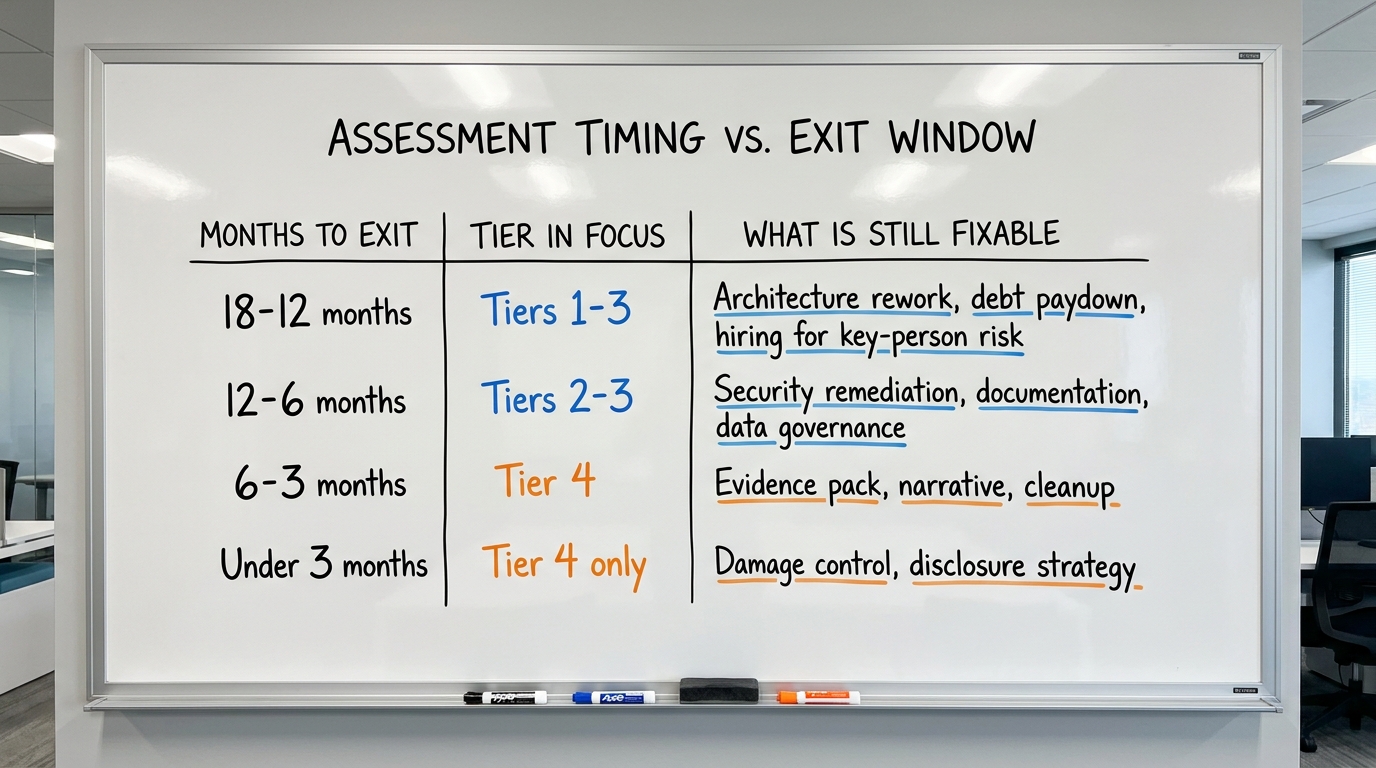
At eighteen to twelve months out, deep remediation is still possible: rearchitecting a bottleneck, paying down debt, or hiring to break a key-person dependency. Under three months, the assessment shifts from fixing to disclosing, and the operating partner’s job becomes managing how findings are presented rather than resolving them. Starting late does not make problems disappear; it just removes your leverage to fix them before the buyer names them.
6. Reading the engineering organization, not just the code
A buyer prices the team as much as the technology. Attrition risk, hiring dependency, the ratio of contractors to employees, and the concentration of critical knowledge all feed the concentration-risk line. This is also where sell-side sourcing decisions come back to matter. If the platform was built by a partner, the assessment should test whether that relationship is documented, transferable, and priced on outcomes rather than opacity. The discipline in how to choose a product engineering partner and judge it on value, not hours applies directly: a buyer wants to see a relationship built on measurable output, and strategic IT sourcing decisions made earlier in the hold become evidence in the data room now.
7. The remediation decisions the operating partner actually owns
The assessment produces a list. The operating partner has to decide, item by item, whether to fix, disclose, or accept. Three questions govern each decision:
- Does fixing it raise the multiple or protect it? A scalability fix that unlocks the growth case earns its cost. A cosmetic cleanup rarely does.
- Is there time? Tie the answer to the exit window above. A six-month rearchitecture at four months out is not a fix, it is a distraction.
- Is disclosure cheaper than remediation? Sometimes a known, bounded, disclosed issue costs less than an incomplete fix that raises new questions.
Common high-value remediations include process automation for portfolio companies that removes manual dependencies before they read as key-person risk, and cloud modernization decisions operating partners have to weigh when hosting cost or scalability is capping the growth story. Each should be judged on whether it changes what a buyer will pay, not on engineering preference.
8. What good looks like when the data room opens
A ready company hands the buyer’s diligence team a coherent pack that answers the four priced risks before they are asked. Findings are documented, remaining issues are disclosed with owners and timelines, and the growth case is supported by evidence rather than assertion. PitchBook’s research and data on deal timelines shows that cleaner processes close faster and with fewer retrades, which is the practical prize. The assessment does not guarantee a higher multiple. It removes the reasons a buyer would justify a lower one, and it shortens the path to close.
9. Where this connects to the broader operating plan
Exit readiness is not a standalone event bolted on at the end. The strongest evidence packs are built by portfolio companies that treated technology as a value driver from the first 100 days. A disciplined systems implementation early in the hold, and an application modernization decision made deliberately rather than deferred, produce artifacts that populate Tier 4 almost automatically. Companies that skip that discipline spend the last year of the hold reconstructing evidence they should have generated along the way.
10. A next-step checklist for the operating partner
- Set the exit window and map remediation against it before commissioning any work.
- Commission the assessment across all four tiers, not just a code review.
- Demand buyer-legible artifacts, not summaries: diagrams, logs, inventories, registers.
- Score each finding as fix, disclose, or accept, with a cost and a value-at-risk figure.
- Test the engineering organization and any partner relationships for transferability.
- Build the Tier 4 evidence pack for the data room, not for internal comfort.
The BCG principal investors and private equity practice and S&P Global’s Market Intelligence both underline the same shift: buyers are more forensic than they were a decade ago, and unexamined technology is a repricing risk waiting for a diligence team. The sell side’s advantage is time, and only if it is used.
To scope an exit readiness technology assessment against a live sale timeline, and to build the evidence pack a buyer’s diligence team will accept rather than discount, review the private equity engagement approach and route the assessment through the DevriX and GrowthShuttle PE offer.