A portfolio company CEO asks for a budget to rebuild the website, and the operating partner has to decide inside a week whether that spend belongs in the value-creation plan or in the backlog. The question is rarely “is the site old.” It is whether web platform modernization in a private equity context moves revenue, margin, or exit readiness enough to justify the capital and the disruption during a hold period that is already short. Get this wrong in one direction and the company runs a two-year replatform that delivers nothing a buyer will pay for. Get it wrong in the other and the commerce engine throttles growth the thesis depends on.
This guide is for the person standing up sales and revenue operations inside a portfolio company, and for the operating partner who signs off on the spend. It gives you a way to frame the decision, sequence the work, and judge whether what you are buying is worth what it costs.
1. Start from the thesis, not the technology
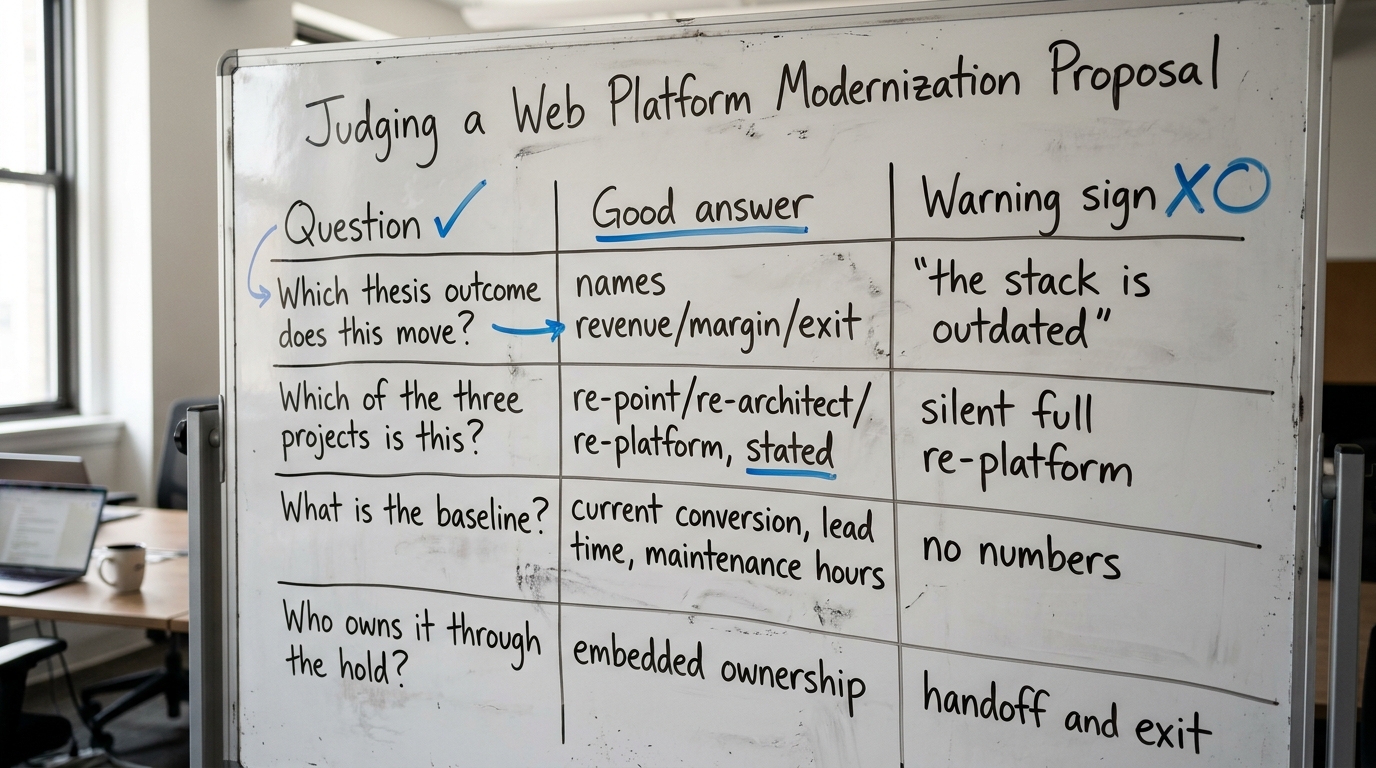
The reason to modernize a web platform is never that the stack is dated. It is that the current platform blocks something the deal thesis promised: a pricing change the business cannot ship, a new segment the site cannot serve, an acquisition it cannot absorb, or a conversion rate that caps revenue below plan.
Before any vendor conversation, write down the one or two commercial outcomes the modernization is supposed to produce. Connect the project to revenue growth, margin, faster integration of add-ons, or a cleaner story at exit. That framing follows directly from what technology transformation for portfolio companies actually has to deliver, and it is the test every later section returns to.
2. Decide whether this is a diligence finding or a hold-period project
Timing changes the decision. If the platform risk surfaced during technology due diligence, you have leverage to reflect it in the plan and sometimes the price, and you can scope the work before close rather than discovering it in month four. The questions worth settling before the data workstreams close are laid out in what to decide in middle-market due diligence before the data workstreams close.
If instead the need appears after close, during the first 100 days, treat it as a forecast risk to the value-creation plan and size it against everything else competing for the same capital and management attention. Both paths are legitimate. What is not legitimate is letting a replatform start as an IT initiative with no owner on the commercial side.
3. Separate the three things people mean by modernization
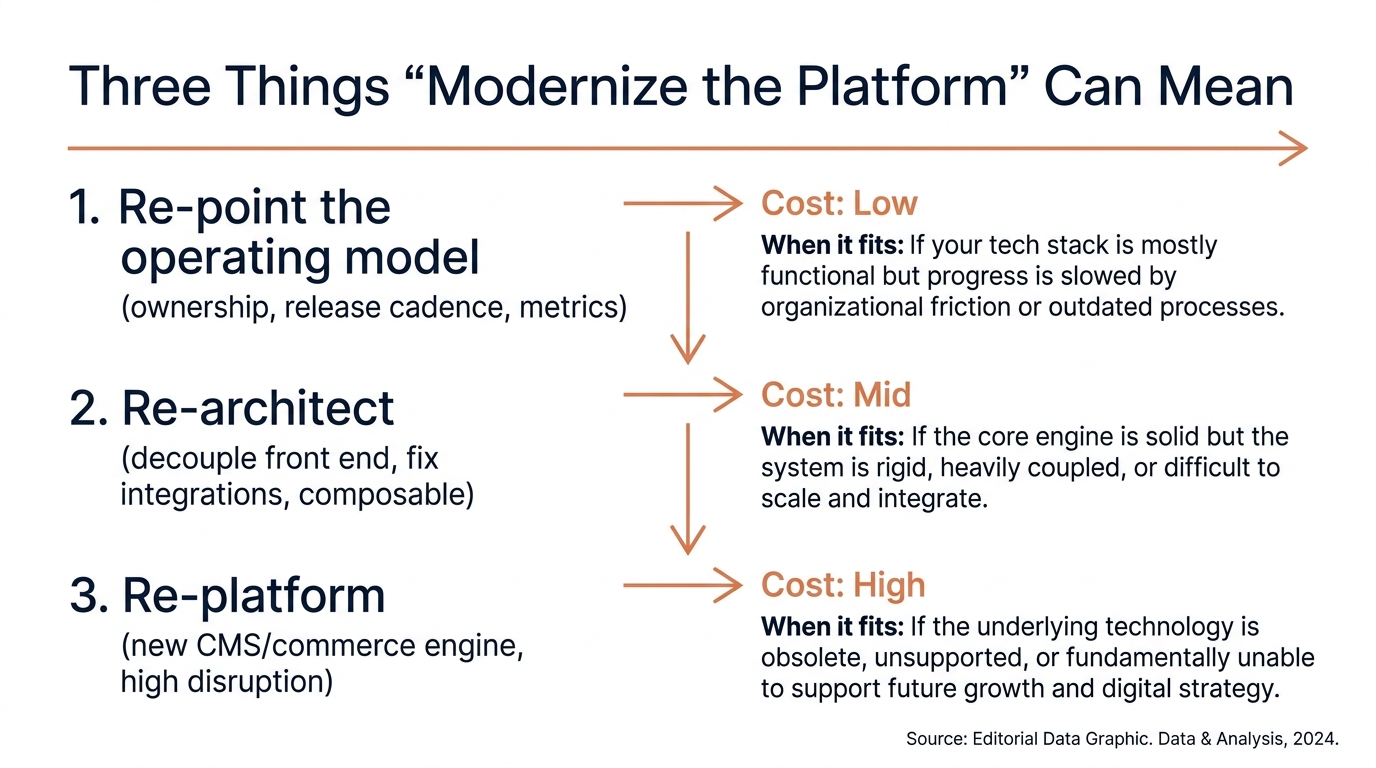
“Modernize the platform” usually hides three different projects with different costs and different payoffs.
Re-platform
Moving to a new CMS or commerce engine. High cost, high disruption, justified only when the current system structurally blocks the thesis.
Re-architect
Keeping the core but decoupling the front end, fixing integrations, or moving to a composable setup. Mid cost, and often the right answer when the problem is speed of change rather than the platform itself.
Re-point the operating model
Changing who maintains the site, how releases ship, and how performance is measured. Lowest cost, and frequently the real fix, because many “old platform” complaints are actually an operating-model problem dressed up as a technology one.
Insist that the vendor or internal team tell you which of the three they are proposing. A quote that silently assumes a full re-platform when a re-architecture would do is the most common way this spend doubles.
4. Baseline what the current platform actually costs the business
You cannot judge the return on a modernization without a baseline, and most portfolio companies do not have one. Pull the numbers that connect the platform to money: conversion rate by key journey, page performance on the pages that carry revenue, the engineering hours spent on maintenance versus new capability, and the lead time to ship a pricing or catalog change.
If the business runs those numbers out of spreadsheets rather than connected systems, that gap is itself a finding. The discipline of getting to a reliable baseline is the same one described in data readiness for an exit portfolio company and how to judge it, and the baseline you build here will serve the exit story later.
5. Size the prize before you size the project
Put a number on what the modernization is supposed to unlock. A realistic conversion lift on the journeys that matter, the revenue from a segment the current site cannot serve, the engineering capacity freed up when maintenance drops, the cost avoided when an add-on no longer needs its own standalone site.
Classify each number honestly. Some of it is forecast, some is enabled (it becomes possible but is not guaranteed), and only a little is realized on day one. Bain’s annual Global Private Equity Report has documented for years that returns increasingly come from operational improvement rather than leverage or multiple expansion, which raises the bar on projects like this to show an operating result. Research from McKinsey on private capital points the same direction.
6. Choose the build-versus-rent model deliberately
A short hold period rarely justifies hiring a full in-house platform team from scratch. The practical choices are an embedded partner who runs the modernization and the ongoing platform, a staff-augmentation model, or a one-off project vendor who hands you the keys and leaves.
The one-off project vendor is usually the wrong fit for a portfolio company, because the platform needs continued ownership through the hold. The trade-offs between these models are worked through in how to structure outsourced product and engineering for a portfolio company and in how to choose an embedded technology partner. For most mid-market portfolio companies, an embedded model that owns release velocity and platform performance through the hold is the one that survives a board’s scrutiny.
7. Judge the vendor on commercial fluency, not stack preference
The fastest way to screen a partner is to see whether they arrive understanding the business model. A distributor, a clinic group, and a subscription media company need different things from a web platform, and a vendor who applies the same SaaS template to all three is telling you they will need constant correction.
Ask for how they would measure success in your revenue terms before they recommend a technology. If the first thing they want to discuss is a specific CMS, the conversation is backwards. The same test applies when you vet adjacent specialists, which is why how to hire and judge a technology roadmap consultant and how to judge a machine learning consultant use the same yardstick.
8. Watch the performance and traffic risk under load
If the business depends on high-traffic moments, campaign spikes, seasonal peaks, or a marketplace, platform performance under load is a direct revenue question, not an engineering nicety. A modernization that improves page performance on the revenue-carrying pages can pay for itself, and one that ignores load behavior can quietly cost sales no dashboard attributes to the platform. What that engineering is actually worth in a deal is covered in what high-traffic platform engineering is worth.
9. Decide what AI belongs in this phase and what does not
Modernization proposals now arrive bundled with AI features, and most of them should be deferred. The foundation of clean data, a stable platform, and reliable measurement has to exist before anything clever runs on top of it. Fund the search-visibility and content work that affects how buyers find the company, and be skeptical of generative features pitched before the base is solid.
Two site guides help you draw that line: how operating partners should judge generative AI value creation and agentic AI for portfolio companies and how to decide what to fund.
10. Sequence the work so value lands before the project ends
A two-year replatform that delivers nothing until the end is a bad bet in a five-year hold. Structure the work so measurable improvement arrives in phases: fix the revenue-carrying journeys first, then re-architect the parts that block speed of change, then migrate the core if the thesis still requires it. Each phase should move a number you baselined in section four, and each should be defensible on its own if the plan changes.
11. A checklist before you approve the spend
- The project names a specific thesis outcome (revenue, margin, integration, or exit readiness), not “the site is old.”
- You know whether this is a diligence finding or a hold-period project, and you know who owns the commercial outcome and who owns the technical work.
- The proposal states which of the three projects it is: re-point, re-architect, or re-platform.
- You have a baseline: conversion by journey, performance on revenue pages, maintenance hours, and lead time to ship a change.
- The prize is sized and each number is labeled forecast, enabled, or realized.
- The delivery model fits the hold, with ownership of the platform through to exit rather than a handoff.
- The vendor led with your business model and your revenue metrics before proposing a stack.
- Performance under load is addressed if the business depends on traffic peaks.
- AI features are scoped only after the data and platform foundation is in place.
- The work is phased so value lands before the project ends.
For the broader context on how this fits a value-creation plan, the BCG principal investors and private equity research and deal data from PitchBook are useful references, and the private equity operating view ties the pieces together.
12. The next step
If you are weighing a web platform modernization inside a portfolio company and want a scoped read on whether it belongs in the value-creation plan, and in what sequence, review the DevriX and GrowthShuttle private equity offer for an embedded team that owns the modernization and the platform through the hold.