An operating partner who greenlights a machine learning consultant inside a private equity portfolio company is making a capital allocation decision. The spend shows up against the value creation plan, the timeline competes with integration work in the first 100 days, and the board will ask what moved. Most of the pitches that land on your desk describe model accuracy, data pipelines and training runs. None of that is what you are buying. You are buying a measurable change in revenue, margin or forecast reliability, and the person you engage has to be able to name which one before they touch a dataset.
This guide is for the executive standing up sales and revenue operations inside a portfolio company, and for the operating partner signing off on the work. It covers what to decide, in what order, and how to tell a consultant who will produce enterprise value from one who will produce a dashboard nobody uses.
1. Start with the decision the model is supposed to change
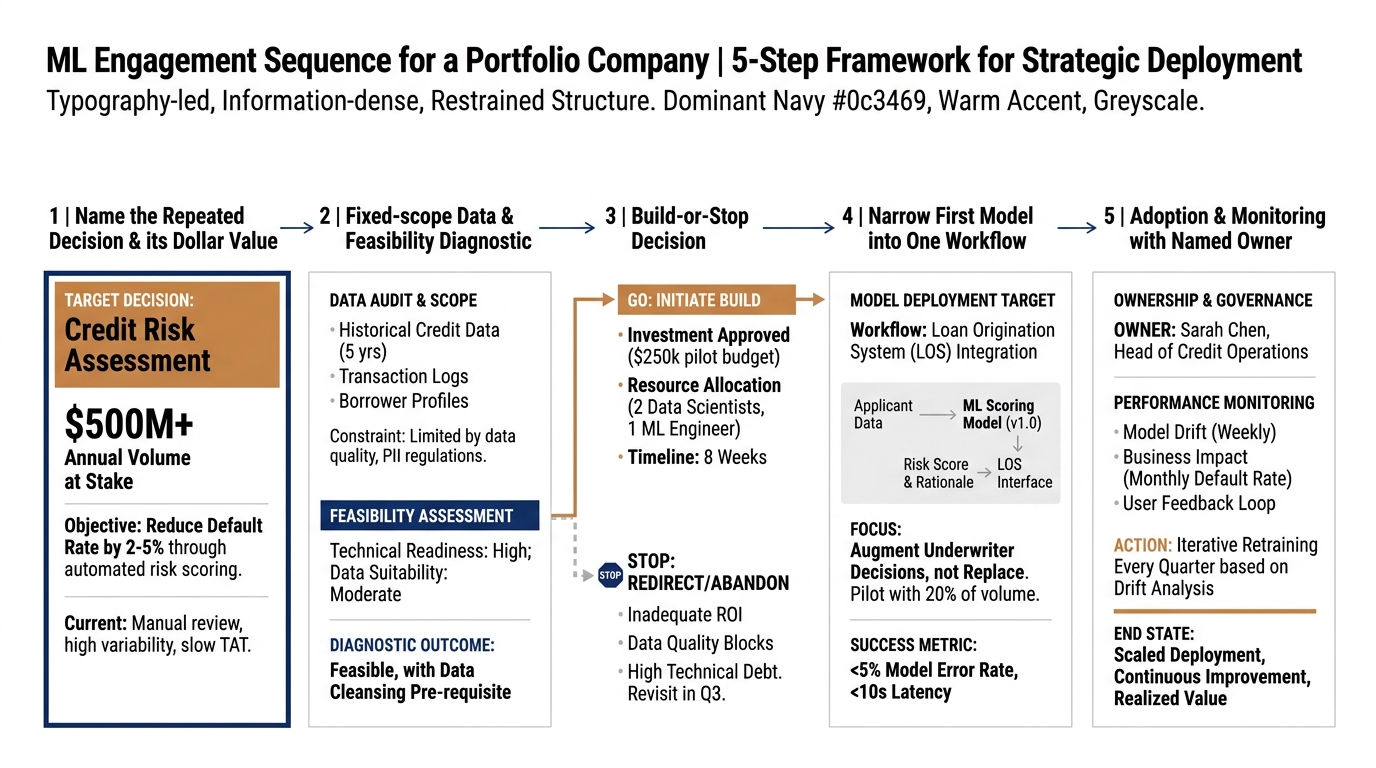
A machine learning engagement earns its keep only when it changes a decision that someone in the business makes repeatedly. Lead prioritization, churn intervention, dynamic pricing, demand forecasting, and credit or fraud scoring are the common ones in a mid-market portfolio company. Before any consultant is engaged, write down the decision, who owns it today, how often it gets made, and what a better version of that decision is worth in dollars.
If you cannot complete that sentence, the problem is not a modeling problem yet. Bain’s annual private equity report has tracked for several years how value creation has shifted from financial engineering toward operational improvement, which means the bar for a technical engagement is a traceable line to EBITDA. You can read Bain’s ongoing work on this in its Global Private Equity Report.
2. Separate the diagnostic from the build
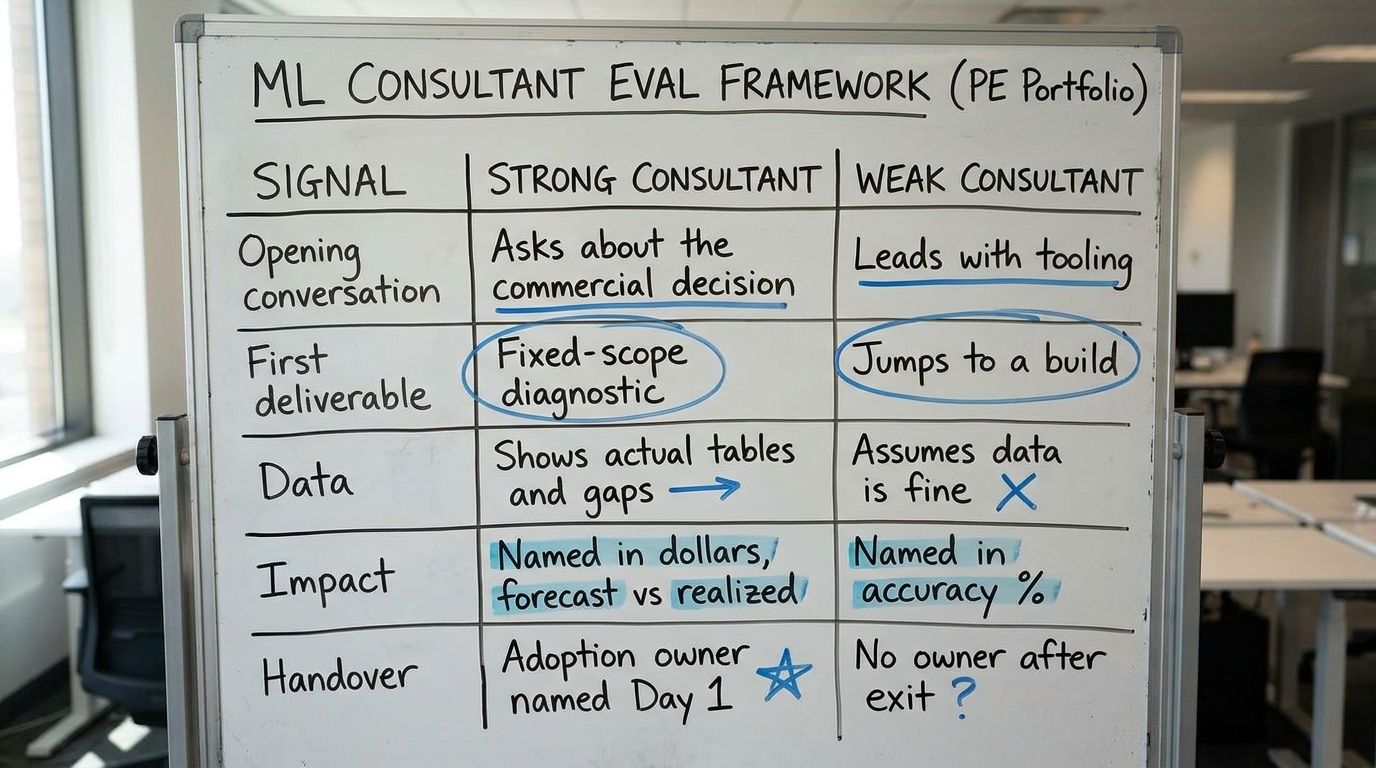
The first thing to buy is rarely a model. It is a diagnostic that tells you whether the data exists, whether the decision is worth automating, and what the realistic lift is. A good machine learning consultant in a private equity portfolio will quote a short, fixed-scope assessment before proposing a build, and will be willing to recommend against the build if the data is thin.
This is the same discipline you apply to a digital value creation purchase. Pay for the finding first, then decide on the capital-intensive work once you know the ceiling on the return.
What the diagnostic should produce
- The target decision, its current owner, and its current baseline performance.
- A data inventory: what exists, where it lives, its quality, and the gaps.
- An estimated range of impact, classified as forecast rather than realized.
- A build-or-stop recommendation with the reasoning stated.
3. Check the data before you check the resume
The constraint on most portfolio-company machine learning work is data. A consultant can be excellent and still deliver nothing if the CRM has three years of inconsistent stage definitions, the ERP and the billing system disagree on customer identity, or the historical labels needed to train a model were never captured.
Ask the consultant to show you, in the diagnostic, the actual tables they would use and the record counts. McKinsey’s research on analytics and AI adoption has repeatedly found that the organizations capturing value treat data foundations as the gating item, a theme that runs through its private capital and digital research. If the data is not there, the honest recommendation is to fix the data first, and a consultant who skips that step to get to the modeling is selling you the part that is fun to build, not the part that pays.
4. Decide whether this is a project or a capability
One model, shipped and left alone, degrades. Prices move, customer behavior shifts, and the model that scored leads well in Q1 quietly stops working by Q4 if nobody retrains it. Before you engage, decide whether you want a one-time deliverable or an ongoing capability, because the two require different contracts and different owners.
For most portfolio companies, the right answer is an embedded arrangement where the consultant builds, hands over, and then maintains on a retainer until internal staff can carry it. The economics of that choice mirror the build-versus-outsource decision for product and engineering, and the same question applies: who owns this on Day 1 after the consultant leaves.
5. Judge the consultant on business framing, not model choice
A strong candidate will spend most of a first conversation on your commercial situation and very little on algorithms. The right diagnostic questions from them are about your sales process, your margin structure, and how decisions actually get made on the floor. Weak candidates lead with their tooling stack and their preferred frameworks.
This is the same evaluation lens you would use for a technology roadmap consultant or a technical value creation partner. The person who can translate a model into an EBITDA line is worth more than the person with the best accuracy score, because accuracy that nobody acts on is a cost, not a return.
Questions that separate the two
- Which decision does this change, and what is one point of improvement worth to this business?
- What would make you recommend we not build this?
- Who on the client side has to change their behavior for this to pay off?
- How will we know in 90 days whether it is working, in dollars?
6. Price the engagement against the value plan, not the market rate
The relevant comparison is the value of the decision improvement across the hold period. A pricing model that lifts average deal size by a few percent, or cuts churn by a point in a subscription business, compounds across the value creation plan in a way that a flat day rate does not capture.
That framing changes how you negotiate. You are not minimizing spend, you are maximizing the ratio of forecast value to committed capital, and you want the consultant to share enough of the downside that their incentive matches yours. PitchBook and S&P Global both publish data on how value creation levers perform across holds, useful context when you size the prize, available through PitchBook’s research and S&P Global Market Intelligence.
7. Tie the work to diligence and the first 100 days
When this matters is tied to real triggers. During confirmatory diligence, a machine learning claim in the seller’s growth story is something you verify, not something you accept, and that belongs in your technology due diligence scope. In the first 100 days, the question is whether a quick analytics win is realistic given the data you inherited, or whether the honest sequence is a foundation year first.
An operating partner working across a private equity portfolio should resist the temptation to roll out one model across several companies before it has proven itself in one. The data differences between portfolio companies usually defeat a copy-paste rollout, and a failed group initiative costs more credibility than a single-company test ever would.
8. Set the adoption plan before the build, not after
A model that sales reps ignore returns nothing. Adoption is a change-management problem that lives with the revenue operations leader, and it has to be designed into the engagement rather than bolted on when usage comes in low. Decide early who trains the users, how the output appears inside tools people already use, and what happens to the old process.
This is where the enablement discipline this site writes about pays off directly. The same rigor you apply to standing up an embedded engineering team or choosing an embedded technology partner applies here. If the people who make the decision will not use the model’s output, the accuracy of the model is irrelevant.
9. Insist on a baseline and a measurement method
No impact claim means anything without a baseline measured before the work started and a method stated for attributing the change. Capture the current conversion rate, churn rate, forecast error or whatever metric the decision drives, and agree with the consultant how you will isolate the model’s contribution from everything else moving in the business.
Classify every number in the final report as realized, run-rate, forecast or risk avoided, and do not let a forecast figure appear in a board deck as though it were banked. This is the discipline the AICPA applies to performance measurement generally, reflected across its standards and guidance, and it is what keeps a value creation story defensible at exit.
10. A checklist before you sign
- The repeated business decision the work changes is written down, with its owner and its dollar value.
- You are buying a fixed-scope diagnostic first, with a build-or-stop recommendation attached.
- The data inventory is real: named tables, record counts, quality and gaps.
- You have decided whether this is a one-time project or a maintained capability, and named the owner after handover.
- The consultant framed the work in commercial terms and named what would make them say no.
- A baseline is captured before work begins, and an attribution method is agreed.
- An adoption plan sits with the revenue operations leader, designed in from the start.
- The engagement is tied to a real trigger: diligence, Day 1, a system migration, or a specific board commitment.
Work through those eight before the statement of work, and the engagement either has a path to enterprise value or it does not, which is exactly the clarity you want before the capital leaves the account. For the related evaluation of broader partners, the companion guides on judging a digital value creation partner and on what an IT roadmap has to deliver cover the terrain around this decision.
To scope a value creation diagnostic or an embedded retainer against a specific portfolio company, review the DevriX private equity practice and bring the target decision with you.