An operating partner who has just approved a value-creation plan usually has three to five levers riding on technology, and no reliable way to tell whether the firm delivering that work is moving enterprise value or billing hours. The gap shows up around the first board meeting, when the CFO asks what the six-figure engineering spend actually changed in the forecast and the answer is a list of shipped features. Choosing a digital value creation partner for private equity is a buying decision with real EBITDA consequences, and most of the disappointment traces back to picking on capability instead of on how the partner ties its work to a number in the model.
This guide is for the operating partner or portfolio company executive who has budget and a mandate, and who needs a way to judge candidates before signing. It walks through what to decide, in order, and what a good answer sounds like at each step.
1. Start with the value lever, not the vendor
Before evaluating anyone, name the specific lever the work is meant to move. Revenue growth through a rebuilt commercial funnel is a different engagement than margin recovery through process automation across portfolio operations, which is different again from removing a diligence risk before exit. Each implies a different partner, a different timeline, and a different measure of success.
The most common mistake is buying general technical capacity and hoping it attaches to a thesis later. It rarely does. Bain’s annual Global Private Equity Report has documented for years how much of the return now depends on operational improvement rather than multiple expansion or leverage, which raises the bar on whether any workstream can point to a financial outcome.
2. Ask which financial statement the work touches
A serious partner can tell you, without prompting, whether an engagement is meant to grow revenue, expand EBITDA, improve cash conversion, or reduce a risk that would otherwise show up in a quality of earnings review. If the answer stays in the language of tickets, sprints, traffic, and dashboards, the partner is describing activity and leaving the translation to you.
Push for the mechanism. “We will lift qualified pipeline by fixing lead routing and attribution” is testable. “We will modernize your marketing stack” is not, because it does not say what the modernization is worth or how you would know it worked.
3. Decide whether you need diagnosis or delivery first
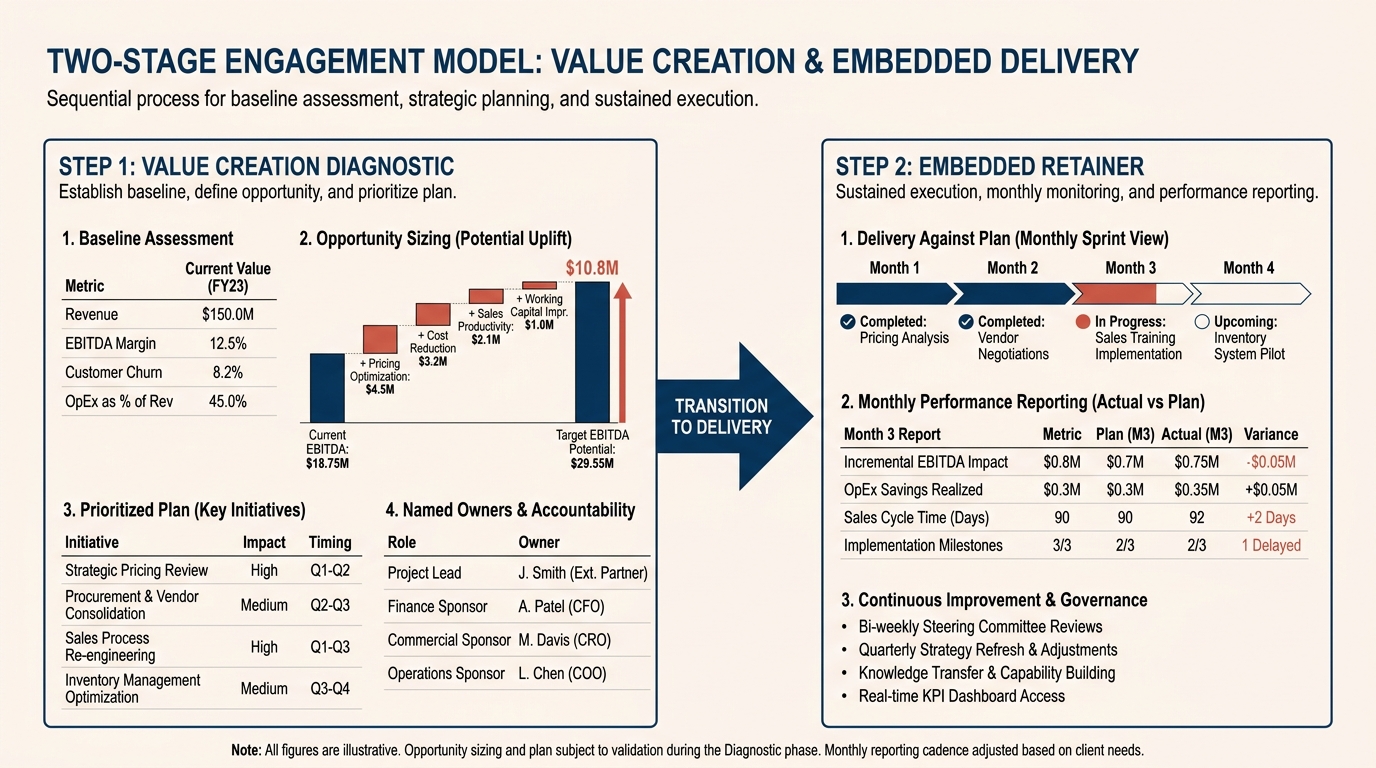
Two engagements get conflated. One is a scoped assessment that establishes a baseline, sizes the opportunity, and produces a prioritized plan with owners. The other is embedded delivery against that plan over months. Buying delivery before anyone has established a baseline is how firms spend real money and cannot answer the actual-versus-plan question later.
If you are inside technology due diligence or the weeks right after close, a diagnostic usually comes first. A focused value-creation diagnostic, in the range of a light assessment through a fuller one, exists precisely to give you a defensible baseline before you commit to a retainer. Trainer Hangout’s breakdown of exit readiness cost in private equity is a useful reference for how these scopes and price points tend to be structured.
4. Judge the baseline, not the pitch deck
Any partner can present a capabilities deck. Fewer can walk into a portfolio company, measure the current state of the commercial and technical estate, and hand you numbers you did not have before. Ask a candidate to describe what they would measure in the first two weeks and how they would establish it. Weak answers stay abstract; strong answers name the systems, the data sources, and the specific metrics they would pull.
This is the same discipline behind a proper exit readiness technology assessment. A baseline you can defend to an incoming buyer is worth more than a plan you cannot measure against.
5. Separate embedded capacity from advisory
A digital value creation partner for private equity should be able to embed operators who own a workstream, not only advisors who recommend one. The difference matters at the first board meeting, when someone has to be accountable for whether the pipeline number moved. Advisory produces recommendations; embedded delivery produces the change and the reporting on it.
For product and engineering work specifically, Trainer Hangout’s guide on how to choose a product engineering partner and judge it on value rather than hours covers the same accountability test in more depth.
6. Test how the partner reports
Reporting cadence and format tell you whether a partner thinks like an operator or a vendor. Ask to see a sample monthly report. You want to see progress framed against the plan, the current baseline, and the financial lever, with risks flagged before they become surprises. If the sample is a list of completed tasks and hours consumed, you will spend every board meeting translating for the deal partner.
Classify what the report claims. A responsible partner distinguishes realized impact from run-rate, forecast, or enabled impact, and does not let a projection read as money already in the bank.
7. Check the fit with the deal clock
The right partner for the first 100 days after close is not always the right partner two years later when the bankers are near. Early on, speed of baseline and quick operational wins matter. Approaching exit, the priority shifts to removing diligence risk and making the growth story legible to a buyer.
Trainer Hangout’s exit readiness sprint and its go-to-market exit readiness assessment both map to that later stage, and are worth reviewing before you commit a partner to a multi-year retainer without checking whether they carry the exit motion.
8. Weigh technical debt as a financial item
Technical debt is not only an engineering concern. Unaddressed, it slows every subsequent initiative and can surface as a discount in diligence. Ask a candidate how they would size the debt in the current estate and where they would draw the line between what to fix now and what to disclose and defer. Trainer Hangout’s treatment of technical debt elimination in private equity frames this as a value question rather than a purity exercise, which is the correct lens for a portfolio company.
9. Confirm decision rights and owners
An engagement fails quietly when nobody owns the outcome inside the portfolio company. Before signing, agree who holds the decision right on each workstream, who the partner reports to, and what escalates to the board. This is unglamorous and it prevents most of the drift that shows up in month four. McKinsey’s private capital research and BCG’s work on principal investors both point to governance clarity as a repeated separator between value plans that land and ones that stall.
10. Price against the value at stake
An embedded retainer in the range of roughly fifteen thousand to fifty thousand dollars a month and up is a meaningful commitment, and the right way to judge it is against the size of the lever the retainer is meant to move. A retainer that credibly protects or adds several points of EBITDA is cheap; one attached to no measurable lever is expensive at any price.
For a broader view of how portfolio companies structure external technology spend, Trainer Hangout’s guide to strategic IT sourcing in private equity is a practical companion to this decision.
11. The short checklist before you sign
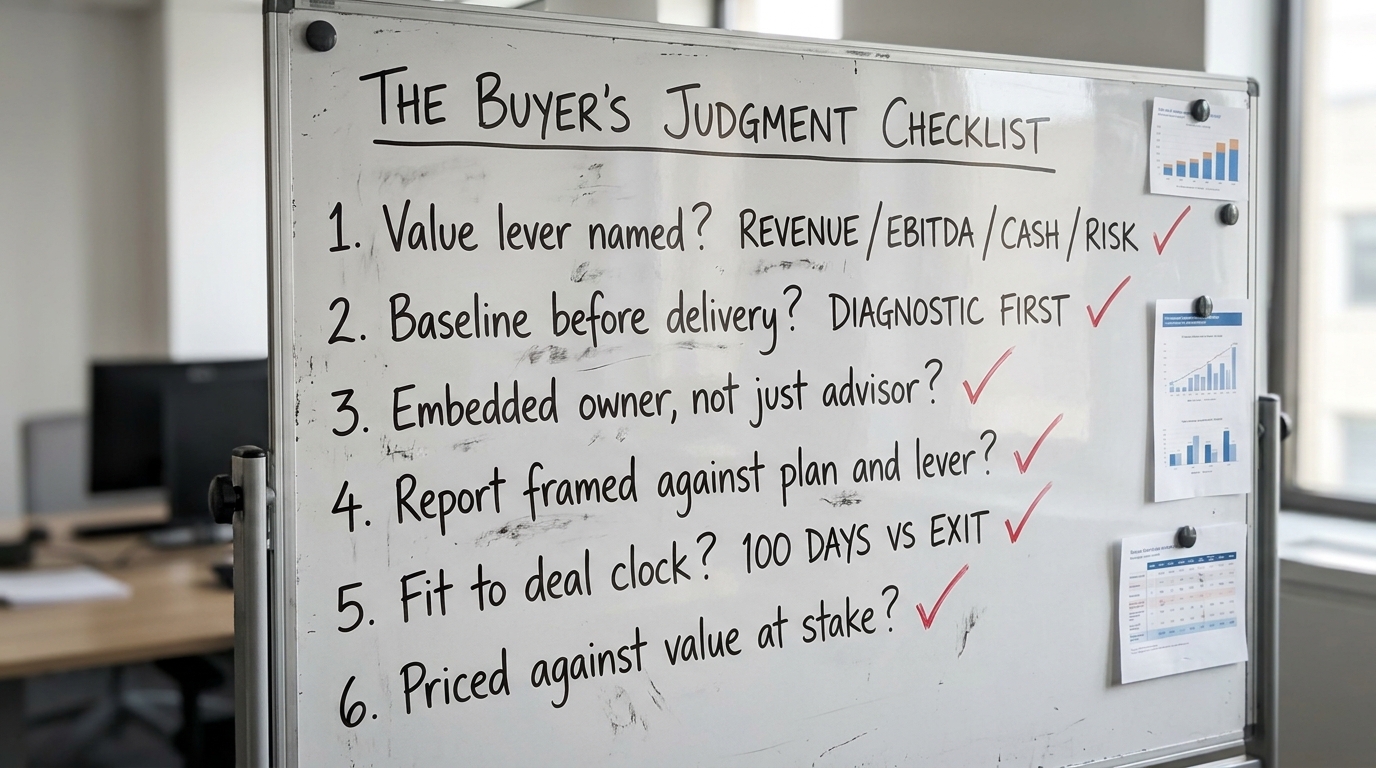
- The specific value lever is named, and the partner ties its work to it without prompting.
- A diagnostic establishes a baseline before any retainer commits.
- The partner will embed an owner for each workstream, not only advise.
- Monthly reporting is framed against plan, baseline, and financial lever, with impact classified as realized, run-rate, forecast, or enabled.
- Decision rights, reporting line, and board escalation are agreed in writing.
- The partner’s stage fit matches your position on the deal clock.
- Pricing is judged against the value the engagement is meant to move.
Two further references are worth a look while you run this checklist: PitchBook’s research and data on operational value creation trends, and the practical selection framing in Trainer Hangout’s guide on how to choose an exit readiness consultant for a portfolio company, which applies the same value-over-activity test to a related buying decision. For SaaS assets specifically, the exit readiness guide for a SaaS company narrows these questions to that model.
12. What to do next
Run the checklist above against every candidate before you shortlist, and require a scoped diagnostic before any embedded retainer. If you want a partner that structures the diagnostic and the embedded delivery around the value levers rather than the hours, review the DevriX approach to private equity value creation and use it as the benchmark for what a serious answer to each question above should sound like.