An operating partner approving a six-figure digital retainer for a portfolio company is not buying websites, dashboards or engineering hours. The check is underwriting a specific claim about enterprise value, that some combination of revenue growth, margin expansion or a cleaner exit story will be worth more than the spend. When a buyer of digital value creation services private equity firms retain cannot tie the scope to that math, the engagement drifts into activity and the operating partner is the one explaining the gap at the next board meeting. This guide is for the executive standing up or approving that work inside a portfolio company, and it walks through what to decide up front.
The timing matters because most of these decisions land in the same two windows: the first 100 days after close, when the value creation plan is still being sequenced, and the twelve months before a sale, when the go-to-market and technology stories have to hold up to a buyer’s diligence.
1. Start from the value creation plan, not the vendor’s scope
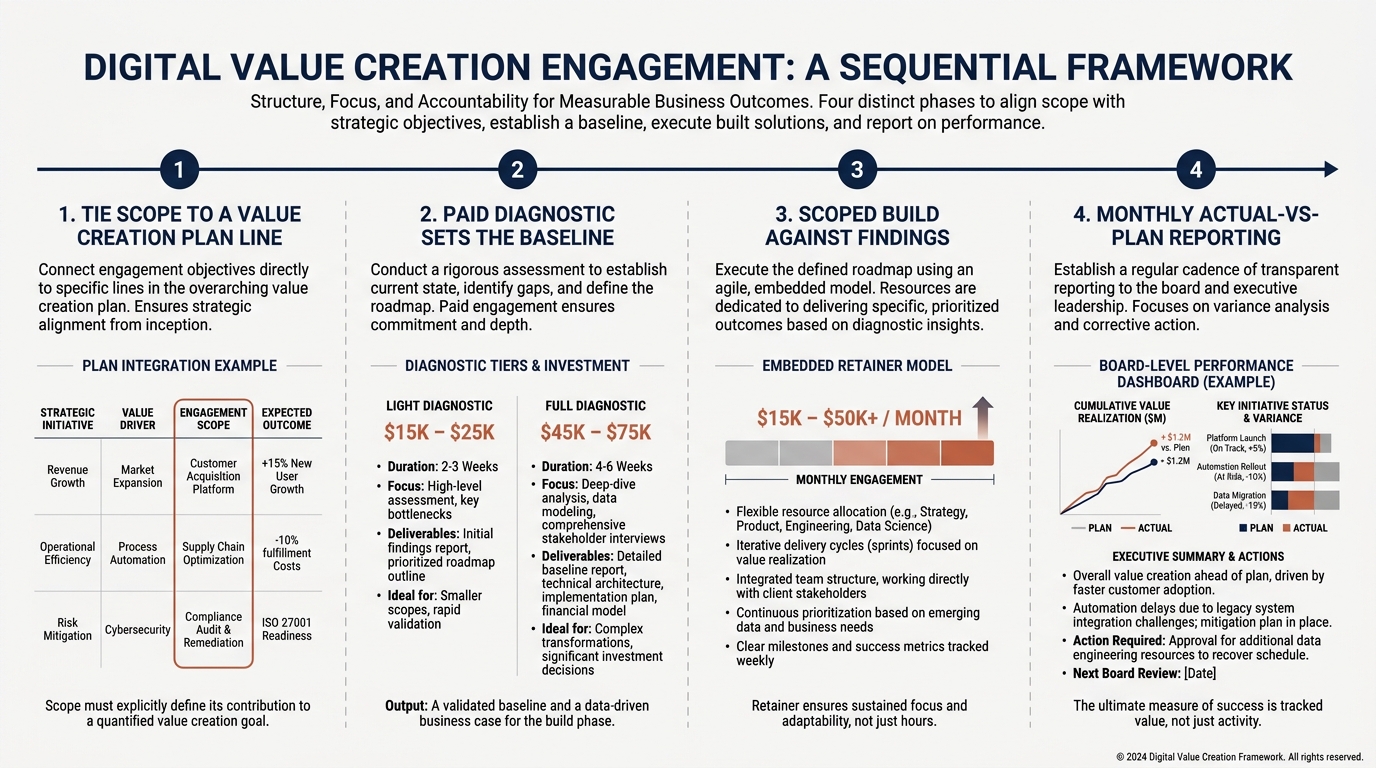
The first thing to decide is which line of the value creation plan the digital work is supposed to move. Bain’s annual Global Private Equity Report has tracked for several years how much of the industry’s return now depends on operational improvement rather than multiple expansion or leverage, which means the digital workstream has to earn its place against a named financial outcome.
If the thesis calls for revenue growth, the work is demand generation, conversion and pricing infrastructure. If it calls for margin, the work is automation, self-service and cost-to-serve. A vendor scope that reads the same regardless of the thesis is the first warning sign, because it means nobody has connected the activity to the plan.
2. Name the owner and the decision right before anyone starts
Digital work fails quietly inside portfolio companies when the operating partner, the CEO and the vendor all assume someone else owns the outcome. Decide, in writing, who owns the number the work is meant to move, who signs off on scope changes, and who has the decision right when the roadmap and the forecast disagree.
This is the same discipline that separates a useful technical value creation partner from an expensive one. The partner who asks who owns the P&L line before quoting a scope is worth more than the one who leads with a capabilities deck.
3. Decide what evidence you will accept as progress
Set the reporting standard before the first invoice. The reader should decide, up front, which metrics count as evidence of enterprise-value movement and which are the vendor’s internal register that never reaches the board.
- Pipeline created and closed, measured in dollars with a period.
- Cost-to-serve and gross margin, measured in basis points or percentage of revenue.
- Lead-to-close conversion and cycle time, measured in days and percentage improvement.
- Actual against the plan number, restated every month.
McKinsey’s private capital research has argued for years that the portfolio companies that create durable value instrument their operations early rather than reconstructing the story before a sale. The reporting standard you accept in month one is the one you will live with at exit.
4. Separate the diagnostic from the build
A common mistake is buying a build before anyone has established a baseline. The sequence that holds up is a short, paid diagnostic first, then a scoped build against what the diagnostic found. A light diagnostic in the $15-25K range establishes the baseline, the revenue leaks and the technology risk; a full one in the $45-75K range goes deep enough to underwrite a multi-quarter plan.
The diagnostic is also where you catch the expensive problems early, the kind that surface in technology due diligence when a buyer’s advisors open the hood and the story does not match the code.
5. Judge the operating model, not the logo
Decide whether you are buying an embedded team that sits inside the portfolio company’s cadence or a project shop that delivers and leaves. For a company that has to sustain growth through the hold period, the embedded model usually wins, because the capability stays after the engagement and the vendor is accountable to the same forecast the CEO is.
The test is whether the provider will report against the value creation plan in the CEO’s own numbers. A useful frame for this is the same one you would apply when you judge a digital value creation partner against the thesis rather than the portfolio of past logos.
6. Price the work against the value at stake, not the hourly rate
An embedded retainer in the $15-50K-plus per month range is a meaningful line item, and the right way to size it is against the enterprise value it is meant to move, not against a blended day rate. A retainer that would move a mid-market company’s EBITDA by a few points is cheap; the same retainer attached to a workstream nobody can connect to the plan is expensive at any price.
PitchBook’s research and data on holding periods is worth keeping in view here, because a longer hold changes the arithmetic on capability you build in-house versus capability you rent by the month.
7. Insist on a risk register that names the operating risks
Ask the provider to maintain a risk register that a board can read, listing the integration dependencies, the single points of failure, the data problems and the key-person risks. A digital partner who will not surface operating risk in writing is a partner who will surprise you during confirmatory diligence.
This is especially true where technical debt is quietly compounding. The cost of ignoring it shows up at exit, which is why serious operators treat technical debt elimination as a value item rather than a cleanup chore.
8. Tie the digital plan to the exit story you will have to defend
Everything the digital workstream produces should make the eventual sale process easier, not harder. The go-to-market metrics, the technology architecture and the reporting all become evidence a buyer’s advisors will test. Running a go-to-market exit readiness assessment well before the bankers arrive tells you which of those stories currently hold and which need eighteen months of work.
If the portfolio company runs on an ERP that cannot support the growth thesis, you want that finding before the LOI, while you can still reprice or walk. The discipline that surfaces it is the same one behind judging an ERP implementation before it breaks the forecast: ask whether the system can handle the volume, the rate of change, and the reporting granularity the business case requires, and require evidence for each.
9. Set the reporting cadence to the board’s calendar
Decide the reporting rhythm before Day 1 and align it to the board cadence. Monthly actual-against-plan, a quarterly restatement of the thesis contribution, and a standing risk register that updates in real time is a defensible minimum. The Harvard Law School Forum on Corporate Governance hosts a steady stream of practitioner writing on how boards hold operating plans accountable, and the pattern is consistent: the number the board sees has to be the number the operator manages to.
10. A short checklist before you sign
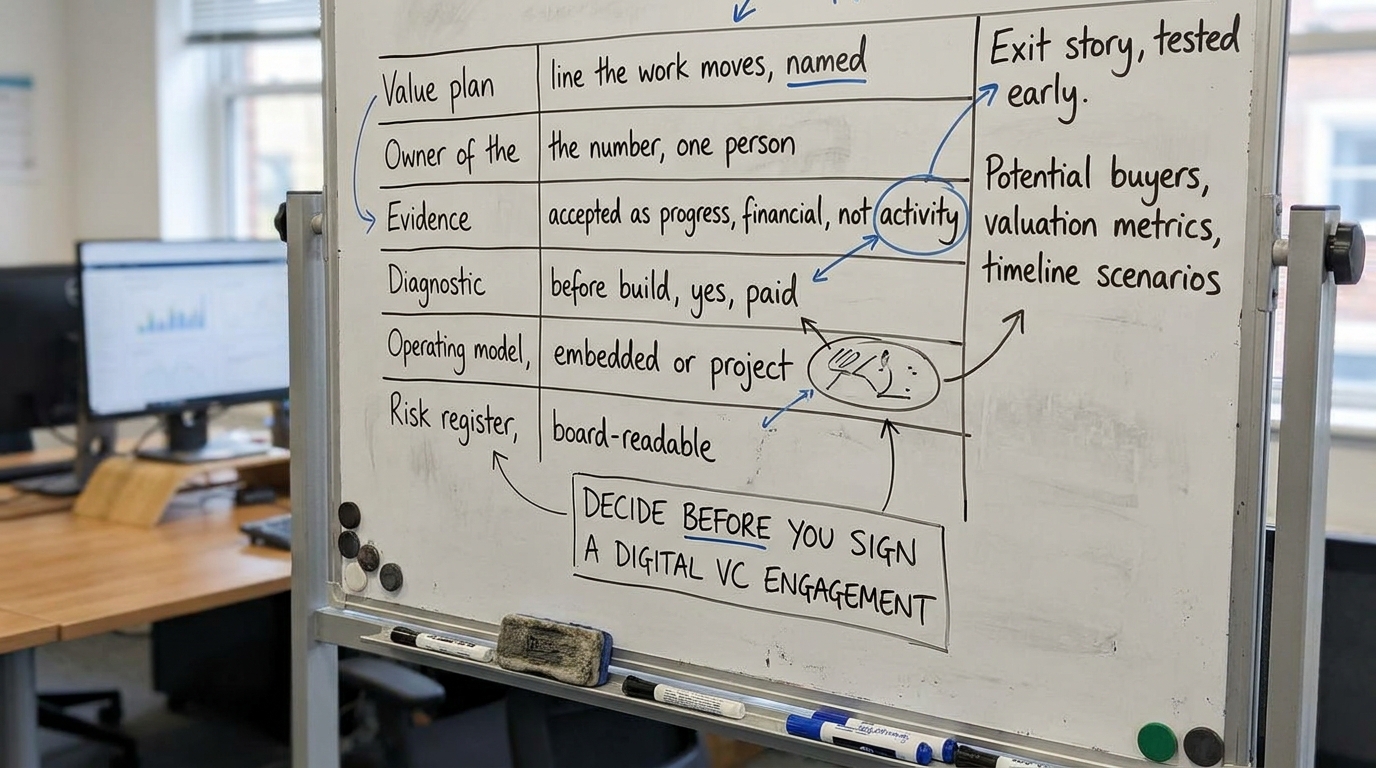
- The scope maps to a specific line of the value creation plan, and you can state which one.
- One named person owns the number the work is meant to move.
- You have agreed which metrics count as evidence and which are the vendor’s internal register.
- A paid diagnostic establishes the baseline before any build is scoped.
- You have chosen the operating model deliberately, embedded or project, and know why.
- The retainer reflects the enterprise value the work protects or creates. A $200M EBITDA improvement justifies a different engagement structure than a $2M one, regardless of the hours required to deliver it.
- The provider maintains a risk register a board can read.
- The digital plan strengthens the exit story rather than creating diligence surprises.
If several of these boxes are still empty, the engagement is not ready to start, whatever the vendor’s timeline says. For the broader operating context these decisions sit inside, DevriX’s private equity practice pages lay out how the diagnostic and embedded retainer connect to the value creation plan across the hold.
To scope a Value Creation Diagnostic or an embedded retainer against a specific portfolio company thesis, review the DevriX private equity offer and start with the diagnostic.