A value creation plan is often commissioned in the weeks after close, when the deal partner wants a credible path to the underwriting case and the operating partner has to make it real. What gets delivered varies widely: some firms provide a slide deck restating the thesis, others a sequenced workstream plan with owners, baselines and a cadence that survives the first board meeting. An executive standing up sales and revenue operations needs to know which one they are buying before they sign, or the first 100 days get spent arguing about scope instead of moving numbers.
This piece gives the buyer, an operating partner or a portfolio-company executive with budget, a way to decide what to buy and how to judge the work once it lands.
1. Start with the decision the plan has to inform
A value creation plan is not a document you grade on completeness. It exists to settle a short list of decisions: where EBITDA comes from over the hold, which initiatives get funded first, who owns each one, and what evidence tells you whether an initiative is working by the next quarter. If a provider cannot name those decisions back to you in the first conversation, the engagement will drift toward analysis that reads well and commits to nothing.
Bain’s annual private equity report has tracked the shift toward operational improvement as the dominant source of returns, which is the context most mid-market sponsors now underwrite against. You can read the current thinking in Bain & Company’s Global Private Equity Report. The practical consequence for the buyer is that a plan built on multiple expansion or cheap leverage is not a plan.
2. Separate the diagnostic from the plan
The most common packaging mistake is bundling discovery and the plan into one fixed-price deliverable, which hides where the provider is guessing. A clean engagement runs a diagnostic first, cheap and fast, to establish baselines and size the opportunities, then a value creation plan that sequences what the diagnostic found.
In practice the diagnostic sits around $5K and the full 100-day value creation plan runs $30K to $50K for a mid-market company, depending on data access and the number of functions in scope. Paying for the diagnostic alone is a reasonable first move, because it tells you whether the provider can read the business before you commit to the larger spend.
What the diagnostic should produce
- A revenue baseline by segment, channel and product, reconciled to actuals rather than the CIM.
- A short list of value creation initiatives, each sized in EBITDA terms with the assumption behind the number stated.
- A data and systems read on whether the company can even measure the thing the plan proposes to improve.
- A risk register naming what could stop each initiative, including dependencies on hiring, systems or management bandwidth.
For the data question specifically, the provider should be able to tell you whether the company’s reporting can support the plan, a judgment covered in more depth in this guide to data readiness for a portfolio company and how to judge it.
3. The four tiers of a value creation plan, and where most providers stop
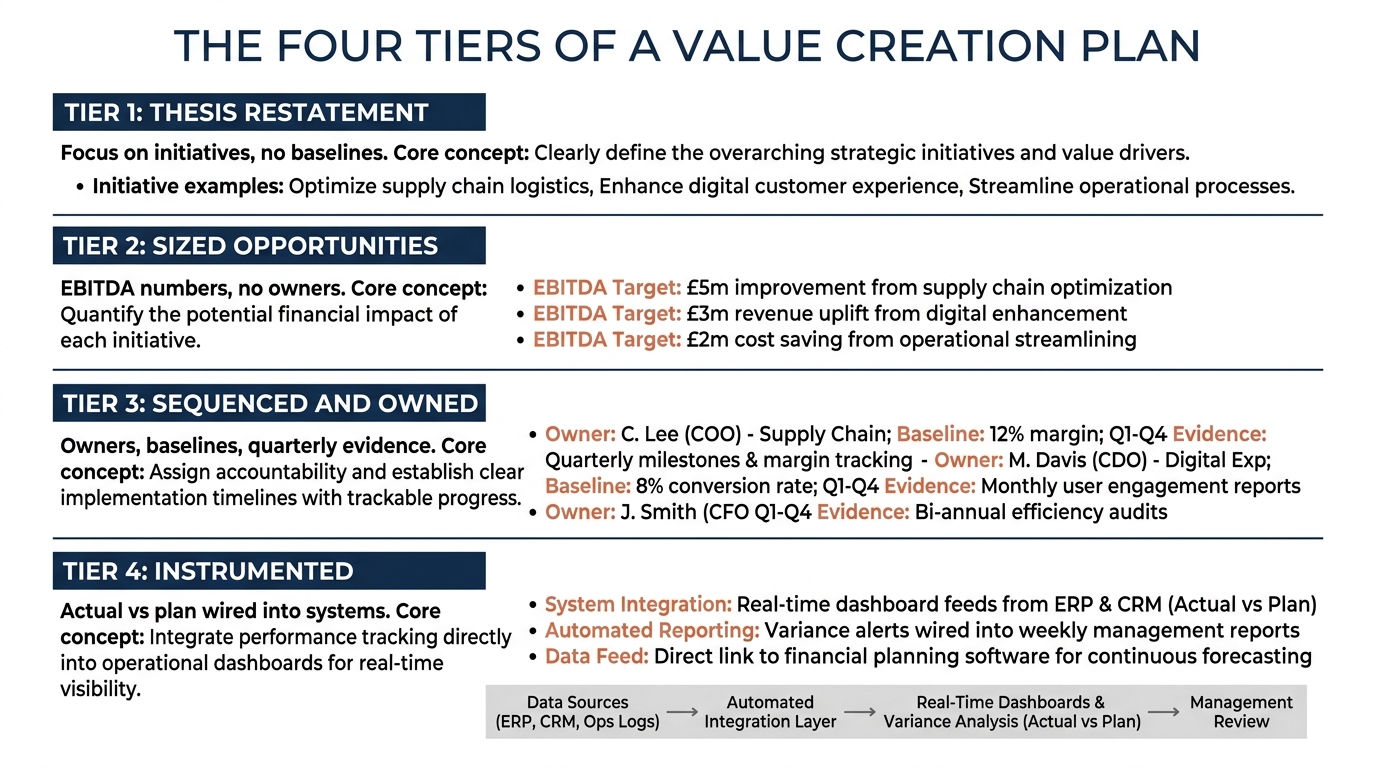
Providers deliver at different depths, and the price difference between a deck and an executable plan is small relative to the value gap. Use these four tiers to place any proposal you receive.
- Tier 1, thesis restatement. The provider repeats the deal thesis in tidy language and lists initiatives without baselines or owners. This has no operating value after the first week.
- Tier 2, sized opportunities. Each initiative carries an EBITDA number and a rough timeline, but ownership and measurement are left to the company. Useful for a board conversation, thin for execution.
- Tier 3, sequenced and owned. Initiatives are ordered by dependency and payback, each has a named owner and a baseline, and the plan states what evidence confirms progress by quarter. This is the floor for a real 100-day plan.
- Tier 4, instrumented. Everything in Tier 3 plus the reporting to track actual against plan, wired into the systems the company already uses, so the next board meeting runs on data rather than anecdote.
Most mid-market providers deliver Tier 1 or Tier 2 and price it as if it were Tier 3. The buyer’s job is to hold out for owned initiatives and defined evidence, because a plan nobody owns is a plan nobody runs.
4. Who the plan is written for changes what it should say
A deal partner wants the line from initiative to EBITDA to exit multiple. An operating partner wants sequencing, owners and a cadence they can run. A CFO wants the numbers tied to the forecast and the covenants. A good provider writes one plan that serves all three without blurring them, and a weak one writes to whoever is in the room.
When the plan touches technology or data initiatives, the translation into financial terms matters more than the technical description. The same discipline applies when you judge an engineering or roadmap partner, which this piece on how to hire and judge a technology roadmap consultant works through in detail.
5. How to judge the revenue and sales-operations content
For a company where the thesis rests on commercial improvement, the sales and revenue operations section is where a plan earns or loses credibility. Generic advice to hire reps or buy a CRM is a sign the provider did not look at the pipeline data.
Signals the commercial plan is real
- It names the specific stage in the funnel where conversion breaks and ties the fix to a win-rate or cycle-time number.
- It distinguishes capacity problems (not enough sellers) from productivity problems (sellers underperforming a defined benchmark), because the two have different fixes and different costs.
- It states what the company must be able to measure, pipeline by stage, by rep, by segment, before the enablement spend is justified.
- It sequences enablement after the data and process are fixed, not before, so training lands on a system that can show whether it worked.
That last point is where enablement budgets get wasted most often. Training a sales team on a process the company cannot measure produces activity and no evidence, and the next board meeting has nothing to show for the spend.
6. Baselines are the part that is easy to skip and expensive to miss
An initiative without a baseline cannot be judged later, which means it cannot be defended at the board or in the next diligence cycle. The provider should reconcile every baseline to the company’s actuals, not to the model used at underwriting, because the gap between the two is frequently where the real work lives.
McKinsey’s private capital research and PitchBook’s deal and performance data both point to holding periods that reward operational discipline over financial engineering; you can follow the former through McKinsey’s published work on private markets. For the buyer, the takeaway is that a plan’s baselines are the thing the whole hold will be measured against, so they deserve more scrutiny than the headline EBITDA targets.
7. The integration and systems dependency most plans understate
Commercial initiatives almost always depend on a system doing something it does not currently do, from clean CRM data to a reporting layer that shows actual against plan. A plan that ignores this ships a set of targets the company has no way to track.
If the thesis includes an add-on or a platform migration, the dependency gets heavier, because the integration work competes for the same management bandwidth as the value creation initiatives. Judging that work is its own discipline, and the technical read belongs in technology due diligence rather than in the commercial plan, though the two have to reconcile. For AI-specific initiatives, the funding decision deserves the sober treatment laid out in this guide to how operating partners should judge generative AI value creation.
8. An applied example of judging a proposal
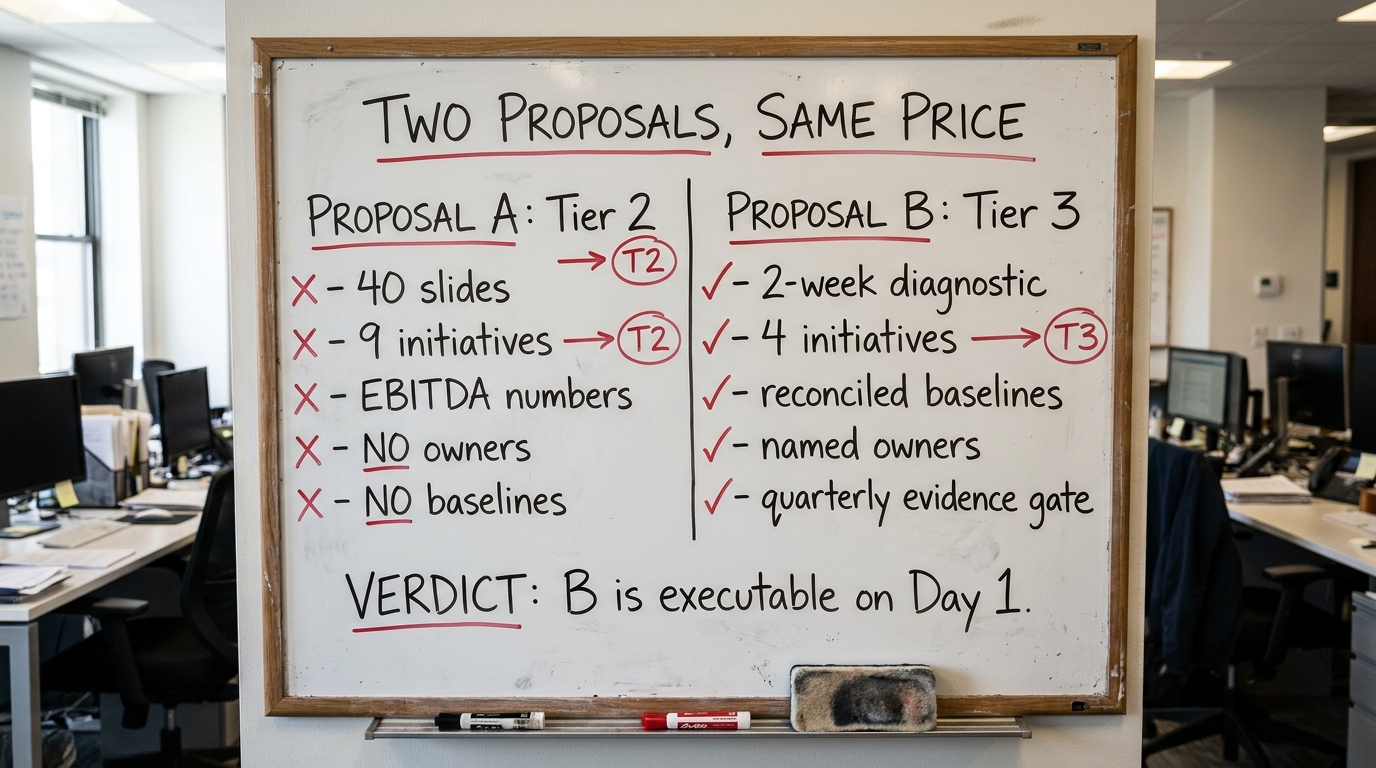
The following is an illustrative scenario, not a client account. A sponsor buys a mid-market B2B services company and the thesis rests on lifting sales productivity and cross-selling an underused service line. Two providers submit proposals at similar prices.
The first returns a 40-slide deck listing nine initiatives, each with an EBITDA number and a timeline, and no owners. That is a Tier 2 deliverable priced as if it were more. The second runs a two-week diagnostic, finds that the CRM cannot report pipeline by service line, sizes four initiatives against reconciled baselines, names an internal owner for each, and states what the company must track by quarter before the next tranche of enablement spend is released.
The second proposal costs slightly more and is worth several times the first, because it hands the operating partner something to run on Day 1. The constraint is whether anyone could execute the initiatives Monday morning, not how many of them appear in the deck.
9. Where the plan meets the first 100 days
A value creation plan that does not resolve into a sequenced first 100 days is an essay. The plan should end with a dated cadence: what gets decided in week two, what the first board meeting reviews, which initiatives have measurable evidence by quarter. The Harvard Law School Forum on Corporate Governance publishes useful material on post-close governance and board cadence, available through the Harvard Law School Forum on Corporate Governance, which is worth reading alongside the plan to pressure-test its reporting rhythm.
10. How this connects to broader digital value creation
The commercial plan is one workstream among several, and the buyer should understand how it fits with the digital and data initiatives that often carry the heaviest EBITDA assumptions. The broader decision of what to pay for sits in this companion piece on what to buy when you buy digital value creation services, which complements the commercial lens here.
11. A checklist before you sign
- The provider can name the decisions the plan has to inform, and can name the deliverables that serve them.
- The diagnostic is priced separately so you can judge the provider’s read before the larger commitment.
- Every initiative carries a reconciled baseline, a named owner and a defined piece of evidence by quarter.
- The commercial section names where the funnel breaks and sequences enablement after the data is fixed.
- Systems and integration dependencies are stated in the plan, and the plan accounts for them in the timeline and the workstream sequence.
- The plan resolves into a dated 100-day cadence the operating partner can run.
If a proposal clears all six, it belongs at Tier 3 or above and is worth its price. If it clears two, it is a deck, and the budget is better spent on a diagnostic from someone who can read the business first.
For the broader operating context this plan sits inside, including diligence and the post-close execution cadence, review how a sponsor-backed private equity value creation engagement is scoped, then route your diagnostic and 100-day plan through the DevriX private equity practice to put owners and baselines against the thesis before the first board meeting.