An operating partner weighing a fractional CMO is usually not short of marketing opinions. The company has a pipeline that missed plan two quarters running, a founder-era marketing hire who plateaued, and a value-creation plan that assumes revenue growth nobody has the capacity to deliver. The decision in front of you is narrow and expensive: do you install a part-time senior marketing leader, hire a full-timer, or buy an operating capability that runs without a single head attached to it. That choice sets your spend for the hold period and your reporting line into the board. This guide describes how to judge a fractional CMO against each option.
1. Name the problem before you name the headcount
The common error is to decide “we need a fractional CMO” before anyone has written down what the company cannot currently do. A fractional leader fixes a leadership gap. It does not fix a data gap, a RevOps gap, or an attribution gap, and buying a person to solve a systems problem wastes most of the retainer.
Separate three failure modes before you shortlist anyone. There is no marketing strategy that connects to the investment thesis. There is a strategy but no one senior enough to run it. Or there is a leader but the plumbing underneath (CRM governance, clean pipeline data, the right reports) is broken, so every plan dies on execution. The first two are leadership problems a fractional CMO can own. The third is an operating problem, and a senior part-time hire will spend six months discovering what a diagnostic would have told you in two weeks.
2. The unit-versus-person decision that actually sets your cost
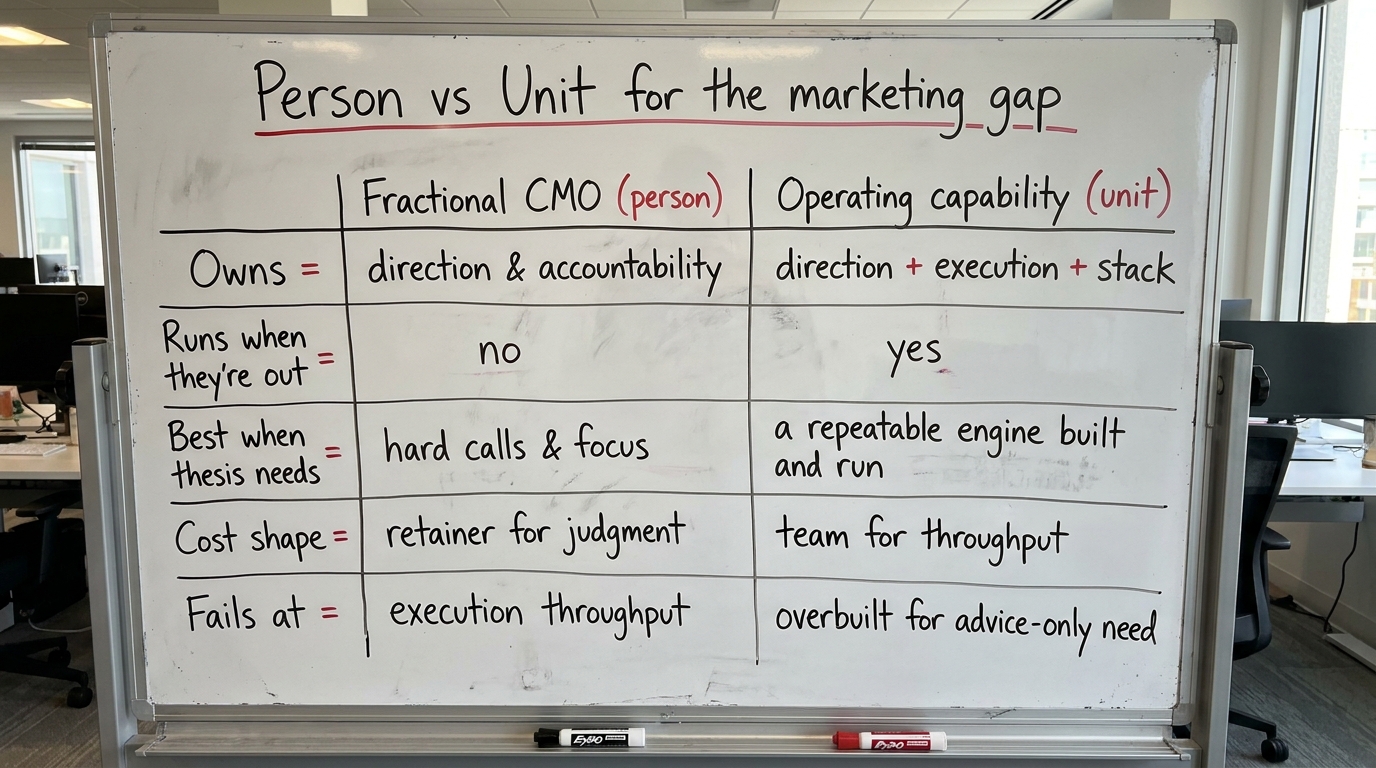
This is the kill-line for most portfolio companies, and it is worth slowing down on. A fractional CMO is a person: one calendar, one set of relationships, two or three days a month of senior attention, and a retainer that buys judgment rather than throughput. An operating capability is a unit: a standing team that owns the revenue engine, runs the stack, and keeps producing when any one person is on leave.
The question is which one your value-creation plan depends on. A thesis that needs a repeatable demand engine built and run across a hold period cannot execute on a single part-time executive because execution volume outpaces their capacity. A thesis that needs direction, hard calls on positioning, and someone who can hold the marketing function accountable does not need a full unit because you are paying for capacity the plan will not use.
Bain’s annual private equity report has documented for years how much of the return now has to come from operational improvement rather than multiple expansion, which raises the bar on whether a part-time leader can realistically carry a growth thesis. Read the current edition in Bain’s Global Private Equity Report before you assume a fractional hire closes the gap.
3. Tie the role to one line in the value-creation plan
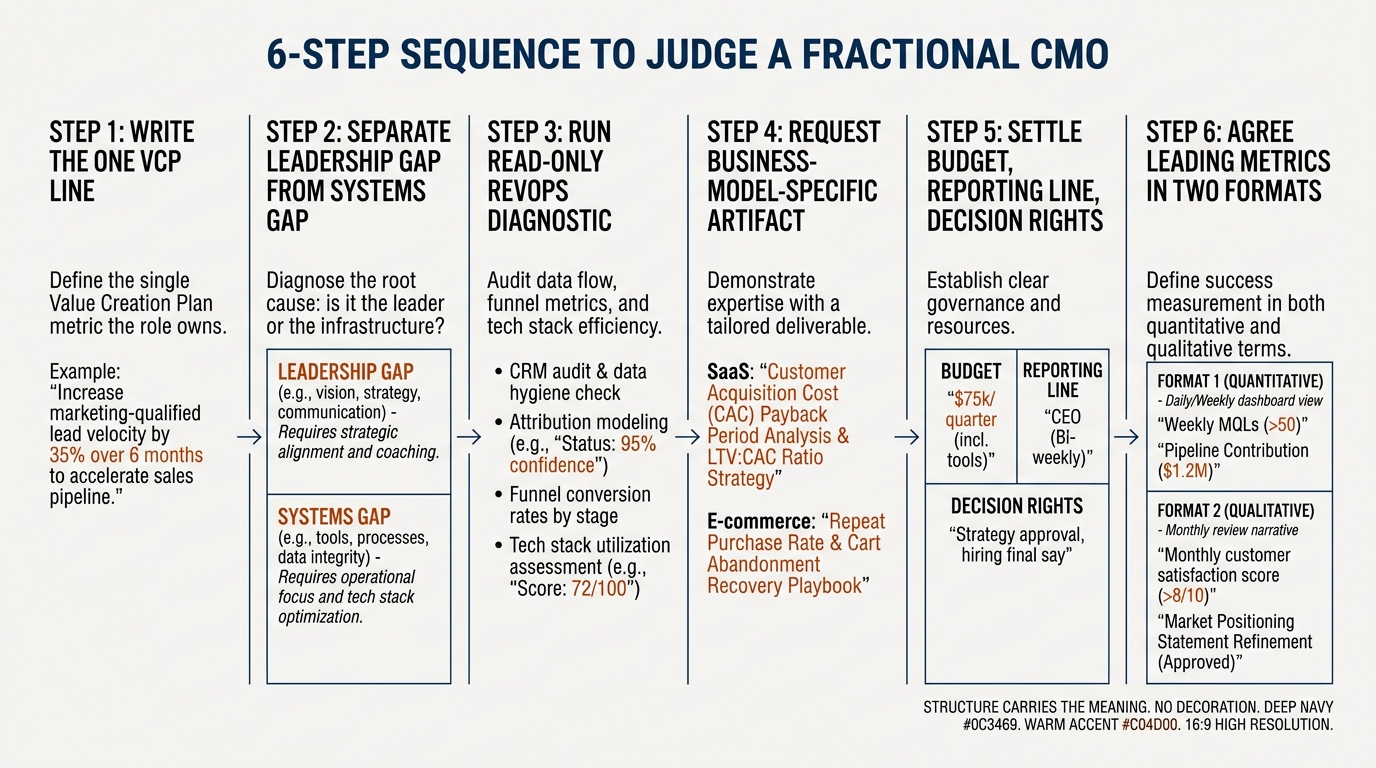
Before any interview, write the single sentence in the value-creation plan the fractional CMO is accountable for. “Grow qualified pipeline to support the FY27 revenue bridge” is a sentence you can judge against. “Modernize marketing” is not. If you cannot name the line, the problem is upstream of hiring, and you should fix the plan first.
The same discipline applies to the related questions buyers conflate with this one. Deciding whether to rent or hire a technology leader follows the same logic, and the reasoning in judging a virtual CTO before you sign the retainer transfers directly to the marketing seat.
4. Check the foundation before you buy the leadership
A fractional CMO inheriting broken RevOps will spend the first quarter unable to trust any number they report to the board. If the ERP, CRM and martech do not reconcile and the business runs on spreadsheets, the marketing leader is managing fiction.
Run a short, read-only diagnostic first. You want to know whether pipeline data is captured consistently, whether attribution reflects how deals actually close, and whether leadership and finance are looking at the same numbers in different formats. This is cheaper than a retainer and it tells you whether you are buying a leader or papering over a systems problem. The approach in judging data readiness for a portfolio company maps cleanly onto the revenue data a marketing leader will depend on.
5. What to test in the evaluation
A commercial buyer should not judge a fractional CMO on a conversation. Ask for a short, built artifact before you commit: a first-pass account or segment plan for the business model you are actually running. A distributor, a clinic group and a project-delivery firm do not share a go-to-market, and a candidate who arrives with a SaaS template they intend to retrofit has already told you the answer.
Ask for the first 90-day sequence in writing
Any serious candidate can describe what they would do in the first weeks: what they would stop, what they would measure, and what they would leave alone until the data is trustworthy. McKinsey’s research on value creation in private capital and BCG’s work with principal investors both point to the same pattern, that early wins come from focus and sequencing rather than breadth. You are judging the sequence they propose and whether they can explain it.
6. Settle the reporting line and the decision rights
A fractional CMO with no decision rights is an expensive advisor. Before the engagement starts, settle who owns the marketing budget, who the role reports to, and what the leader can decide without escalating. The most common friction is a founder-CEO who wants outside seniority but keeps every call. That arrangement burns the retainer and the relationship.
Write the decision rights into the engagement, the same way you would scope a technology leader. The judgment framework in hiring and judging a technology value creation consultant is built around exactly this: naming the owner, the decision right and the artifact, which keeps a part-time senior hire from becoming a committee of one with no authority.
7. Set the metrics the board will actually read
The fractional CMO should report in two formats on the same data: the numbers finance needs and the view the board reads. Pick leading indicators the role controls (qualified pipeline created, conversion by stage, cost to acquire against contribution) rather than vanity traffic. Classify each claim honestly as realized, run-rate or forecast, so a forecast number never reaches the board dressed as a result.
8. Know when a fractional CMO is the wrong instrument
Three situations argue against a part-time leader. When the thesis depends on standing up a demand engine and running it at volume, you need a unit with throughput, not a calendar with two days a month on it. When the real problem is RevOps hygiene, fix the foundation first and bring in leadership after. And when a platform acquisition will double the company inside the hold period, you are prescribing integration capacity, which is closer to the discipline in web platform modernization inside a value-creation plan than to a marketing retainer.
The honest version of this decision looks a lot like the one in judging value-creation plan services for a mid-market portfolio company: match the instrument to the line in the plan, and do not buy a person when the plan needs a system.
9. When this decision matters most
The timing triggers are specific. In confirmatory diligence, a weak marketing function shows up as pipeline risk against the revenue bridge, and the decision belongs in the value-creation plan before close, not after. In the first 100 days, the question is whether to install leadership fast or stabilize the data first. And ahead of an add-on, the marketing integration dependency usually surfaces late, which is why reading the revenue systems early, the way you would scope technology due diligence, keeps a hiring decision from becoming a Day 1 scramble.
Preqin’s alternative assets data and the deal coverage in PE Hub both show how much hold-period value now rests on commercial execution, which is reason enough to make this a diligence conversation rather than a post-close reaction. Preqin’s dataset sits at Preqin.
10. The decision checklist
- Write the one line in the value-creation plan the fractional CMO is accountable for. If you cannot, fix the plan first.
- Separate the leadership gap from the systems gap. A part-time leader does not fix broken RevOps.
- Decide unit versus person deliberately. Match it to whether the thesis needs direction or a running engine.
- Run a read-only diagnostic on pipeline data and attribution before you commit to a retainer.
- Require a built, business-model-specific artifact in the evaluation, not a generic pitch.
- Settle budget ownership, reporting line and decision rights in writing before the engagement starts.
- Agree leading metrics reported in two formats on the same data, with every claim labeled realized, run-rate or forecast.
- Re-check the choice against the hold-period triggers: diligence, first 100 days, and any planned add-on.
If the honest answer is that your thesis needs a running revenue engine rather than a part-time head, scope that against an operating capability built for private equity portfolio companies, and decide the unit-versus-person question with the plan in front of you rather than after the retainer is signed.