A portfolio company’s revenue plan slips two quarters, and the operating partner has to decide who owns the fix. The management team wants a senior marketing hire. The deal partner wants proof the pipeline model works before anyone signs a long contract. The question on the table is narrow and expensive: a fractional CMO vs embedded team for portfolio companies, and which one actually moves the number you underwrote in the value-creation plan.
This decision tends to arrive in the first 100 days, right after confirmatory diligence exposes a go-to-market function that was never built for the growth case. Pick wrong and you spend two quarters discovering it. This guide lays out how to frame the choice, what each option can and cannot deliver, and how to judge the work once it is running.
1. Why this decision shows up when it does
The trigger is almost always the same. The deal team underwrote a revenue ramp, diligence confirmed the demand was real, and then the first board pack showed the company has no reliable way to generate, qualify or report on pipeline. The CRM is a contact list. Attribution is last-touch or nonexistent. Nobody owns the number across marketing and sales.
Bain’s annual private equity report has tracked how much return now depends on operational improvement rather than multiple expansion, which puts commercial execution squarely in the operating partner’s lap. You can read the current edition on the Bain & Company Global Private Equity Report hub. The practical consequence is that a go-to-market gap is no longer a marketing problem. It is an enterprise-value problem with a clock on it.
2. What a fractional CMO actually buys you
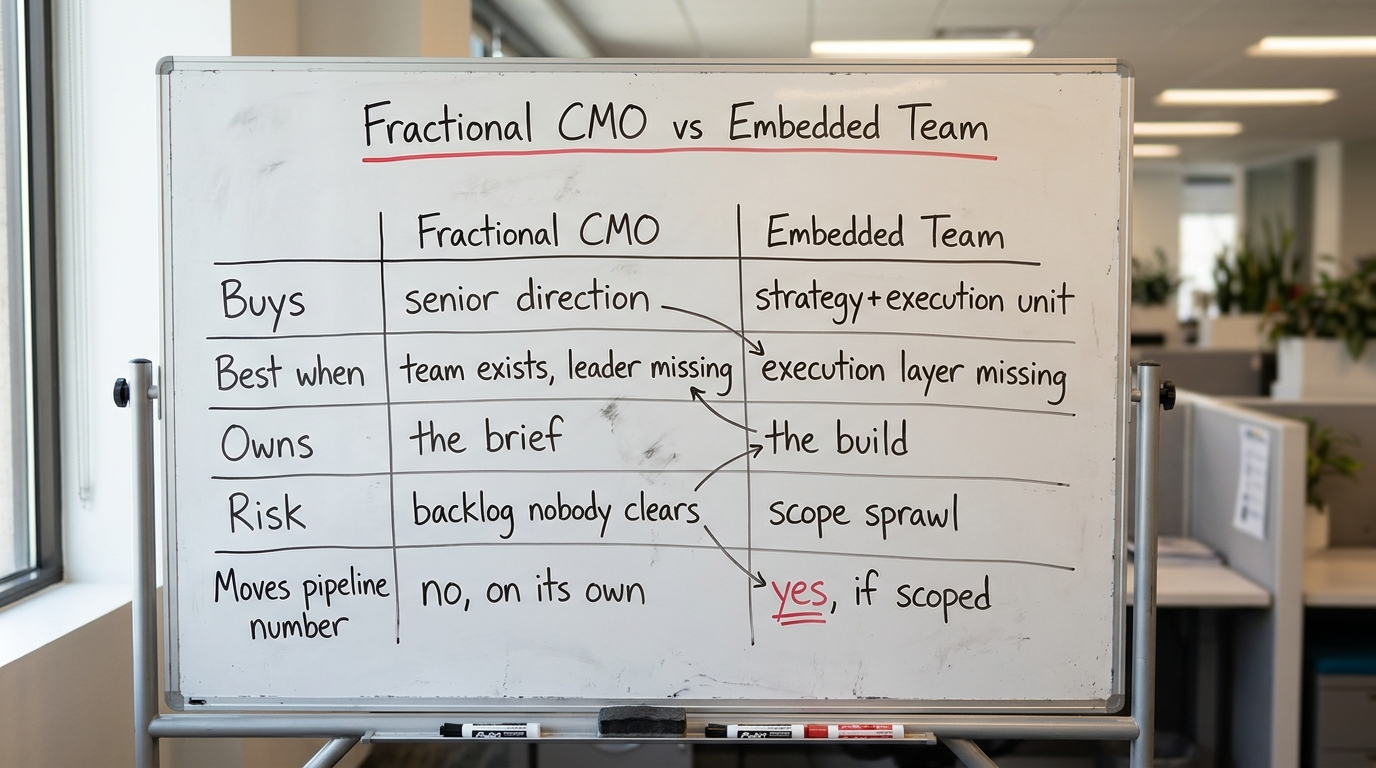
A fractional CMO is one senior person, part-time, carrying a title and a point of view. The value is strategic direction and credibility with the board: positioning, pricing input, channel priorities, and a plan the management team can rally behind. For a company that has a functioning marketing team but no senior leadership, this fills a real hole.
The limit is capacity. One person two or three days a week sets direction and reviews work. They do not build the CRM governance, wire the enrichment, fix the reporting, or stand up the account plans. If the execution layer underneath them is thin, a fractional CMO produces good decks and a backlog that nobody clears.
3. What an embedded team actually buys you
An embedded team is a unit, not a person: RevOps, demand generation, data and reporting, working inside the company’s systems with defined owners for each workstream. The value is that strategy and execution land together. The same group that recommends the attribution model also builds it, connects the sources, and ships the first dashboards.
For most mid-market portfolio companies, advice has nowhere to land because the data foundation and the operating cadence do not exist yet. A team closes that gap because it owns the build, not just the brief. The trade is cost and coordination: more people to manage and a clearer scope needed to avoid sprawl.
4. The kill-line between the two
Here is the test that settles most cases. If the company already has marketing execution capacity and lacks only senior judgment, a fractional CMO is the right call. If the company lacks the execution layer itself, the CRM is unreliable, nobody owns reporting, and the pipeline cannot be measured, then one more senior advisor will not move the number, and the embedded team is what the value-creation plan needs.
The failure mode worth naming: hiring a fractional CMO to compensate for a missing team. You get strategy with no hands, and two quarters later the pipeline still is not instrumented. The reverse failure, buying a team when the company only needed a leader, wastes budget but at least produces working systems.
5. Start by naming the need, not the role
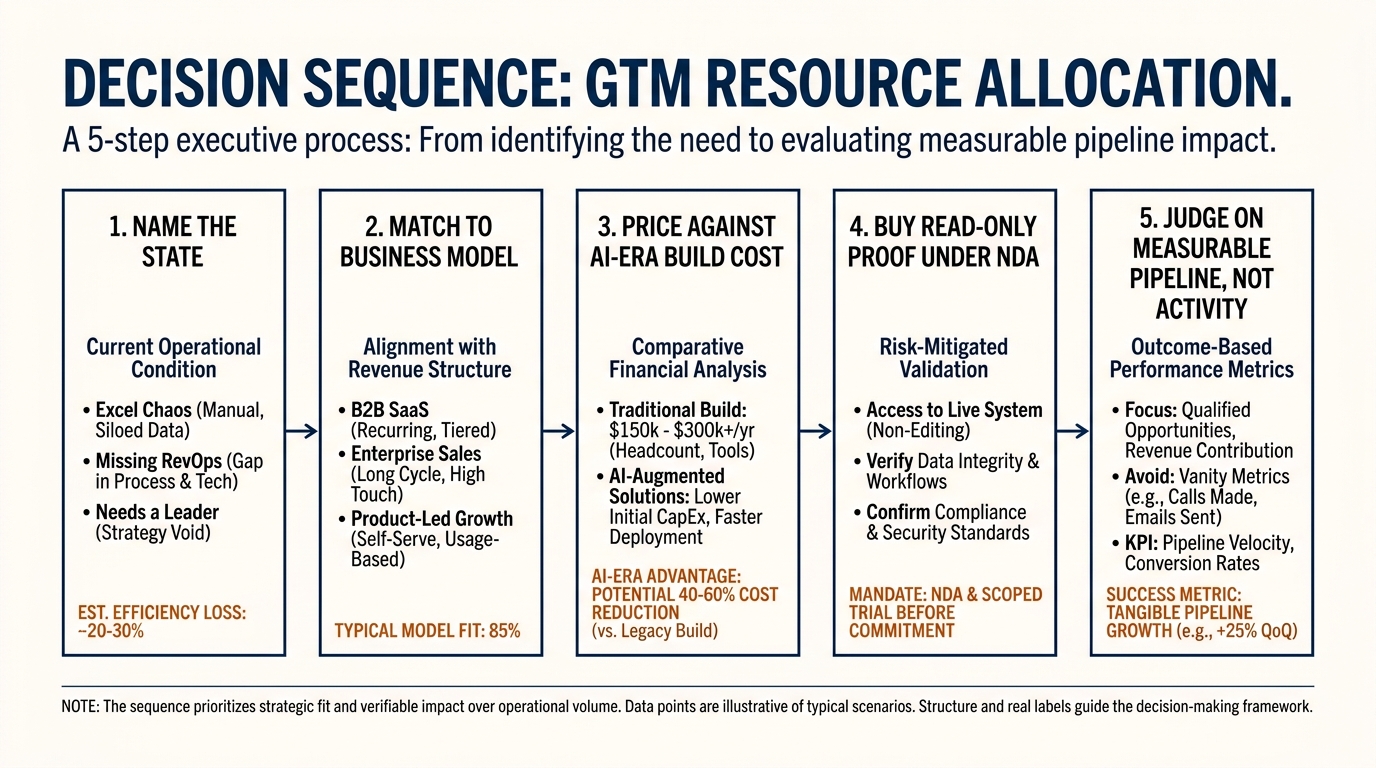
Before comparing vendors, write down which problem you are actually solving. Companies in this position usually sit in one of a few states: the numbers live in Excel because ERP, CRM and martech are disconnected; the RevOps basics are missing, with no CRM governance and the wrong reports; or the foundation works and the company simply needs someone senior to set direction.
The first two states call for an embedded build. The third calls for a fractional leader. Name the state before you name the role, because the role is a solution and you have not yet agreed on the problem. The same discipline applies when you judge a virtual CTO before signing the retainer: scope the gap first, pick the shape of the resource second.
6. Match the choice to the business model
Templates built for a SaaS company fail on a distributor, a project-delivery firm or a multi-site clinic group. A SaaS business might genuinely need campaign-driven demand generation, where a fractional CMO with a lean team is enough. A distributor that barely runs campaigns needs account mapping, CRM hygiene and sales-team reporting, which is embedded RevOps work, not CMO work.
Ask any candidate, person or unit, to describe the revenue engine for your specific model before the first working session. A partner who arrives with a generic SaaS playbook and needs constant correction is telling you how the engagement will go. The same business-model fluency you expect when you judge value-creation plan services applies here.
7. Price it against the AI-era build cost
Entry work in this category should cost tens of thousands and move in days. A read-only connection to the existing systems, a unified data model and the first dashboards can be stood up quickly when the vendor is not selling a long time-and-materials project. Benchmark every quote against that standard. A six-figure entry price with a multi-month runway is a signal to push back.
McKinsey’s private capital research, published on the McKinsey site, has documented how operational levers now carry more of the return than financial engineering, which is exactly why speed to a working baseline matters more than the size of the engagement.
8. Demand low-risk proof before the long contract
The right sequence protects the deal team. Start with read-only access under NDA and MSA, a cheap or free first pass that produces anonymised proof of what is broken and what the first wins are, then a staged plan. That gives the operating partner something they can sell internally to the board without committing to a leader or a team on faith.
This is the same prevention logic that applies to a first 100 days plan: fix the gap before the key hire lands or the new platform acquisition closes, rather than firefighting after the forecast misses. For the deeper build decisions that sit alongside this, what technology transformation for portfolio companies has to deliver covers the systems view.
9. Judge the work on leading indicators, not activity
Judge either option on whether pipeline became measurable, whether the CRM now holds clean, governed data, whether the right reports exist, and whether the management team can see its own numbers without rebuilding a spreadsheet each month. Hours logged, campaigns launched and decks delivered belong to the vendor register.
For finance, keep an Excel view on the same underlying data. For leadership and the board, deliver dashboards with insights flagged. If a fractional CMO or an embedded team cannot show that distinction working within the first quarter, the engagement is producing motion and not progress.
10. Where this connects to the rest of the value-creation plan
The go-to-market build does not sit alone. It depends on data readiness, which the operating partner should already be scoping as part of technology due diligence, and it feeds the exit story when the company eventually goes to market. A revenue engine with clean data and real attribution is worth more in a sale than a founder’s narrative, which is the argument behind data readiness for an exit portfolio company.
BCG’s work on principal investors, available on the BCG site, has documented commercial infrastructure driving value through the hold. The CMO-versus-team decision is one node in the plan that depends on how the other workstreams are resourced and sequenced.
11. A checklist before you sign
- Written statement of which state the company is in: disconnected data, missing RevOps foundation, or working foundation needing senior direction.
- Explicit choice: a senior leader because execution capacity exists, or an embedded unit because it does not.
- A business-model-specific description of the revenue engine from the candidate, produced before the first working session.
- An entry price benchmarked against days-not-months, tens of thousands not six figures.
- A read-only, NDA-covered first pass that produces anonymised proof and a staged plan.
- Defined owners for each workstream, and named leading indicators: measurable pipeline, CRM governance, correct reports, a finance Excel view and a board dashboard.
- A clear line to the broader plan, including the private equity value-creation thesis and the exit story.
Run that list and the choice usually makes itself. The companies that waste a quarter are the ones that pick a role before agreeing on the problem, then discover the mismatch when the next board pack reads the same as the last one.
If you are scoping this decision for a specific portfolio company and want the revenue-engine build sized and staged before you commit to a leader or a team, route the engagement through the DevriX private equity practice for a read-only first pass and a costed plan.