An operating partner inheriting a portfolio company with a cloud modernization line item on the value-creation plan faces a specific problem: the CTO wants a nine-figure re-platform, the sponsor wants EBITDA in eighteen months, and the two are not obviously connected. Deciding cloud modernization in a private equity portfolio is not a technical vote. It is a capital-allocation decision made under a hold-period clock, and the person standing up sales and revenue operations inside the asset usually feels the consequences first, in the form of a CRM that will not scale, a data warehouse nobody trusts, and a forecast that breaks every quarter close.
This guide is written for the buyer with budget who has to judge that spend, sequence it, and defend it to the deal team. It does not define IaaS or explain what a container is. It answers a narrower question: what does the modernization actually buy, when does it matter, and how does an operator tell real enterprise value from an engineering wish list.
1. Frame the problem as enterprise value, not architecture
A sponsor is not buying cloud. It is buying measurable improvement to the thing it will sell at exit: revenue growth, EBITDA expansion, cleaner cash flow, faster add-on integration, lower operating risk, and better management visibility. Every modernization proposal should be forced through that filter before a dollar is committed.
The failure mode is well documented. Bain’s annual Global Private Equity Report has tracked how value creation has shifted away from financial engineering toward operational improvement, which means technology spend now has to earn its place against the same return math as any other lever. McKinsey’s private capital research makes a similar point: the assets that outperform tend to treat digital and cloud as a route to margin and speed, not as an IT refresh.
2. Separate the three things people call “cloud modernization”
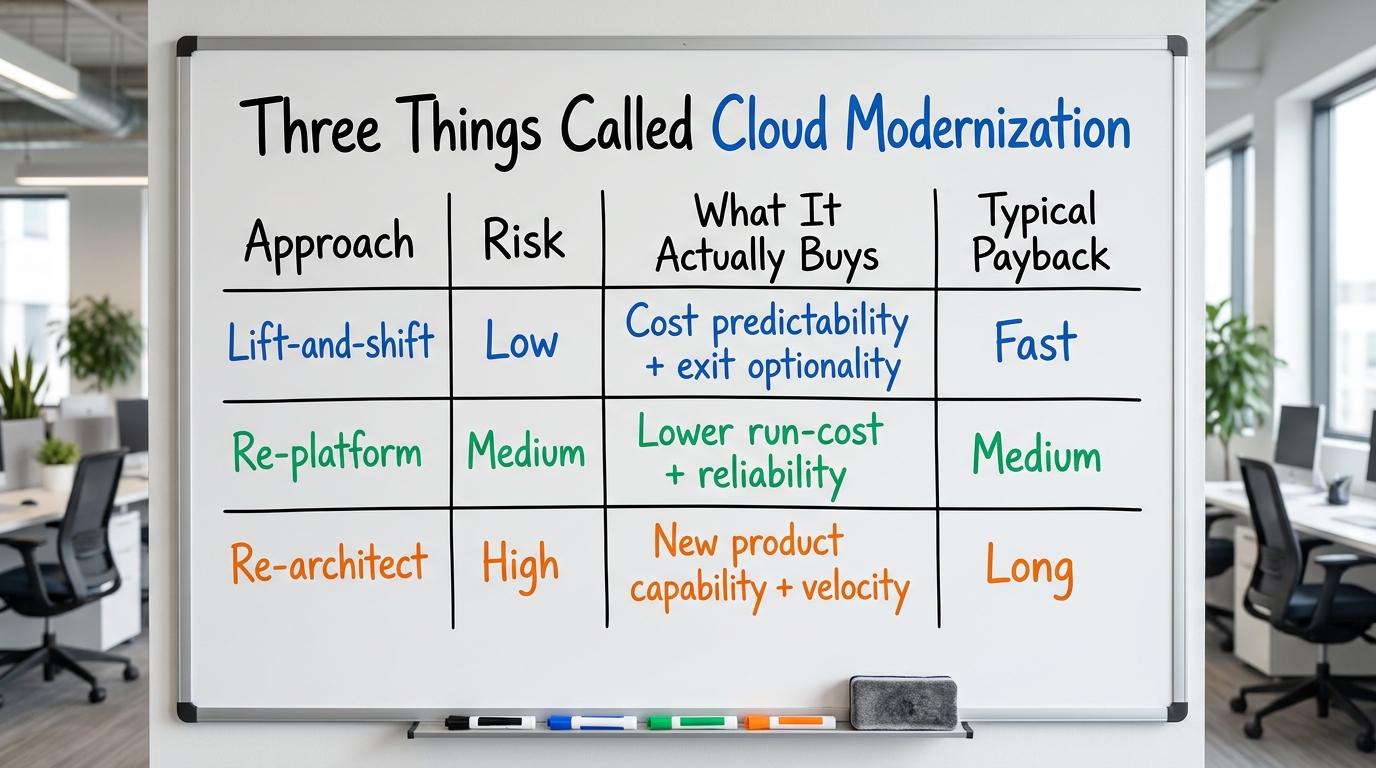
The phrase hides at least three different projects with different risk profiles and different payback. An operating partner should never approve “cloud modernization” as a single line.
- Lift-and-shift. Move existing workloads to a cloud provider with minimal change. Fast, lower risk, and it mostly buys cost predictability and exit optionality, not growth.
- Re-platform. Adopt managed services (databases, queues, identity) to cut operating toil and improve reliability. Medium risk, real reduction in run-cost and downtime.
- Re-architect. Rebuild the application to unlock new capability, multi-tenancy, or product velocity. Highest risk, longest payback, and the one most likely to consume the hold period without a visible return.
Most value-creation theses need the first two and can defer the third. When a CTO leads with re-architecture, the operator’s job is to ask which revenue or EBITDA claim depends on it and by when.
3. Tie each workstream to a value lever the deal team recognizes
Before approving spend, require the sponsor and management to name which lever each workstream serves. A useful discipline is to classify the impact so forecast value never reads as realized value.
Cost and margin
Cloud consolidation and right-sizing produce run-rate savings you can point to on the P&L. These are the easiest wins to defend because they show up in operating expense within a quarter or two.
Revenue enablement
A modernized data layer that lets sales operations trust the pipeline number, run clean territory and quota models, and stop reconciling spreadsheets is an enabler of revenue, not a realization of it. Label it that way. The realized number comes when the sales motion actually improves, which is why this work belongs next to your revenue operations plan, not buried in an infrastructure budget.
Integration speed
For a buy-and-build thesis, the cloud posture that lets you onboard an acquisition’s systems in weeks instead of quarters is often the single highest-value modernization outcome. BCG’s work on principal investors and private equity has repeatedly emphasized integration speed as a driver of deal-model returns.
4. Run cloud diligence before you write the plan
If the asset is pre-close or in confirmatory diligence, the modernization plan should be an output of the technology due diligence workstream, not a separate exercise invented in month four. The diligence should establish a baseline: current cloud spend, contract lock-in, reliability history, security posture, and the honest state of the data estate. Without that baseline you cannot judge whether the proposed spend is a fix or a rebuild.
This is the same evaluation discipline that applies when you compare specialist providers. The way an operator judges a modernization partner mirrors how they would judge any embedded technology firm, a subject covered in this site’s look at how an operating partner judges the fit of a West Monroe alternative.
5. Sequence the work against the hold-period clock
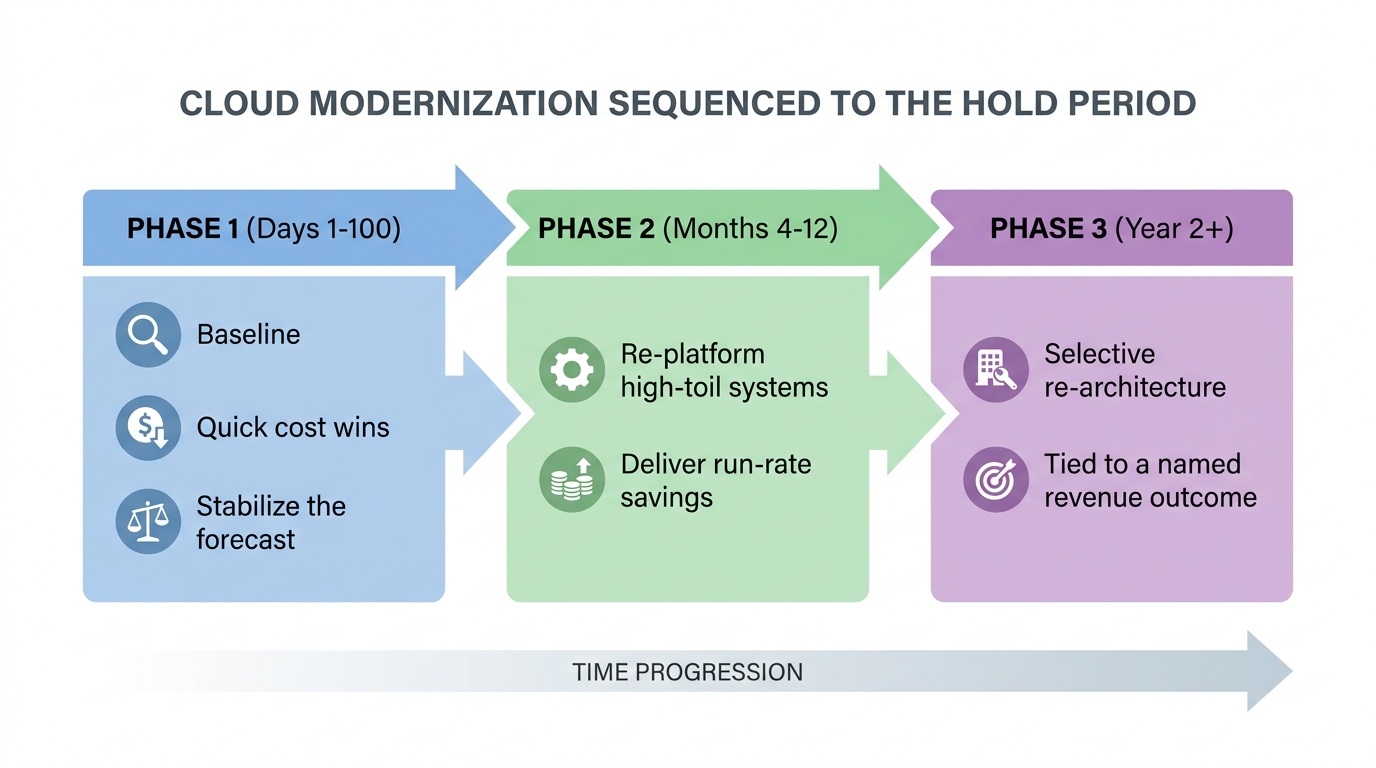
A three-to-five year hold cannot absorb a modernization program that only pays off in year six. Sequence for evidence early.
- Days 1 to 100. Baseline, quick cost wins, and stabilize whatever is actively breaking the forecast. Fold this into the first 100 days plan rather than treating it as a standalone IT project.
- Months 4 to 12. Re-platform the highest-toil, highest-risk systems. Deliver the run-rate savings and reliability the deal model assumed.
- Year 2 and beyond. Selective re-architecture only where a named revenue or product outcome justifies it, and only if the earlier phases proved the team can deliver.
Getting the sequence wrong is the classic reason post-merger synergies never appear on the board deck. The mechanics of that failure are worth reading in detail in this site’s breakdown of why RevOps integration and post-merger synergies fail.
6. Decide who owns the decision and who owns delivery
Modernization stalls when decision rights are unclear. Name an owner for each: the operating partner owns whether the spend is approved against the thesis, the portfolio CTO or CFO owns the delivery plan and the actual-versus-plan tracking, and any external partner owns the workstreams assigned to them with dependencies made explicit on the risk register.
The build-versus-buy question here is the same one operators face across the portfolio. This site’s guidance on when to outsource sales operations in a PE-backed company applies almost directly: outsource capacity you cannot build fast enough, but never outsource the decision right.
7. Buy outcomes, not activity
The fastest way to waste modernization budget is to pay a vendor for tickets, story points, and migrated servers with no line back to a financial result. Hours are the register of a firm that is managing its own utilization, not your enterprise value.
The same trap appears when hiring advisory help, which is why this site’s guide on how to hire a sales operations consultant without buying activity is worth reading before signing any statement of work. Structure the engagement around a baseline, a target, and a method for proving movement. If the partner cannot state what “done” looks like in P&L terms, that is the answer.
8. Do not skip the risk register the deal team will ask about
Cloud modernization introduces real operating risk during the transition: data migration failures, security exposure, and downtime that hits the very revenue the plan was meant to protect. Regulatory and control expectations belong in the register too. Guidance from bodies such as the AICPA and CIMA on controls and the SEC’s disclosure expectations around cybersecurity are the kind of considerations a CFO will want reflected before Day 1, not discovered after an incident.
Accessibility and compliance obligations often ride along with any platform rebuild. Operators underestimate how quickly these become gating items, a point this site covers in its piece on accessibility compliance engineering in a portfolio company.
9. Measure it the way the board will
Set the reporting up so the first board meeting after approval can see actual versus plan on the metrics that matter: run-rate cost reduction, reliability, integration cycle time for add-ons, and the forecast accuracy your sales operations team can now defend. Pipeline data and provider research from sources such as PitchBook and S&P Global Market Intelligence can help benchmark the pace of value creation, but the number that matters is the one on your own P&L against the plan you committed.
10. The decision checklist
Before approving any cloud modernization spend in a portfolio company, an operating partner should be able to answer yes to each of these:
- Every workstream names a value lever: cost, revenue enablement, integration speed, or risk reduction.
- The impact of each is classified as realized, run-rate, forecast, enabled, or risk avoided, with no forecast dressed up as realized.
- The plan came out of technology diligence with a documented baseline, not from an internal wish list.
- The sequence delivers visible evidence inside the first year and defers re-architecture until it is justified.
- Decision rights and delivery ownership are named, and dependencies sit on the risk register.
- Any external partner is paid against outcomes and a baseline, not hours and tickets.
- The board reporting shows actual versus plan on cost, reliability, integration speed, and forecast accuracy.
Cloud modernization is worth doing in most portfolio companies. It is worth doing badly in almost none. The discipline is the same one that governs every good value-creation decision: connect the spend to the number the asset will be sold on, sequence it against the clock, and refuse to pay for activity.
For operators scoping a modernization program as part of a broader private equity value-creation plan, route the engagement through the DevriX and GrowthShuttle PE offer to structure the work around measurable enterprise value rather than migrated servers: see the DevriX private equity practice.