The revenue forecast in the model assumes a functioning sales operation. The company you just bought often does not have one. It has a founder who closed deals from memory, a CRM used as a contact list, and pipeline numbers that no one can reconcile to booked revenue. If you are an operating partner or a portfolio executive standing up sales and revenue operations, the question is rarely whether the work needs doing. It is whether you build the capability internally, hire a leader and staff around them, or buy it. Sales operations outsourcing private equity buyers keep circling back to because it moves faster than a hire and costs less than a wrong one. This guide covers what you actually need to decide and how to judge the answer.
The decision matters most at three moments: confirmatory diligence, when RevOps gaps become a value-creation line item; the first 100 days, when you need reporting you can trust before the first board meeting; and any add-on, when two sales motions have to reconcile onto one system fast.
1. Name the problem before you name the solution
Outsourcing is a delivery model, not a diagnosis. Before scoping a vendor, an operating partner needs a baseline of what is actually broken. In most lower-mid-market portfolio companies, the failure is not effort. Reps are working. The failure is that the commercial engine produces no reliable evidence.
Three symptoms recur:
- No trustworthy pipeline. Forecast accuracy swings 30 points month to month and nobody can explain why.
- No defined process. Stages mean different things to different reps, so conversion math is fiction.
- No systems discipline. The CRM, the marketing tool, and the finance system disagree about the same customer.
Each of these ties directly to enterprise value. Unreliable forecasts undermine covenant planning and board credibility. Broken process caps sales productivity, which caps revenue growth. Disconnected systems raise integration cost and slow every future add-on. Bain’s annual global private equity report has repeatedly documented how revenue and margin expansion, not multiple arbitrage, now drive returns, which is exactly what a working sales operation protects. See the Bain & Company Global Private Equity Report for the trend.
2. Decide what you are actually buying
A PE-backed buyer is not purchasing “sales ops hours.” It is purchasing measurable improvement: a forecast the CFO can defend, a shorter ramp for new reps, cleaner data that survives due diligence, and a repeatable motion that scales across add-ons. Write the decision in those terms and the build-versus-buy math gets clearer.
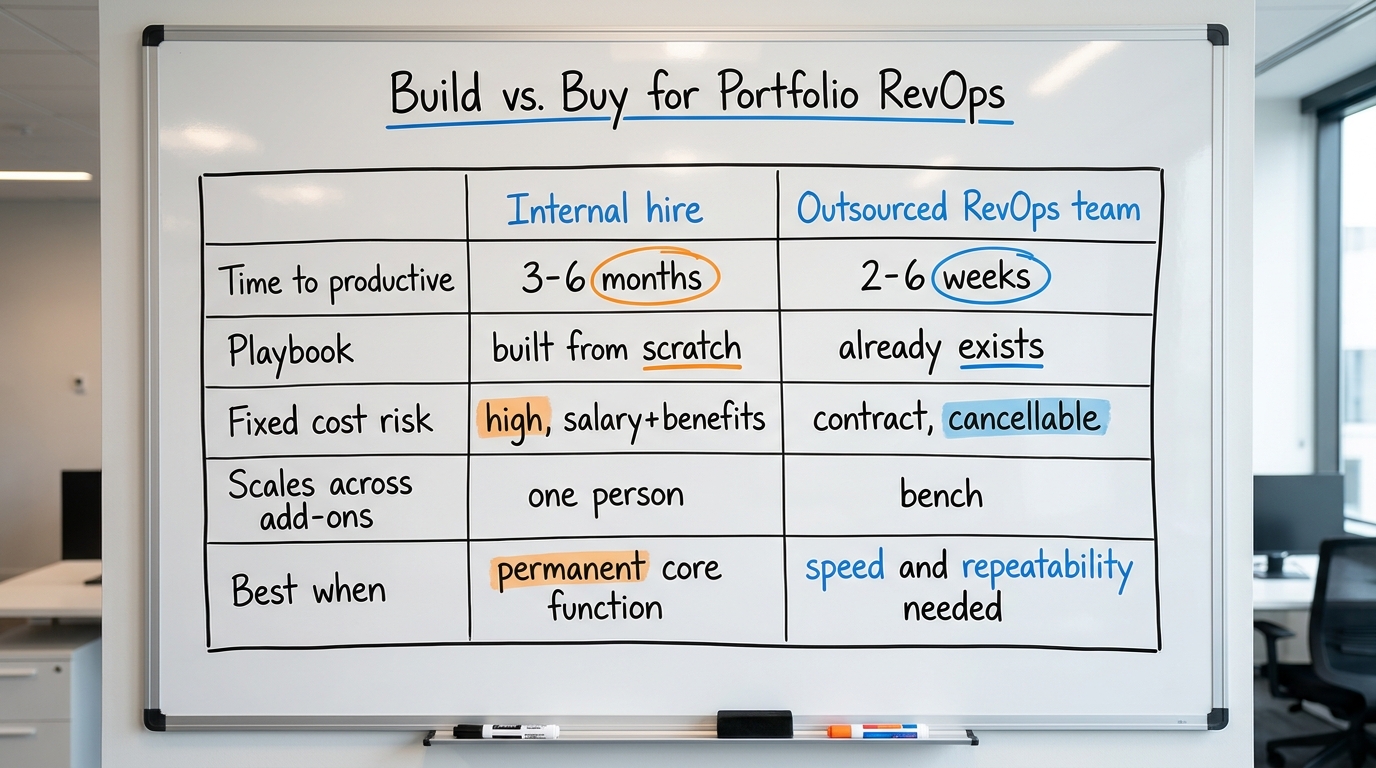
Ask what outcome must exist by a specific date. “Board-ready pipeline reporting by the first quarterly meeting” is a decision. “Improve RevOps” is a wish. The dated outcome tells you whether an internal hire (slow to source, slower to ramp) can hit it, or whether an external team already carrying the playbook is the faster path.
3. Separate the work that must stay inside
Not everything should leave the building. Keep the decision rights and the customer relationships inside. Outsource the systems, the reporting infrastructure, the process design, and the recurring operational execution.
Keep inside
- Sales leadership and quota ownership.
- Deal-level judgment and pricing authority.
- The customer relationship itself.
Safe to outsource
- CRM administration, hygiene, and integration.
- Pipeline reporting, dashboards, and forecast modeling.
- Sales process design, stage definitions, and playbook build.
- Lead routing, territory logic, and comp-plan mechanics.
The line is simple. Judgment stays; execution and infrastructure can move. If a vendor pitch wants to own your pipeline decisions, that is a governance flag, not a convenience.
4. Time the decision to a real trigger
The strongest reason to outsource is that a build cannot hit the date. Tie the choice to an event, not a calendar quarter.
- At confirmatory diligence: when a technology due diligence review surfaces a commercial data mess, an external team can quantify and remediate it faster than a not-yet-hired leader.
- In the first 100 days: when the board expects a defensible number and there is no analyst to produce it.
- At an add-on: when two CRMs, two sales processes, and two comp plans must reconcile. Post-merger integration is where RevOps most often quietly fails, a pattern worth studying in why post-merger synergies fail.
5. Judge the vendor on evidence, not activity
Most sales ops vendors sell activity: tickets closed, dashboards shipped, hours logged. Activity is the wrong scorecard. Judge on outcomes tied to enterprise value.
Force the conversation onto four questions:
- What baseline do you measure against? A vendor who will not establish a starting number cannot prove improvement.
- What decision does your output inform? Reporting that no one uses to make a call is cost, not value.
- Who owns each workstream? Ambiguous ownership between the vendor and the internal team is where delivery stalls.
- How does this survive your exit? Documented process and clean systems, not vendor dependency.
McKinsey’s research on private capital and value creation is a useful external anchor for how operating improvement, not financial engineering, carries the return; see McKinsey’s private capital research. BCG’s work on principal investors makes the same case from the operating-partner seat at BCG.
6. Set the reporting spine first
Before any optimization, insist the engagement establish a reporting spine: one agreed definition of pipeline, one forecast method, one source of truth. This is the deliverable that makes the first board meeting survivable and every subsequent one comparable.
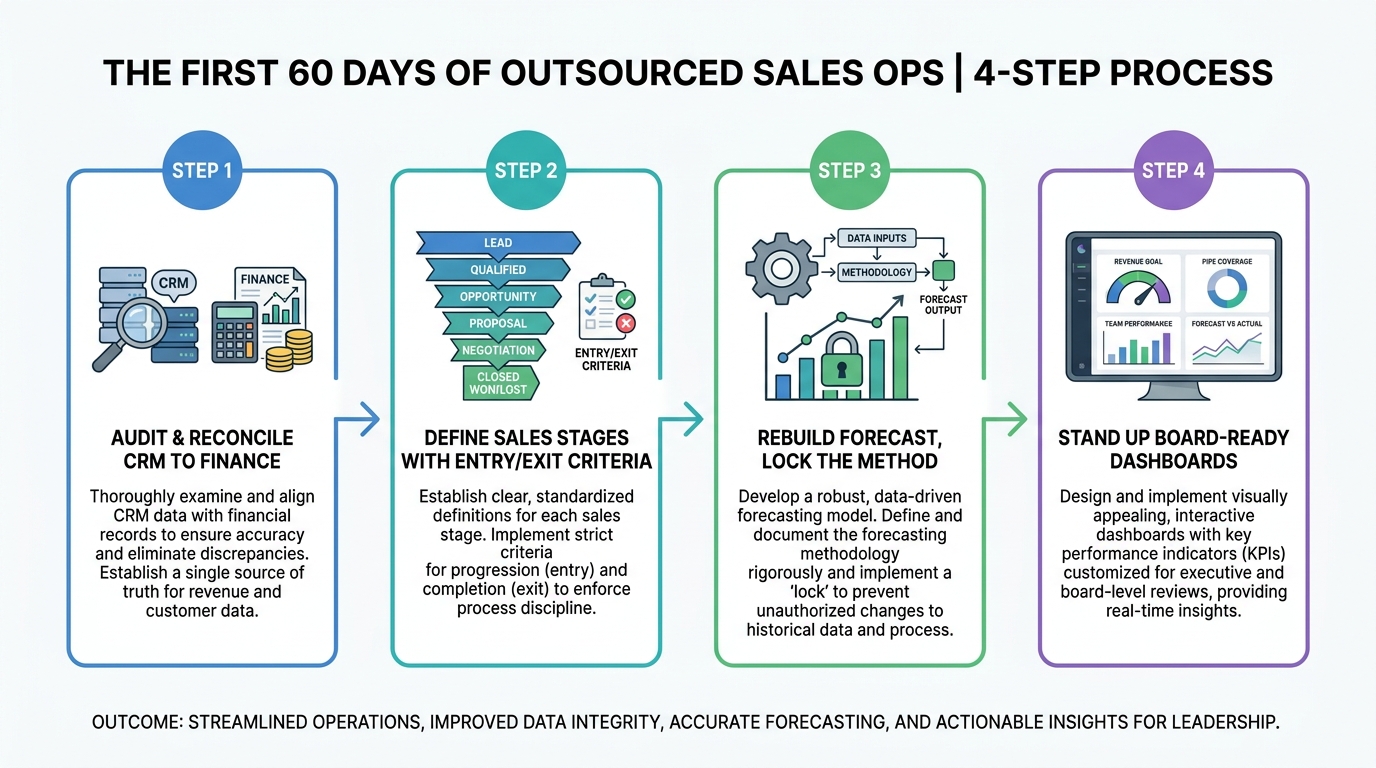
A practical sequence for the first 60 days:
- Audit the CRM and reconcile it to booked revenue in finance.
- Define sales stages with entry and exit criteria everyone signs off on.
- Rebuild the forecast on those definitions and lock the method.
- Stand up dashboards the CFO and the board actually reference.
Get this right and the number stops being a debate. That alone often justifies the engagement.
7. Price it against the wrong-hire cost
The honest comparison is not vendor fee versus zero. It is vendor fee versus the fully loaded cost of a sales ops hire who takes three to six months to ramp and may not fit. An outsourced team carrying an existing playbook compresses time to value and stays cancellable if the fit is wrong. For a permanent, strategic core function you plan to keep through exit, an eventual internal hire may be right. For speed, for a defined window, or for a capability you need repeatable across a platform of add-ons, buying it usually wins on both cost and risk.
8. Do not skip the adoption problem
The most common reason outsourced sales ops fails has nothing to do with the vendor’s technical work. It is that reps do not use the new system, so the data stays dirty and the forecast stays fiction. Systems change is a behavior-change problem. Budget for enablement alongside the build.
Adoption is not a memo. The research on the science of motivation in employee training applies directly to CRM adoption, and teams that are part remote need the deliberate approach covered in adapting training for a remote workforce. A vendor engagement that ships tooling but ignores adoption has bought you a dashboard nobody trusts.
9. Build the risk register into the contract
Treat the engagement like any other value-creation workstream. Name the risks and assign owners.
- Data quality risk: who signs off that the migrated data is clean?
- Dependency risk: is process documented so you are not hostage to the vendor at exit?
- Continuity risk: what happens to the reporting spine if the contract ends mid-integration?
- Governance risk: are decision rights on pricing and forecasting explicitly retained inside?
PitchBook and S&P Global both track how operational data quality affects deal outcomes and diligence; their research hubs are worth monitoring at PitchBook and S&P Global Market Intelligence.
10. The decision checklist
Before signing anything, an operating partner or portfolio executive should be able to answer yes to each of these:
- The problem is named as a baseline number, not a vague “improve sales ops.”
- The outcome is dated and tied to a real trigger (board meeting, add-on, diligence remediation).
- Decision rights and customer relationships stay inside; only infrastructure and execution move out.
- The vendor commits to a baseline and to outcomes tied to forecast reliability and revenue, not hours.
- A reporting spine, one pipeline definition and one forecast method, is the first deliverable.
- Enablement and CRM adoption are budgeted, not assumed.
- A risk register with named owners is written into the contract.
- Process documentation ensures the capability survives your exit.
If you cannot answer yes, the engagement is not ready to sign, and neither is the internal build.
11. Where this connects to the broader thesis
Clean sales operations is not a back-office nicety. It is the machinery that produces the revenue growth in the model, the forecast reliability the board needs, and the data integrity that survives the next diligence. Getting it right early compounds across the hold. Getting it wrong, or leaving it to a founder’s memory, quietly caps the multiple at exit. The Harvard Law School Forum on Corporate Governance regularly publishes on operating discipline in sponsor-backed companies at its forum.
DevriX and GrowthShuttle run this work as a defined RevOps engagement for private equity portfolio companies: baseline the commercial engine, build the reporting spine, and hand back a repeatable motion your team owns. To scope a RevOps sprint against a specific portfolio company and a specific board deadline, review the DevriX private equity RevOps offer and bring the checklist above to the first working session.