A demand letter lands, or a customer’s procurement team flags the portfolio company’s web application as non-conformant, and suddenly accessibility is on the board agenda. The operating partner is not being asked to admire the standard. They are being asked a commercial question with a deadline: how much exposure sits under this, what does remediation cost, who owns it, and does it slow the integration or the next enterprise deal. Accessibility compliance engineering in a portfolio company is a value-creation and risk decision, not a design preference. This guide is written for the executive or operating partner standing up that decision inside a portfolio asset, and for the sales-operations leader who inherits the enterprise deals it unblocks or stalls.
1. Why accessibility surfaces as a portfolio-level problem
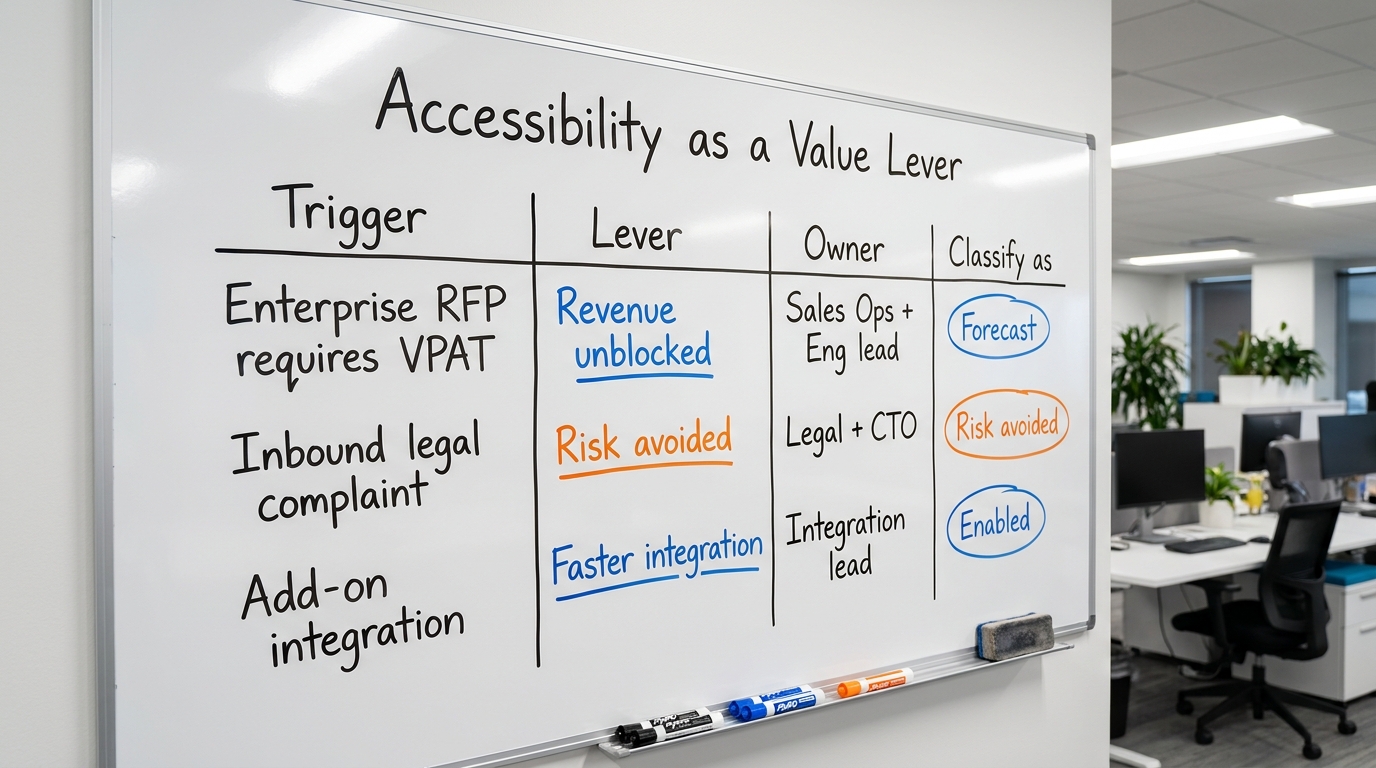
Accessibility stops being a developer’s backlog ticket the moment it touches revenue or risk. Three triggers usually put it in front of the deal team: an inbound legal complaint, an enterprise or public-sector RFP that requires a conformance statement, or confirmatory diligence on a company that sells into regulated buyers. Any one of these converts an engineering hygiene item into a number that affects the model.
The commercial consequence is concrete. Enterprise procurement increasingly requires a VPAT or accessibility conformance report before signing. Government and education buyers require it as a gate. If the portfolio company cannot produce one, deals slip or die, and that shows up in a forecast the CFO has to defend at the next board meeting.
2. Frame it as enterprise value, not as compliance for its own sake
An operating partner should refuse the framing of “get us compliant” and insist on the framing of “what does this protect or unlock.” Accessibility engineering does three commercial things: it removes a sales blocker on enterprise and public-sector deals, it reduces litigation and reputational risk, and it lowers the friction of the next integration if the acquirer inherits the same standard. Each maps to a lever the fund already tracks, revenue growth, risk avoided, and faster integration.
Bain’s annual private equity report has documented how value creation increasingly depends on operational and commercial improvement rather than multiple expansion, and accessibility sits squarely in the operational bucket when it is gating deals.
3. Establish the baseline before anyone scopes work
No remediation should be scoped without an audited baseline. The operating partner needs evidence, not a vendor’s assurance that “we follow WCAG.” A defensible baseline has three parts: an automated scan across the main revenue-generating surfaces, a manual audit of the highest-traffic and highest-value user flows (checkout, onboarding, the core application), and an inventory of every product surface that carries a conformance obligation.
What the baseline document must contain
- The specific conformance target the buyers actually demand (usually WCAG 2.1 or 2.2 Level AA).
- A ranked list of issues by user flow and by revenue exposure, not by technical severity alone.
- An honest read on whether the issues are surface fixes or architectural, because that changes cost by an order of magnitude.
If the asset is still in technology due diligence, this baseline belongs in the diligence findings and the risk register, not in a post-close surprise.
4. Separate the true fix from the overlay trap
Every portfolio company facing this will be pitched an accessibility overlay, a JavaScript widget that promises instant compliance. Operating partners should treat that pitch with suspicion. Overlays have generated their own litigation and have been publicly rejected by accessibility practitioners as insufficient. Buying one to check a box tends to increase exposure, not reduce it, because it creates a paper claim the engineering does not support.
The real work is engineering: semantic markup, keyboard operability, focus management, color and contrast, and accessible components in the design system. This is why the decision is an engineering decision, not a plugin purchase.
5. Decide the owner and the decision rights
Accessibility fails when no one owns it. The operating partner has to assign a single accountable owner, usually the CTO or head of engineering, with a named counterpart in sales operations who owns the deal-facing artifacts (the conformance report, the RFP responses). Ambiguity here is the same failure pattern that sinks post-merger work generally, which our breakdown of why post-merger RevOps synergies fail traces back to unassigned ownership and no decision rights.
The decision the operating partner actually holds is narrow and important: fund a remediation program with a hard scope and a deadline tied to a real commercial trigger, or accept a documented residual risk and move on. Both are defensible. Drift is not.
6. Choose build, hire, or embed
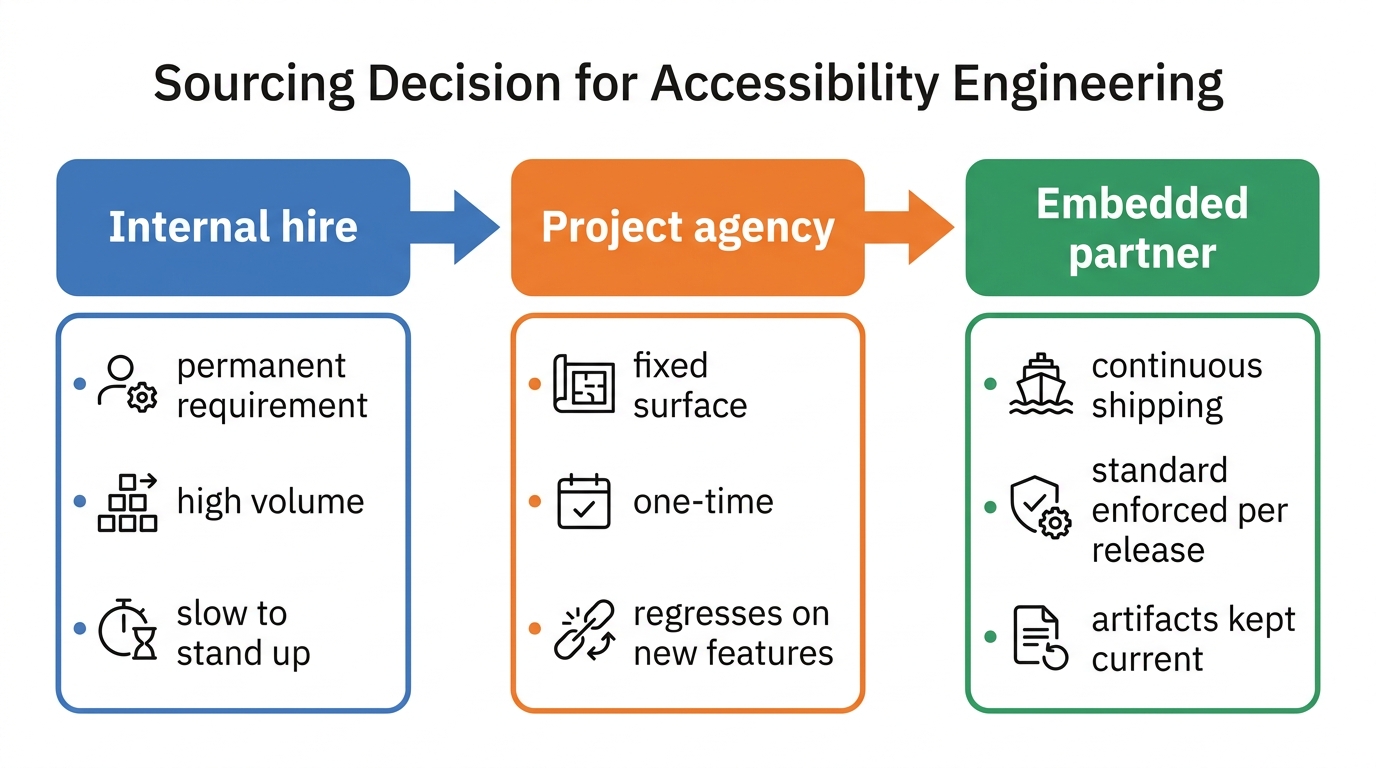
Once scope is clear, the sourcing question follows. A portfolio company rarely has idle senior front-end engineers who also know accessibility deeply, so the honest options are a dedicated internal hire, a project-based agency engagement, or an embedded engineering partner that carries the standard across the roadmap.
How to judge the three routes
- Internal hire: right when accessibility is a permanent product requirement and volume justifies a full-time salary. Slow to stand up.
- Project agency: right for a one-time remediation with a fixed surface. Weak when new features keep regressing the standard.
- Embedded partner: right when the company ships continuously and needs the standard enforced in every release, plus the conformance artifacts kept current. This is where an embedded retainer earns its keep.
The same discipline that governs any outside engagement applies here. The guidance in how to hire a consultant without buying activity transfers directly: buy an outcome and an artifact, not a stream of hours.
7. Tie the plan to the value-creation calendar
Accessibility work has to land against real dates. In the first 100 days, the priority is a baseline, an owner, and a decision on funding. It is rarely the moment to remediate everything. Sequence the fixes against the flows that gate revenue first, the checkout and the enterprise-facing surfaces, then work down the ranked list.
McKinsey’s private capital research has repeatedly emphasized that the operational improvements that survive are the ones tied to specific milestones and owners rather than broad mandates. Accessibility is no different. A dated program against ranked flows is far more likely to close than a standing “improve accessibility” objective.
8. Instrument it so the board can see progress
The CFO and the deal partner do not want a bug count. They want to know whether the sales blocker is clearing and whether the risk is shrinking. Report accessibility in terms they act on: number of enterprise deals gated on a conformance report and their pipeline value, percentage of revenue-generating surfaces at target conformance, and a current, defensible conformance statement the sales team can attach to an RFP.
That reporting discipline is what lets sales operations forecast honestly. When the artifact exists, gated deals move to the reliable column. When it does not, they stay flagged, and the forecast reflects reality instead of hope. Deciding whether to run this internally or outside is the same calculus covered in when to outsource sales operations and how to judge it.
9. Keep it from regressing after the fix
Accessibility is not a one-time remediation, it is a standard that erodes with every unreviewed release. The durable version bakes it into the design system and the definition of done, adds automated checks to the build pipeline, and keeps the conformance report current. Enablement matters here too: the engineers and product managers shipping features need the standard to be a habit, which is where broader thinking about inclusive and accessible practices becomes practical rather than aspirational.
10. The decision checklist
- Trigger identified: legal complaint, RFP requirement, or diligence finding, with a dollar figure attached.
- Baseline commissioned: automated scan plus manual audit of the highest-value flows, ranked by revenue exposure.
- Overlay rejected: no widget purchased in place of real engineering.
- Owner named: one accountable engineering leader, one sales-ops counterpart for artifacts.
- Sourcing chosen: internal hire, project agency, or embedded partner, matched to shipping cadence.
- Program dated: scoped against a real commercial trigger, revenue-gating flows first.
- Reporting set: gated deals, pipeline value, surfaces at target, current conformance statement.
- Regression guarded: checks in the pipeline, standard in the definition of done.
Run through that list and the accessibility question stops being a vague board worry and becomes a scoped program with an owner, a deadline, and a number. That is what makes it a value-creation decision the fund can defend, and it sits alongside the broader operational agenda documented across private equity value creation.
11. Where to take the next step
If the portfolio company has a demand letter, a stalled enterprise RFP, or a diligence flag on accessibility, the immediate move is a baseline and a scoped remediation plan tied to the deals it unblocks. To put engineering ownership behind that program and keep the conformance artifacts current across every release, review the DevriX and GrowthShuttle private equity offer and bring a specific asset and its gated deals to the conversation.