An operating partner rarely inherits a clean revenue function. More often the picture is a portfolio company two quarters into ownership where the forecast keeps slipping, the CRM holds three versions of the truth, and nobody can say why win rates moved. The instinct is to bring in help. The risk is that the help sells motion, dashboards, ticket counts, playbook decks, while the enterprise-value gap stays exactly where it was at close.
This guide is for the executive standing up sales and revenue operations inside a portfolio company and deciding whether to engage a sales operations consultant for a portfolio company at all, what to scope, and how to judge the work once it starts. It assumes budget authority and a live problem, usually a forecast that no longer predicts, an integration that has stalled, or a first board meeting where the revenue story does not hold together. The decisions below are the ones that determine whether the spend converts into EBITDA or into a nicer-looking pipeline that still misses.
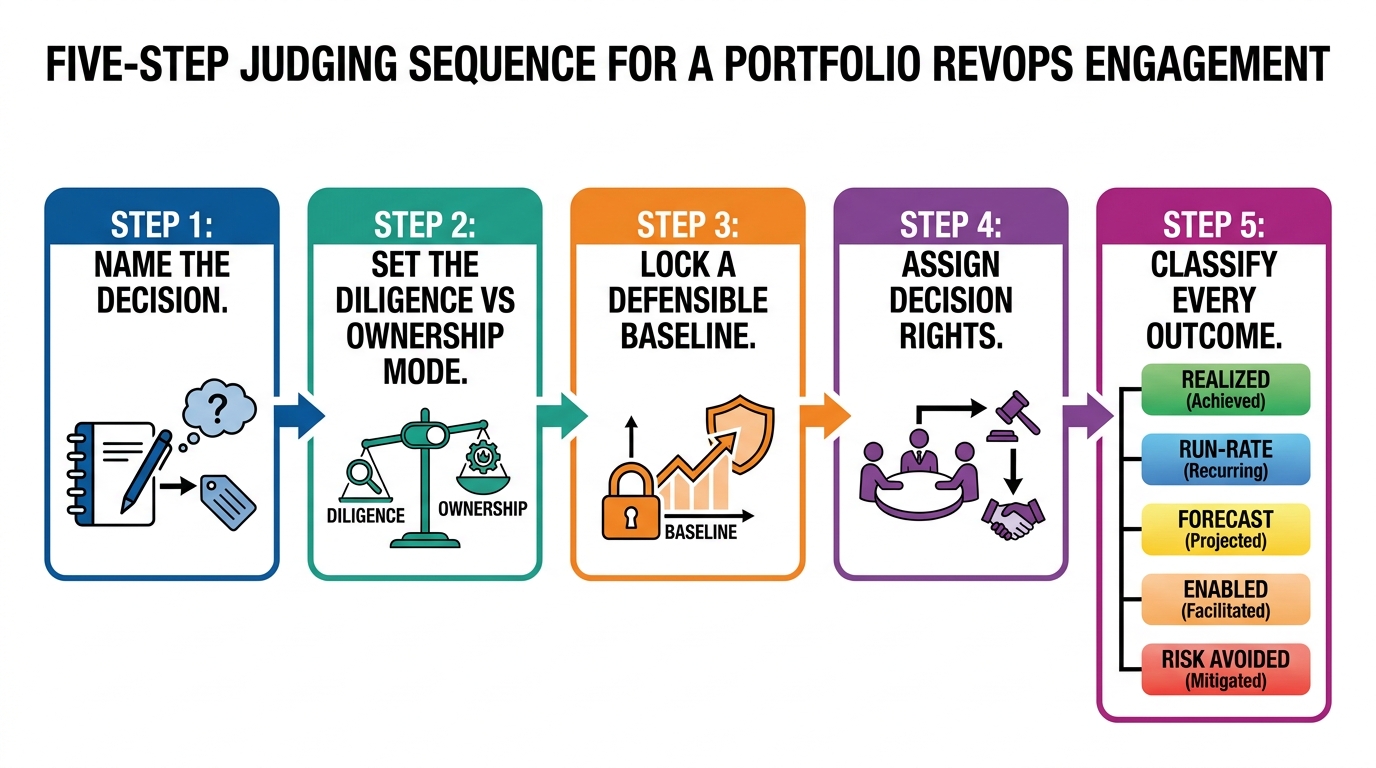
1. Name the decision before you name the vendor
Before scoping anyone, the operating partner should write down the decision the engagement informs. There are only a handful that justify outside RevOps help in a portfolio setting:
- Whether the revenue forecast can be trusted for covenant and board purposes.
- Whether the sales motion is scalable enough to hit the value-creation plan, or needs rebuilding first.
- Whether two merged commercial teams can operate as one without leaking pipeline.
- Whether the current tooling and data are an integration dependency for an add-on.
Each of these ties to a specific commercial consequence: forecast reliability protects the lender relationship, motion scalability protects the growth thesis, merged-team execution protects synergy capture. A consultant who cannot state which of these they are being hired to move is being hired to produce activity. That is the failure mode to screen out on the first call.
2. Separate diligence-stage work from ownership-stage work
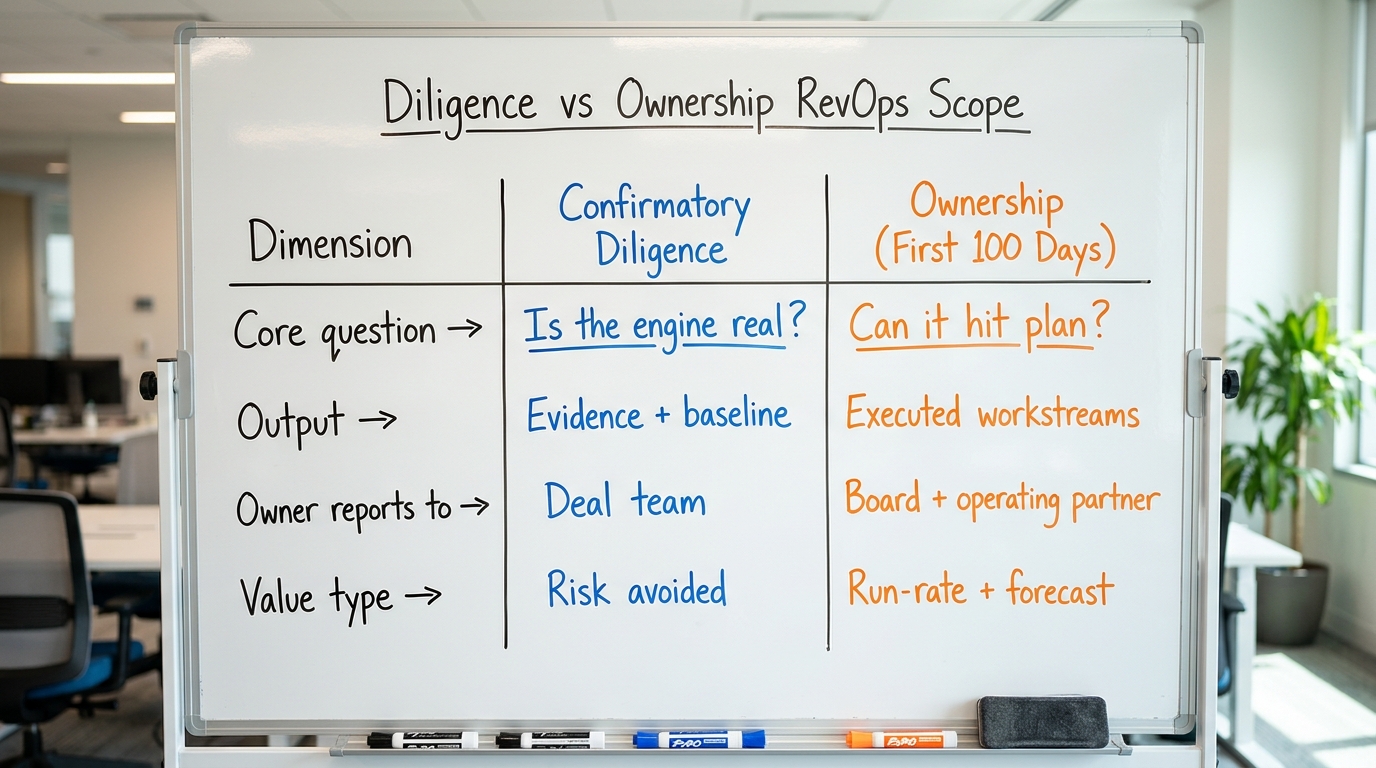
The scope changes sharply depending on where the deal sits. During confirmatory diligence, the useful question is narrow: is the revenue engine what the seller claims, and what will it cost to fix what it is not. That work sits close to technology due diligence, and the output is evidence for the deal team, a baseline of CRM hygiene, pipeline definition, quota attainment, and data quality, not a transformation plan.
After close, the question flips to execution. The consultant now owns workstreams inside the first 100 days plan and reports against actual versus plan. Confusing these two modes is a common and expensive error. Diligence talent priced and scoped for a deep rebuild wastes money before you own the asset; a light diligence reviewer asked to run post-close integration will drown. Bain’s annual private equity report has repeatedly documented how value creation has shifted toward operational improvement rather than financial engineering, which is exactly why the ownership-stage scope now carries most of the weight. That research sits in Bain’s Global Private Equity Report.
3. Insist on a baseline before any build
The single most important deliverable in the first two weeks is a baseline the operating partner can defend in front of the board. That means agreed definitions for pipeline stages, a clean read on current conversion and cycle time, quota attainment by rep and segment, and an honest data-quality score on the CRM. Without a baseline, every later claim of improvement is unverifiable, and the difference between realized gains and forecast gains disappears into a slide.
A good consultant refuses to promise numbers before establishing this. If the pitch leads with a target lift before anyone has measured the starting point, that is a signal the engagement will be run on assertion rather than evidence.
4. Judge the person by the questions they ask, not the tools they name
Tooling fluency is table stakes and easy to fake. The stronger signal is diagnostic quality. A consultant worth the fee will ask about the value-creation plan, the covenant structure that forecast reliability protects, the compensation plan driving current rep behavior, and the specific board metric that is currently unreliable. Those questions show they are working the commercial problem backward from enterprise value.
The weaker candidate leads with platform migrations, dashboard rebuilds, and the number of integrations they will configure. Useful eventually, but as an opening move it reveals someone selling a build rather than an outcome. McKinsey’s private capital research, published on mckinsey.com, has consistently framed value creation around a small number of operational levers rather than tooling breadth, which is the same lens the buyer should apply here.
5. Treat merged-team RevOps as its own risk register item
If the thesis includes add-ons, the hardest RevOps work is not building anything new, it is making two commercial teams operate as one without dropping deals in the seam. This is where synergy capture quietly leaks. Duplicate accounts, conflicting stage definitions, and two comp plans pulling reps in opposite directions can erase the modeled synergy while every dashboard still looks green.
The pattern is well documented, and worth reading alongside this guide is the breakdown of why post-merger RevOps synergies fail, which maps the specific failure points a consultant should be putting on the risk register from day one. Scope the integration explicitly. Do not let it hide inside a general “clean up the CRM” line item.
6. Decide who holds the decision rights
A consultant should have clear decision rights over the operating mechanics, stage definitions, reporting cadence, data standards, and no decision rights over commercial strategy, headcount, or comp design, which belong to the portfolio CEO and the operating partner. Writing this down prevents the common drift where an outside operator quietly starts running the sales organization, or, more often, where nothing gets decided because nobody was named as owner.
Where the RevOps consultant should own the call
- CRM data standards and hygiene rules.
- Pipeline stage and forecast-category definitions.
- Reporting cadence and the board-facing metric set.
Where they advise only
- Comp plan design and quota levels.
- Territory and segment strategy.
- Hiring and firing in the sales org.
7. Tie the fee to outcomes you can classify
Every claimed impact should be classifiable as realized, run-rate, forecast, enabled, or risk avoided. A cleaned forecast that now predicts within a tighter band is risk avoided and better management visibility. A rebuilt lead process that lifts booked revenue is run-rate once it holds for a quarter. Anything described only as “improved efficiency” without a number attached to a period is neither, and should not be paid for as if it were realized value.
This discipline also protects the board conversation. When the operating partner presents at the first board meeting, being able to say “this change is enabled, not yet realized” is far stronger than presenting forecast lift as though the money is in the bank.
8. Do not let enablement become a cost center that produces nothing
Sales operations and enablement live next to each other, and a weak engagement lets enablement expand into activity, endless training modules, certifications nobody uses in the field. The test is whether enablement changes a metric the baseline tracks. Training the merged team on one shared pipeline definition is enablement that reduces integration risk. Generic soft-skills content untethered from a revenue metric is spend without a line to enterprise value.
That said, the human side is not optional. Adoption of new RevOps mechanics fails when reps are not motivated to use them, which is why the work on the science of motivation in employee training and the practical guidance on adapting training for hybrid and remote sales teams both matter to whether a new process actually sticks. A consultant who ignores adoption will deliver a clean system nobody uses.
9. Set the reporting cadence to match the board, not the vendor
The consultant should report against the same metrics the operating partner takes to the board, on the same cadence, so there is no translation layer. Weekly operating reviews internally, monthly against plan, and a clear line into the board pack. When the vendor’s status report and the board pack disagree, the engagement has already gone off the rails.
PitchBook and S&P Global Market Intelligence both maintain research on how sponsors track portfolio performance, available at pitchbook.com and spglobal.com, and the consistent theme is that reliable, standardized reporting is itself a value driver because it shortens the path to confident decisions and, eventually, to exit.
10. The buyer’s decision checklist
Before signing, the operating partner or portfolio executive should be able to answer yes to each of these:
- The engagement names a specific decision it informs, tied to forecast reliability, motion scalability, or synergy capture.
- It is correctly scoped as diligence-stage evidence or ownership-stage execution, not both by accident.
- A defensible baseline is a named deliverable in the first two weeks.
- Decision rights are written down, mechanics to the consultant, strategy to the CEO and operating partner.
- Every promised outcome is classified as realized, run-rate, forecast, enabled, or risk avoided.
- Reporting maps directly to the board metric set and cadence.
- Adoption is a scoped workstream, not an afterthought.
If any answer is no, the fix is in the scope, not in the search for a better vendor. Most failed RevOps engagements in portfolio companies fail because of how they were bought, not who was hired.
11. Where this fits in the value-creation plan
A sales operations engagement is one lever inside a broader operational plan that a private equity sponsor runs across the hold period. The point of getting the scope right is not tidiness. It is that a forecast the board can trust, a motion that scales to plan, and merged teams that do not leak pipeline are the things that hold up multiple at exit. Everything else the consultant produces is in service of that or it is overhead. For how this connects to the wider set of portfolio operating decisions, DevriX’s private equity operating resources lay out the surrounding workstreams.
When the mechanics, the data, and the reporting are set up to convert directly into enterprise value, and when adoption is treated as seriously as configuration, the engagement earns its fee. To scope a full-funnel demand and RevOps engagement built for a portfolio company on this basis, review the DevriX private equity RevOps offer and bring the decision, the baseline, and the board metric you need it to move.