Eighteen months before a targeted exit, an operating partner sitting on a SaaS portfolio company faces a narrow window and a specific set of decisions. The forecast the bankers will build a story around is being set now. The metrics a buyer’s diligence team will pull apart are being generated by systems and processes that already exist. Wait until the sell-side process opens and the company is stuck defending whatever numbers it happens to produce. Start now and the company gets to shape which numbers those are.
This guide is written for the person standing up or tightening revenue operations inside that portfolio company, and for the operating partner who owns the exit calendar. Exit readiness for a SaaS company is not a banking exercise. It is an operating exercise that produces clean, defensible, buyer-legible evidence. The commercial consequence of getting it wrong is measured in multiple points and, in a soft market, in whether the asset trades at all.
1. What exit readiness for a SaaS company actually means
Exit readiness is the condition where a buyer’s diligence confirms the story the seller tells, rather than contradicting it. For a SaaS asset, that story lives in a handful of metrics: net revenue retention, gross retention, ARR growth, CAC payback, gross margin, and the quality of recurring revenue. Readiness means each of those numbers can be reproduced from source systems, reconciled to the general ledger, and explained by someone who was in the room when the business decisions behind them were made.
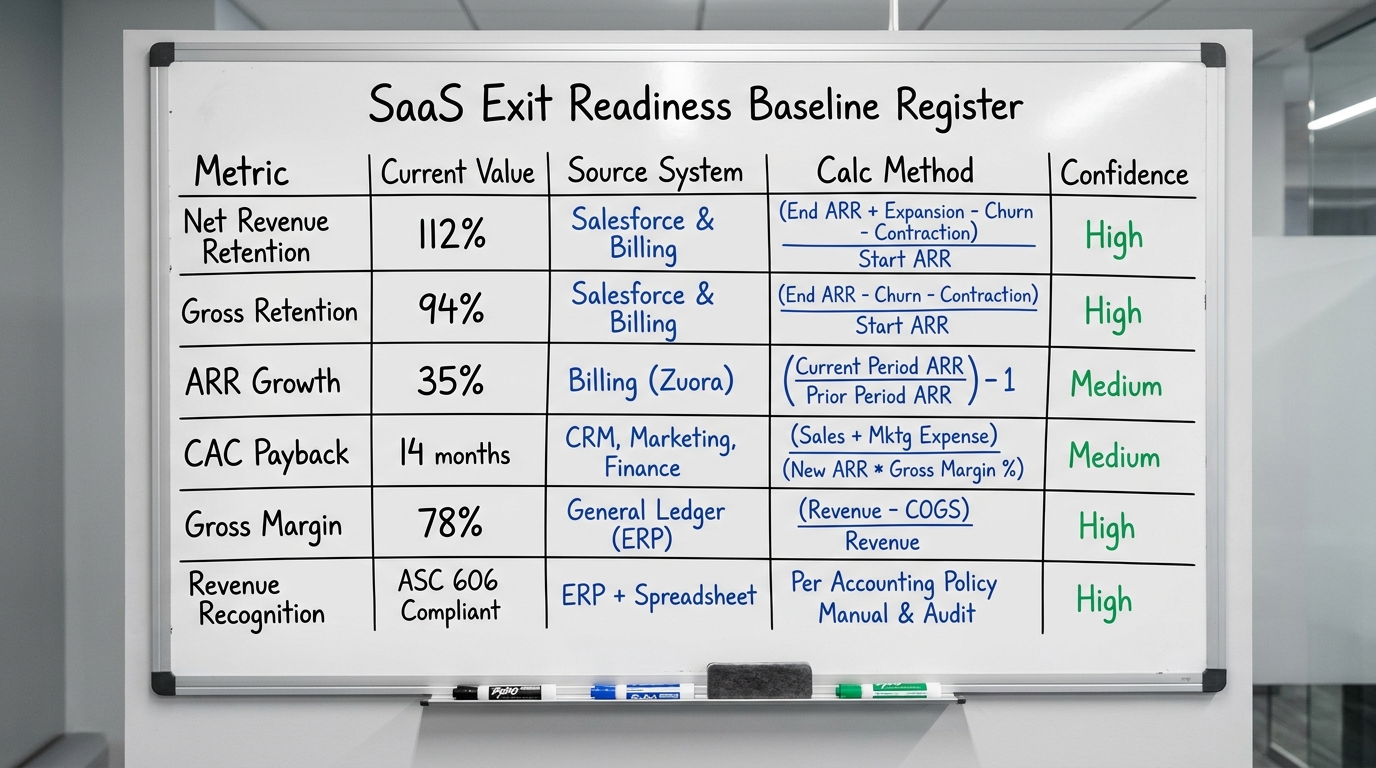
The failure mode is predictable. Management believes NRR is 112 percent. Confirmatory diligence rebuilds it from raw contract and billing data and lands at 104 percent, with a different cohort definition. The eight-point gap is not the real problem. The credibility damage is. Once a buyer catches one number that will not reconcile, they re-underwrite everything, and the discount they apply is no longer about the metric.
2. Why this is an operating decision, not a banker’s job
Bankers package. They do not fix the underlying data model, the CRM hygiene, or the fact that three sales reps recorded renewals as new logos for two years. Bain’s annual review of the industry, its Global Private Equity Report, has documented for several cycles how much longer hold periods and value creation now depend on operational improvement rather than multiple expansion. That shift lands squarely on the operating partner. The work of making an asset defensible happens inside the company, on the operating clock, well before a bank is engaged.
The decision the operating partner owns is not whether to sell. It is whether the evidence base is strong enough to survive a buyer who is motivated to find reasons to pay less.
3. Set the readiness baseline first
Before any remediation, the company needs an honest baseline. That means pulling the core SaaS metrics as they exist today, from the systems that actually hold the data, and documenting how each was calculated. The output is a short register: metric, current value, source system, calculation method, and confidence level.
Where the gaps usually sit
- Retention math that mixes gross and net, or shifts cohort definitions between board decks and internal reports.
- Revenue recognition that does not tie cleanly to the general ledger, a recurring flag in any quality-of-earnings review.
- Pipeline and bookings data that lives in a CRM nobody trusts, so the real forecast lives in a spreadsheet.
- Customer counts that differ depending on which team you ask.
The AICPA’s guidance on financial reporting quality, available through AICPA and CIMA, is a useful reference point for what a buyer’s accountants will expect revenue recognition to look like. If the company cannot map its ARR to recognized revenue on demand, that is the first workstream.
4. Fix the metric that carries the multiple
For most SaaS assets, net revenue retention does more to move valuation than any other single number. A buyer reads high, durable NRR as evidence the business grows even without new logos, which lowers their perceived risk and supports a higher multiple. That makes it the metric worth the most scrutiny before a process.
What defensible NRR requires
- A single, written cohort definition applied consistently across every reporting period.
- Expansion, contraction, and churn each isolated and reproducible from contract data.
- A reconciliation that a diligence team can run themselves and land within a point of management’s figure.
PitchBook’s coverage of SaaS valuation trends, published through its research and data platform, tracks how retention quality has become one of the sharper lines separating premium multiples from average ones. The point is not to inflate the number. It is to make the real number bulletproof.
5. Make the systems tell one story
A buyer’s technical and financial teams will pull the same metric from three places and check whether the answers match. If the CRM, the billing platform, and the general ledger disagree, every disagreement becomes a diligence question, and every question costs time and credibility.
This is where systems work and exit readiness overlap. The company needs its revenue systems to reconcile before a buyer forces the issue. If the CRM is unreliable or billing is stitched together across acquisitions, that remediation belongs on the pre-exit calendar, not the diligence calendar. Teams that have run a disciplined systems implementation inside a portfolio company already know how much lead time this takes. Treat it as a real project with an owner and a deadline, not a cleanup you promise to finish later.
6. Prepare the technology story a buyer will test
SaaS buyers do not only diligence the financials. They send an engineering team to assess architecture, technical debt, security posture, and whether the product can scale without a rewrite. A weak technical story becomes a price adjustment or an escrow. A clean one removes a whole category of buyer objection.
Getting ahead of this means running an internal version of the technology due diligence a buyer will conduct, and fixing what it finds before an outside team documents it in a report the buyer controls. If the company is mid-modernization, the operating partner has to decide how much to finish before the process opens. The judgment calls involved are the same ones covered in this site’s guide to application modernization in a portfolio company. Half-finished migrations read as risk. Either complete a workstream or scope it cleanly so it reads as a funded, understood plan rather than an open liability.
7. Build the data room before you need it
The single cheapest thing an operating partner can do to compress a sell-side timeline is assemble the data room early. Contracts, cohort files, financial reconciliations, org charts, security documentation, and the metric definitions from the baseline register all belong in one organized place, kept current.
Harvard Business Review’s coverage of mergers and acquisitions has repeatedly made the point that deal speed correlates with certainty, and certainty comes from information being ready when a buyer asks. A slow, disorganized data room signals a business that does not know itself, and buyers price that signal.
8. Assign owners and decision rights
Readiness stalls when everyone agrees the work matters and no one owns it. Each workstream, retention math, revenue recognition, systems reconciliation, technology story, data room, needs a named owner, a due date, and a clear decision right for what “done” means.
A workable ownership split
- RevOps or the CRO owns retention, pipeline, and the metric definitions.
- The CFO owns revenue recognition and the reconciliation to the general ledger.
- The CTO owns the technology story and the internal diligence.
- The operating partner owns the calendar and adjudicates trade-offs when a workstream slips.
When a company decides it lacks the internal capacity to run one of these tracks, the honest move is to source it deliberately rather than let it drift. This site’s guidance on when to outsource sales operations in a PE-backed company lays out how to make that call without losing control of the numbers.
9. Decide what to fix and what to disclose
Not every gap can be fixed before a process opens. Some issues are structural and take longer than the exit window allows. For those, the decision is disclosure strategy: present the issue on the seller’s terms, with a credible remediation plan and a cost estimate, rather than letting a buyer discover it and control the narrative.
Buyers penalize surprises far more than known, quantified issues. A documented weakness with an owner and a plan reads as management maturity. The same weakness found in diligence reads as either incompetence or concealment, and both carry a discount. McKinsey’s private capital research has long tied deal outcomes to management credibility, and credibility is built by getting ahead of the bad news.
10. Judge readiness the way a buyer will
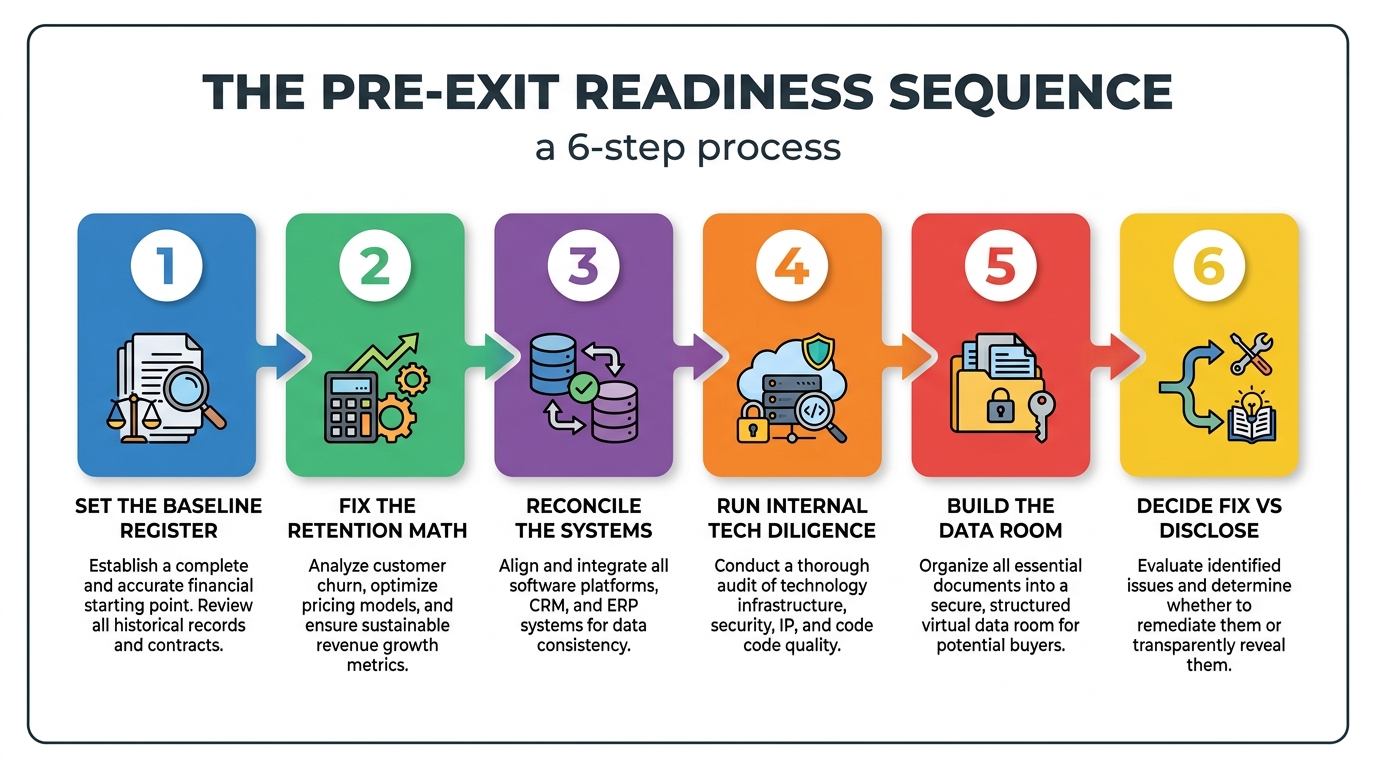
The final judgment is not whether the company feels ready. It is whether an adversarial diligence team can reproduce the story. A practical test: hand the baseline register and data room to someone outside the deal, a trusted advisor or an internal team that was not involved, and have them try to break every number. What survives is defensible. What does not is the remaining work.
This is the same discipline this site applies to vendor selection, where the standard is value and evidence rather than activity, as laid out in the guide to choosing a product engineering partner and judging it on value, not hours. Readiness is judged by what holds up under pressure, not by how much work was done.
11. The exit readiness checklist
- Baseline register built, with every core metric mapped to a source system and calculation method.
- Net revenue retention reproducible from contract data within a point of management’s figure.
- ARR reconciled to recognized revenue in the general ledger.
- CRM, billing, and finance systems telling one consistent story.
- Internal technology diligence completed, with modernization workstreams either finished or cleanly scoped.
- Data room assembled, organized, and kept current.
- Every workstream has a named owner and a due date on the exit calendar.
- Fix-versus-disclose decisions made for every known gap.
- Numbers stress-tested by someone outside the deal.
Work through this list eighteen months out and the sell-side process becomes a confirmation of a known story rather than a discovery of an unknown one. That difference shows up in the multiple and in the certainty of close.
12. Next steps
Start with the baseline register this quarter, because everything else depends on knowing the real numbers. Assign owners before the end of the month. Put the systems reconciliation and internal technology diligence on the calendar with hard dates, since those carry the longest lead times. The first 100 days discipline that operating partners apply after acquisition works just as well applied backward from a targeted exit.
If the company needs help building defensible revenue evidence, cleaning the systems that produce it, or running the internal diligence a buyer will later repeat, the operating and engineering teams behind DevriX and GrowthShuttle work on exactly this. Review the exit readiness and value-creation work through the private equity practice and bring them in on the workstream where the internal calendar is tightest.