Somewhere between eighteen and thirty months before a planned exit, an operating partner looks at a portfolio company and sees the gap that will cost real multiple points at the negotiating table. The forecast has missed twice. The revenue data does not reconcile between the CRM and the finance system. Customer concentration is worse than the last board deck implied, and nobody can produce a clean cohort retention curve on demand. None of this is fatal, but all of it is expensive when a buyer’s advisers find it first. Hiring an exit readiness consultant for a portfolio company is the decision that either closes that gap on your timeline or leaves it open for a diligence team to price against you.
This guide is for the operating partner or portfolio company executive who already owns the budget and the exit thesis. It is about what you actually need to decide, in what order, and how to judge whether the person you are about to engage will move enterprise value or just generate a data room.
1. Decide what the engagement is actually buying
You are not buying a report. You are buying a shorter, cleaner sell-side process and a defensible answer to every question a buyer’s advisers will ask. The output that matters is measurable: fewer diligence surprises, a forecast the CFO will stand behind, and an equity story that survives contact with a QoE team.
Before you speak to anyone, write down the specific value at stake. If the plan is a sale at a target multiple in the next two years, name the two or three areas where you already suspect a buyer will discount, whether that is forecast reliability, revenue quality, systems fragility, or management depth. An exit readiness engagement that does not tie back to those items is activity, not outcome. The same discipline applies here that applies when you hire a sales operations consultant without buying activity: you scope to a financial consequence, not to a task list.
2. Separate exit readiness from vendor-side QoE
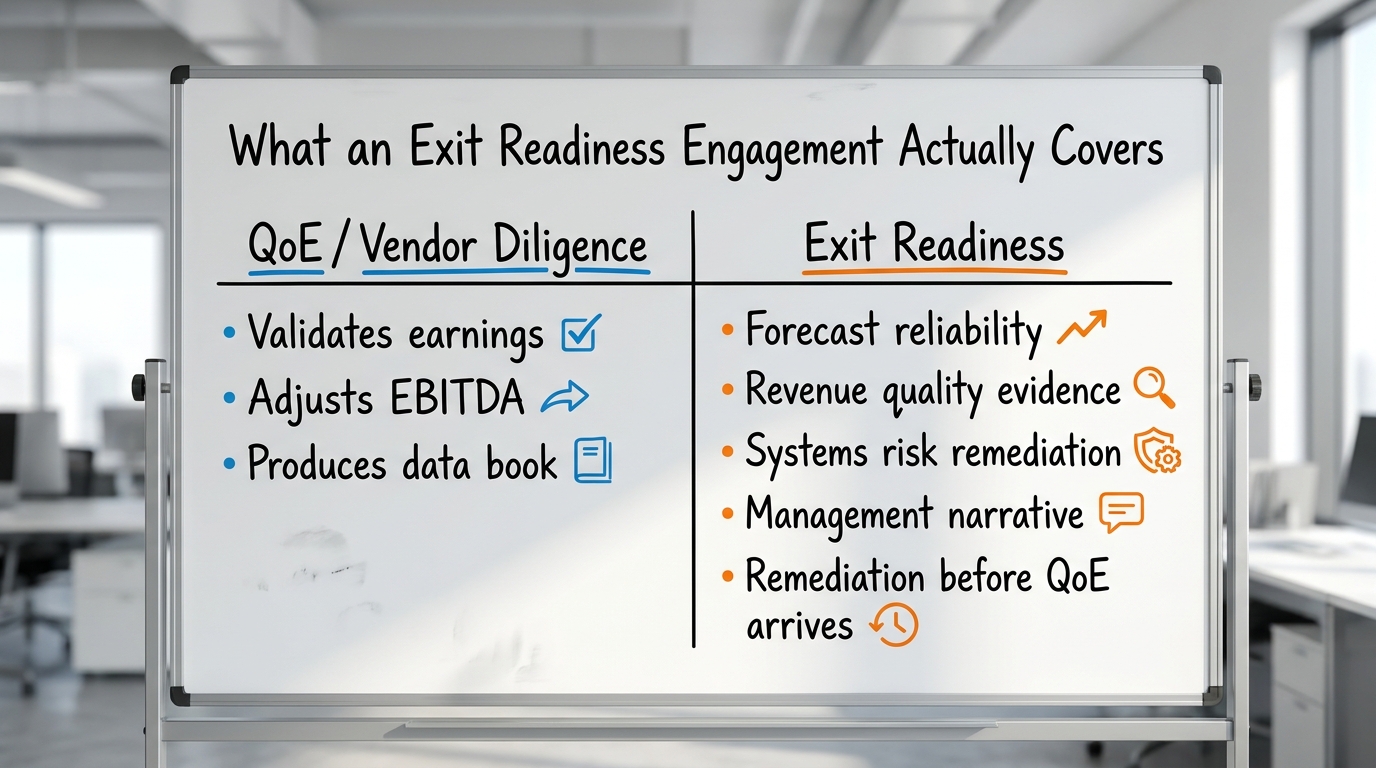
Sell-side quality of earnings work and exit readiness overlap but are not the same purchase. QoE validates the earnings number. Exit readiness is broader: it covers the commercial story, the operating evidence, the data infrastructure, the management narrative, and the remediation work that has to happen before a QoE provider even arrives.
An exit readiness consultant should be comfortable saying “this will not survive diligence, and here is what we fix first.” If the person you are interviewing only knows how to produce a data book, you are buying half the engagement. The Harvard Law School Forum on Corporate Governance has published extensively on how diligence and disclosure practices shape deal outcomes, and the pattern is consistent: sellers who surface and remediate issues early hold price better than sellers who let buyers discover them.
3. Match the consultant to the value gap, not the credential
The temptation is to hire the biggest name. The better move is to hire against the specific gap you named in section one.
If the gap is financial and reporting
You want someone fluent in the standards a buyer’s advisers apply. The AICPA and CIMA maintain the professional guidance that shapes how earnings and revenue recognition get scrutinized, and your consultant should map to that vocabulary without a translator.
If the gap is commercial and revenue-quality
You want an operator who can rebuild a cohort analysis, defend net revenue retention, and explain churn in terms a buyer will accept. This is closer to sales and revenue operations than to accounting.
If the gap is technology and data
You want someone who can run a real technology due diligence pass on the company before a buyer does, and translate the findings into remediation cost and diligence risk rather than a list of tickets.
4. Insist on a baseline before any remediation
No credible engagement starts with fixes. It starts with a baseline: what the current forecast accuracy is, how revenue data reconciles across systems, where the reporting breaks under stress, and what a hostile diligence team will find. Without a baseline you cannot judge whether the work moved anything.
Ask the consultant to define the baseline in the first two to three weeks and to name the owner of each gap. If the answer is vague, that is your signal. Bain’s annual Global Private Equity Report has tracked for years how holding periods and exit conditions tighten seller preparation windows, which means the baseline has to be fast and honest, not a six-month discovery exercise.
5. Judge the data infrastructure question early
A large share of exit friction is not the number, it is the inability to produce the number cleanly and repeatedly. If revenue lives in three systems that do not agree, every buyer question becomes a fire drill and every fire drill reads as risk.
A strong exit readiness consultant will assess whether the company’s systems can actually support a data room, and whether the fix is a reconciliation process or something deeper. This is where exit readiness connects to the same decisions covered in systems implementation for a portfolio company and, at larger scale, in cloud modernization decisions. If the systems cannot produce clean, reconciled reporting on demand, no amount of narrative polish will hold at the table.
6. Require the equity story and the evidence to match
Buyers discount stories they cannot verify. The consultant’s job is to make sure every claim in the management presentation is backed by data that survives inspection. If the growth story rests on new logos, the pipeline and conversion data has to support it. If it rests on retention, the cohort data has to be clean.
McKinsey’s private capital research and PitchBook’s deal data both point to the same reality: value creation narratives that cannot be evidenced get repriced during confirmatory diligence. The consultant should stress-test the story against the evidence before a buyer does.
[Image to add: The Exit Readiness Sequence | 5 steps with labels, 1. Baseline (forecast accuracy, data reconciliation, gap owners) → 2. Prioritize gaps by ]
7. Look at how they price and scope the work
An exit readiness engagement for a mid-market portfolio company is typically a defined, time-boxed piece of work, not an open retainer. Expect a scoped engagement in the range of a focused six-figure-adjacent project, sized to the value gap rather than to hours. A consultant who prices by activity, headcount, or duration is selling you the failure mode. A consultant who prices to a defined set of remediated risks and a diligence-ready data position is selling you the outcome.
The judgment discipline here mirrors when to outsource sales operations in a PE-backed company: you buy against a decision and a consequence, and you refuse to pay for effort dressed up as progress.
8. Check whether they can run a dry-run diligence
The single most useful thing an exit readiness consultant can do is put the company through a diligence dry-run: the same questions, the same data requests, the same pressure a buyer’s advisers will apply. If the consultant has never sat on the buy side or run confirmatory diligence, they cannot simulate it credibly.
Ask directly what a dry-run looks like, what it produces, and how remediation gets tracked afterward. S&P Global Market Intelligence maintains extensive market and credit data that buyers pull in diligence, and a good consultant knows what the other side will be checking before they check it.
9. Confirm the remediation actually gets executed
A findings report that nobody executes changes nothing at exit. The engagement has to specify who owns each fix, on what timeline, and how completion gets verified. If the consultant only diagnoses and hands off, you are back to owning execution risk with less time on the clock.
This is the same execution gap that separates a strong operating partner from a passive one, and it is why exit readiness works best when it connects to the disciplines already running in the portfolio, from the first 100 days playbook through to ongoing strategic IT sourcing decisions.
10. Time it against real triggers, not the calendar
Start exit readiness when the exit thesis firms up, not when the bankers are already pitching. The useful window is roughly twelve to twenty-four months out, which gives room to remediate systems and revenue-quality issues that cannot be fixed in a quarter. Once an LOI is on the table, your leverage to fix and reframe has largely closed. BCG’s principal investors and private equity research has consistently framed exit preparation as a runway problem, not an event, and the operators who treat it that way carry more of the value creation into the price.
11. A checklist before you sign
- Value gap named. You can state the two or three areas a buyer will discount, and the engagement targets them.
- Baseline first. The consultant defines a baseline in the first weeks and names an owner for every gap.
- Matched expertise. The consultant’s strength lines up with your gap: financial, commercial, or technology and data.
- Systems assessed. Someone has judged whether the company can produce clean, reconciled reporting on demand.
- Story tied to evidence. Every equity-story claim has verifiable data behind it.
- Dry-run included. The engagement simulates buyer diligence before the buyer does.
- Remediation executed, not just reported. Owners, timelines, and verification are in scope.
- Priced to outcome. Scope maps to remediated risks and a diligence-ready position, not to hours.
- Timed to the thesis. Work starts twelve to twenty-four months out, not at the banker’s pitch.
If you also weigh larger advisory firms, the same judgment applies whether you are evaluating a boutique or considering a West Monroe alternative: fit is decided by what the engagement moves at exit, not by the logo on the deck.
12. Next step
Run your candidate engagement against the checklist above before you commit budget. If the answers are thin on baseline, evidence, dry-run, or executed remediation, keep looking. To scope an exit readiness engagement built to close the diligence gap and hold the multiple, review the DevriX and GrowthShuttle private equity offer and bring the specific value gap you have already named.