An operating partner staring at a portfolio company with a three-year hold, a flat sales pipeline, and an engineering team that cannot ship features fast enough has a spending decision to make. The question is which model to buy, who owns the outcome, and how to know within 90 days whether the money is producing enterprise value. A technical value creation partner in private equity gets hired to move revenue, EBITDA, and exit multiple, and most buyers judge that hire on the wrong evidence.
This guide is written for the person standing up sales and revenue operations inside a portfolio company, or the operating partner underwriting the plan. It lays out what to decide, in what order, and how to tell a value-creation partner apart from a vendor selling hours.
1. Name the value-creation gap before you shop for a partner
The first mistake is sourcing a partner against a symptom. A partner needs a financial statement to work from, and a testable thesis about where the operating model is breaking.
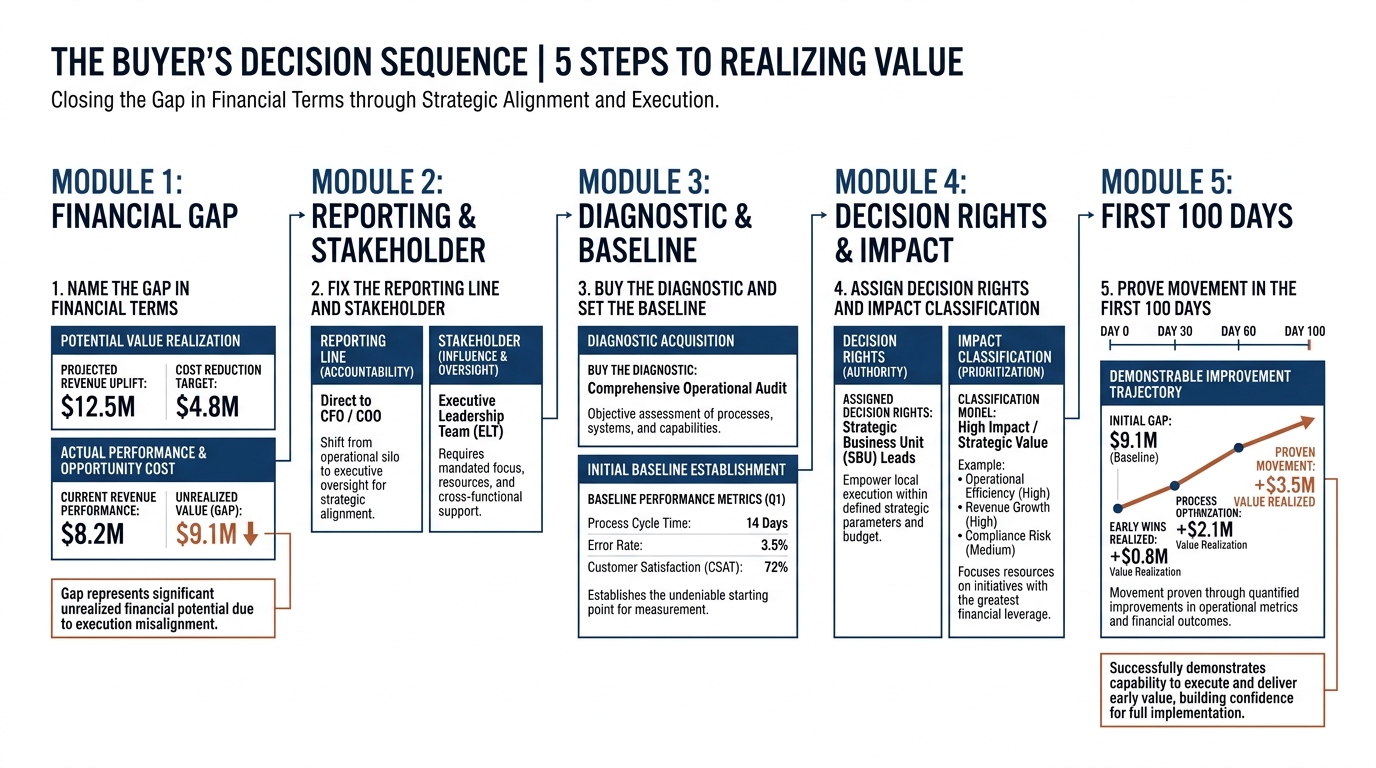
Write the gap as a financial statement instead. Something like: sales cycle runs 40% longer than the deal model assumed, forecast accuracy sits below 60%, and the product roadmap has slipped two consecutive quarters. Each of those ties to a number the deal partner cares about, which means the partner’s work can be scored against a baseline rather than against effort.
Bain’s annual Global Private Equity Report has tracked for years how much of returns now depends on operational improvement rather than multiple expansion or leverage. That shift is why the value-creation gap has to be stated in operating and financial terms from the start.
2. Decide which stakeholder the partner actually reports to
A technical value creation partner serves different masters depending on the mandate, and the reporting line changes what “good” means.
- A deal partner wants thesis validation, risk reduction, and a clean path to exit.
- An operating partner wants speed, adoption, and a repeatable playbook across the portfolio.
- A portfolio CFO wants forecast reliability, cash impact, and covenant headroom.
- A portfolio CEO or CRO wants pipeline, close rates, and a sales org that runs without heroics.
Before you compare firms, decide who signs off on success. A partner optimized for a CFO’s forecast reliability will build different reporting than one optimized for a CRO’s pipeline velocity, and confusing the two produces work nobody wanted.
3. Separate the diagnostic decision from the delivery decision
These are two purchases, and buying them as one is where budgets leak. The diagnostic establishes the baseline, sizes the opportunity, and produces an owner-and-sequence plan. Delivery executes against it.
A short diagnostic (often in the $15-25K range for a light pass, more for a full assessment) is cheap relative to a multi-month engagement built on a wrong assumption. If a firm will not sell you a diagnostic without committing to delivery, that is a signal it sells capacity and calls it strategy. The exit readiness technology assessment and the broader exit readiness sprint both treat this as a discrete, scoped step for that reason.
4. Judge the partner on decision rights, not deliverables
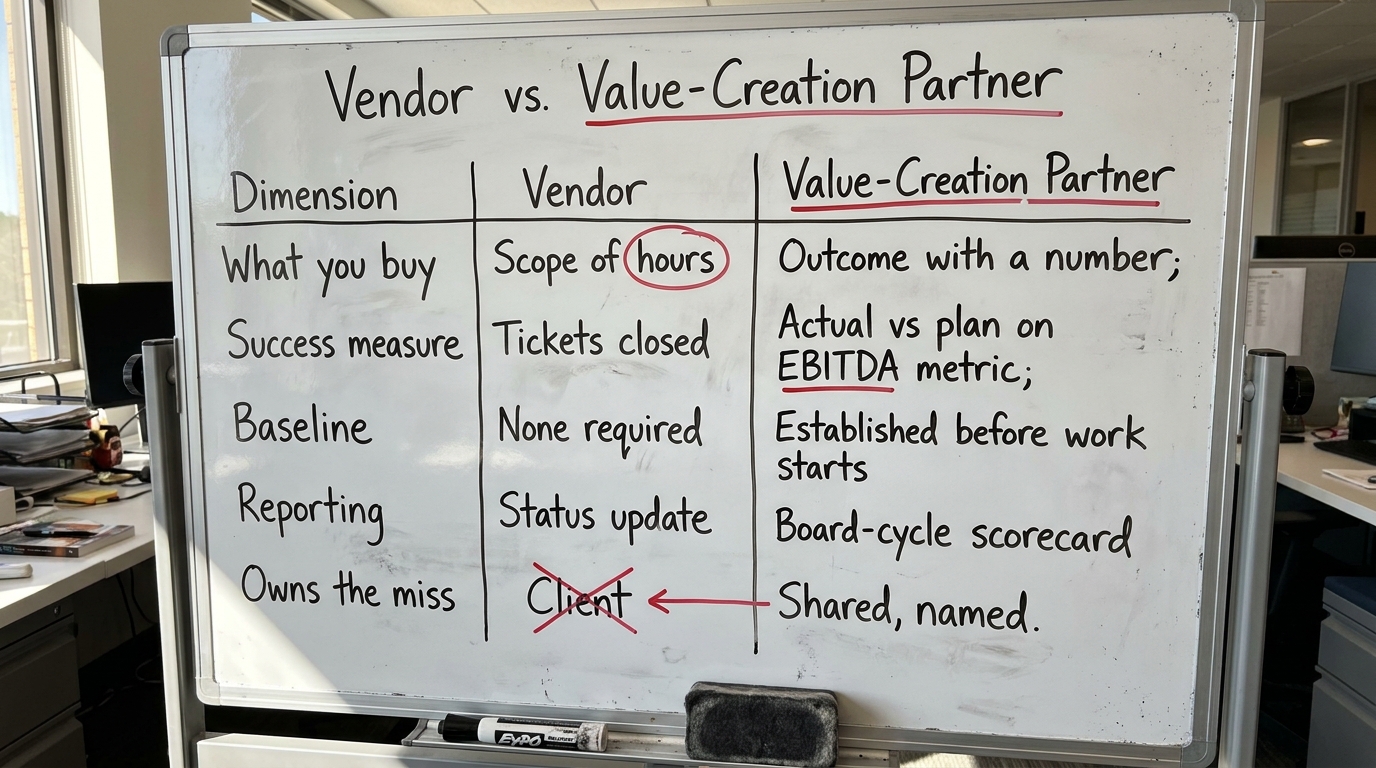
The clearest test of a real value-creation partner is whether it will accept ownership of an outcome with a number attached. A vendor accepts a scope of work: build these features, run these campaigns, deliver these tickets. A value-creation partner accepts a target: move forecast accuracy from 58% to 80% inside two quarters, and reports actual against plan every board cycle.
Ask directly who owns the metric if the plan slips. If the answer is “we deliver what the roadmap says and the client owns the result,” you are buying hours. Hours, tickets, features, and traffic are the vendor register, and none of them is an outcome the deal model can bank.
5. Require a baseline and a measurement method up front
No baseline means no way to prove value later, and no way to defend the spend at the next board meeting. Before delivery starts, the partner should document the current state of every metric it intends to move, the data source for each, and how it will attribute change to its own work versus market or seasonal effects.
This is the same discipline a quality-of-earnings process applies to numbers, and AICPA and CIMA publish extensively on measurement rigor through their standards work. Apply it to operating metrics too, not just the financials, so that a claimed improvement can be classified as realized, run-rate, or forecast rather than asserted.
6. Insist on classifying every claimed impact
When a partner reports progress, make it label each number:
- Realized value already in the P&L.
- Run-rate value proven in-period and annualized.
- Forecast value expected but not yet earned.
- Enabled value the work makes possible if someone else acts.
- Risk avoided, a cost or exposure removed.
The failure mode is a partner presenting forecast or enabled value as though it were realized. That inflates the value-creation story right up until the exit diligence when a buyer’s advisers separate the categories and the number drops. Force the classification early and the story holds together at sale.
7. Connect the technical work to the exit case
Technical improvement only matters to a PE buyer if it survives buyer scrutiny. That means the partner’s work should map to what a future acquirer will test: platform scalability, technical debt, data integrity, and the reliability of the revenue engine.
McKinsey’s private capital research and BCG’s work with principal investors both document how operational and digital improvements feed multiple at exit rather than just current cash flow. Ask the partner how each workstream shortens future diligence or reduces a risk a buyer would discount for. The go-to-market exit readiness assessment is a useful frame for pressure-testing the revenue side of that answer before bankers are in the room.
8. Scope the sales and revenue operations layer specifically
For a portfolio company where the thesis rests on commercial growth, the highest-leverage technical work usually sits in revenue operations, not the core product. CRM hygiene, pipeline instrumentation, forecast automation, and lead routing all convert directly into the numbers a CRO and CFO report.
A partner that treats this as an afterthought behind product engineering is misreading where value hides in a commercially-driven deal. Ask for the revenue operations plan on its own, with its own baseline and its own owner. Process automation for portfolio companies covers where these gains typically concentrate.
9. Set the first 100 days as the proof window
A value-creation partner should show measurable movement inside the first 100 days, even if the full thesis takes the hold period. This is where you catch a mismatch cheaply, while there is still time to change course.
Define two or three early proof points before signing: a baseline captured, one automated report replacing manual work, one metric moving in the right direction. The DevriX approach to the first 100 days sequences exactly this, and it pairs with the technical read a technology due diligence process would have flagged during the deal.
10. Price the engagement against enterprise value, not rate cards
An embedded retainer in the $15-50K per month range looks expensive next to a staff-augmentation quote until you price it against the value at stake. A single percentage point of EBITDA margin, or a two-turn improvement in the exit multiple, dwarfs the retainer over a hold.
Do not judge the partner on blended day rates. Judge it on the ratio of fees to the enterprise-value swing it is accountable for. Exit readiness cost in private equity and the guide on choosing a product engineering partner on value, not hours both work through that math.
11. Watch for the vendor tells
A few signals separate a partner from a supplier reliably:
- It leads with team size, tech stack, and hours rather than a baseline and a target.
- It resists a scoped diagnostic and pushes straight to a long retainer.
- It reports activity (tickets, features, campaigns) as though activity were the result.
- It will not name who owns a missed number.
- It cannot connect its workstreams to the exit case.
Any one of these is a reason to keep looking. Two or more and you are buying capacity dressed as value creation. The guides on choosing an exit readiness consultant and technical debt elimination both cover how to run these checks against a specific company.
12. A checklist before you sign
Run the shortlist through this before committing budget:
- The value-creation gap is written as financial and operating numbers, with a baseline.
- The reporting stakeholder and the success owner are named.
- The diagnostic is a separate, scoped purchase from delivery.
- The partner accepts an outcome target and reports actual versus plan each board cycle.
- Every claimed impact is classified as realized, run-rate, forecast, enabled, or risk avoided.
- Each workstream maps to the exit case and to a risk a future buyer would discount for.
- The sales and revenue operations layer has its own plan, baseline, and owner.
- Two or three proof points are defined for the first 100 days.
- Fees are priced against the enterprise-value swing, not the day rate.
PitchBook’s research and data and coverage in outlets like Private Equity International keep showing that the returns story now runs through operational execution, which is exactly what this checklist is built to protect.
When you are ready to size the gap and set the baseline, the DevriX private equity practice runs the value-creation diagnostic and the embedded delivery that follows it against the numbers your deal model already committed to.