When a sponsor signs an IT roadmap for a portfolio company, the document usually arrives at the wrong altitude. It reads like an internal engineering plan: platform upgrades, cloud migration phases, tooling standardization, a security backlog. None of that answers the question the operating partner is actually holding, which is whether the next 18 months of technology spend moves EBITDA, shortens the path to exit, or removes a risk that a future buyer will price against. If you are approaching a first board meeting, or you inherited a plan built by a CTO who has never sat through confirmatory diligence, this is the gap you need to close before you approve a budget.
This guide is written for the person who owns that decision: the operating partner, the portfolio CEO, or the CFO standing up sales and revenue operations inside a newly acquired company. It walks through what the roadmap has to contain, who owns each piece, and how to judge whether the plan in front of you is a value-creation instrument or a wish list.
1. Start from the value-creation thesis, not the tech backlog
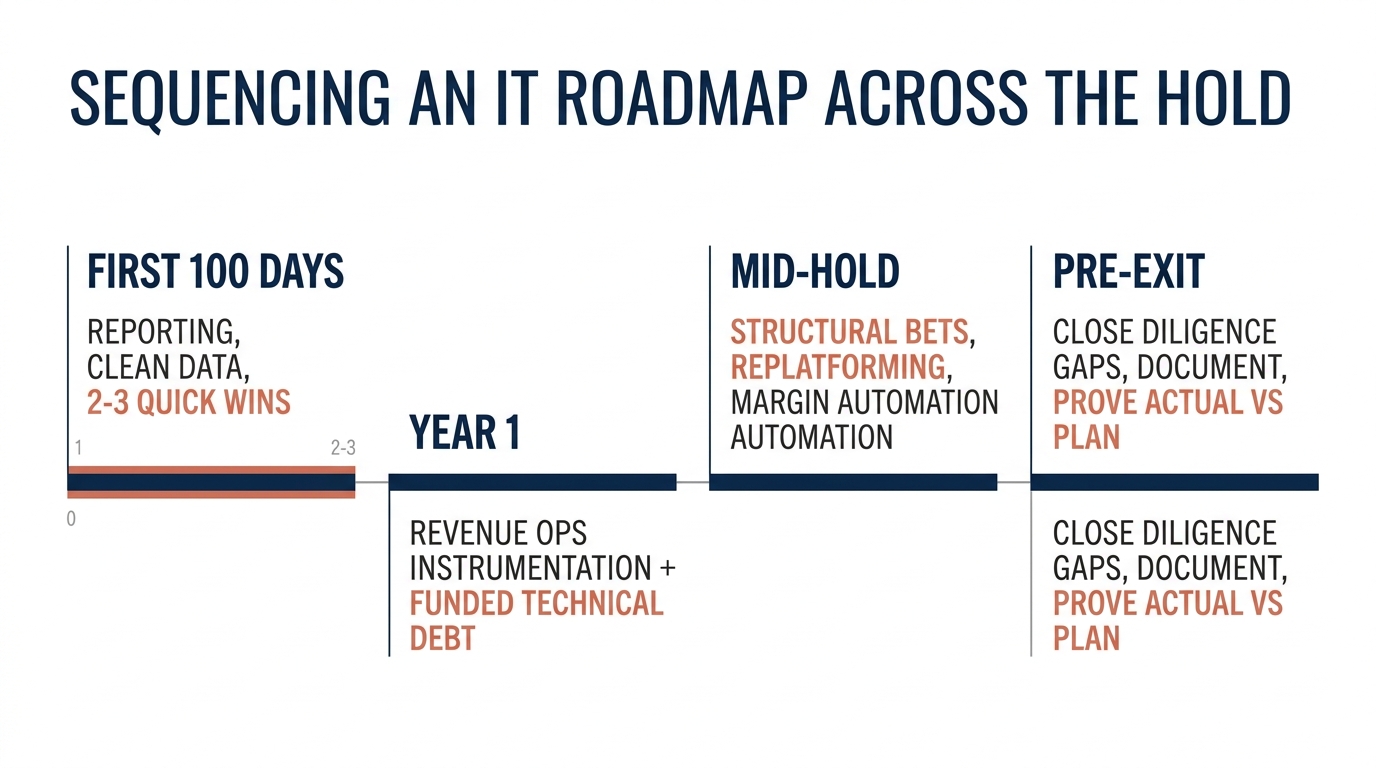
The roadmap has to trace back to the reasons the deal team underwrote the investment. If the thesis was margin expansion through operational efficiency, the roadmap’s first-year weight belongs on process automation and reporting, not on a two-year replatforming project that ties up the team and shows nothing until month 20.
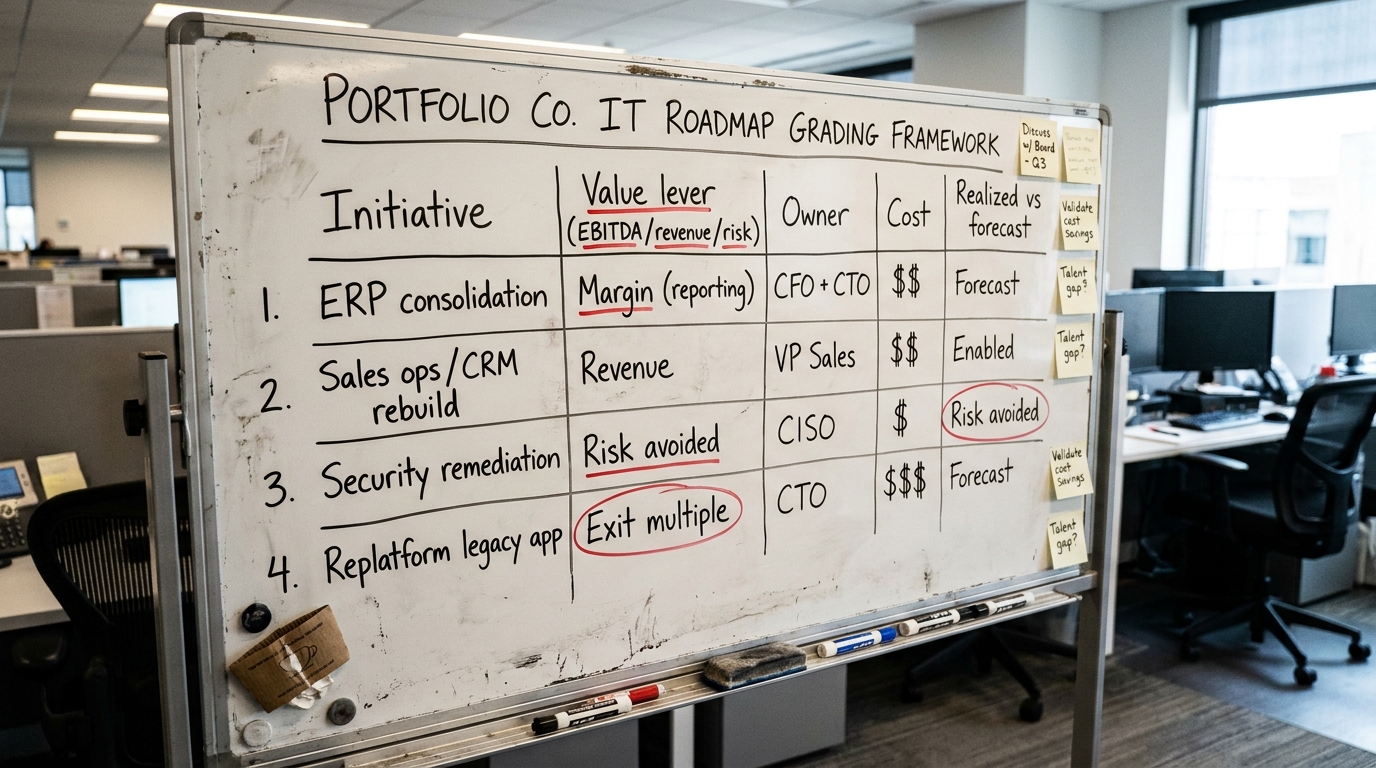
Ask the plan’s author to map each initiative to a specific line in the value-creation plan. An initiative that cannot name the EBITDA lever, the revenue driver, or the risk it retires does not belong in year one. Bain’s annual private equity report has tracked for years how value creation has shifted from financial engineering toward operational improvement, which is exactly where a technology roadmap either contributes or gets in the way. You can read the current edition of the Bain & Company Global Private Equity Report for the broader shift.
2. Reconcile the roadmap against what diligence already found
If the deal went through proper technology due diligence, you already have a baseline: the state of the codebase, the security posture, the integration debt, the key-person dependencies. The roadmap should read as the remediation and growth plan built on top of that baseline, with the diligence risk register carried forward as named line items.
When the plan’s author ignores diligence findings, or when no real diligence happened, you are approving spend against an unknown. That is the first thing to catch. A roadmap that does not reference a single risk the diligence team flagged is either working from different information than you are, or it is not working from evidence at all.
3. Separate run-the-business from change-the-business
Two budgets hide inside every roadmap and they behave differently. Keeping the lights on (licenses, hosting, support, security patching) is non-discretionary and should be benchmarked, not debated. The change budget is where value creation lives, and it competes for the same engineering capacity as the run budget.
Force the split explicitly. If 80% of the team’s hours are consumed keeping the current systems standing, the ambitious transformation on page four is fiction until you either add capacity or reduce the maintenance load. This is the single most common reason a roadmap slips: the change plan was sized as if the run work were free.
4. Put owners and decision rights on every workstream
A roadmap without named owners is a forecast nobody is accountable for. Each workstream needs one owner inside the company, a clear decision right (who can change scope, who signs off on go-live), and a stated dependency on other workstreams. Integration dependencies are where timelines quietly break, because a delay in one system’s data migration stalls three downstream initiatives that looked independent on the chart.
If you are still assembling the team that will run this, the questions in how to judge a technical value creation partner in private equity apply directly to whether the roadmap’s owners can actually deliver it.
5. Sequence the first 100 days differently from the rest
The first 100 days carry a different mandate than the balance of the hold. Early on, the roadmap should prioritize visibility (management reporting, a clean data layer, working KPIs) and the two or three quick wins that build credibility with the management team and the board. Large structural bets come after you have proof the team can ship.
McKinsey’s research on private capital and value creation makes the same point about early operating momentum, and you can find their private capital work at McKinsey. The practical version: if the first board meeting has no delivered result to show, the roadmap loses the benefit of the doubt for everything that follows.
6. Cost the plan the way the CFO will hold it
Every initiative needs a cost, a timeline, and an expected impact classified honestly. Realized impact is already in the P&L. Run-rate impact is booked but not yet annualized. Forecast impact is projected. Enabled impact makes a future initiative possible but delivers nothing on its own. Risk avoided is a cost you will not incur.
The failure mode is presenting forecast or enabled value as if it were realized. A roadmap that claims a system migration will “unlock” a margin number should state clearly that the number is forecast, name the assumptions, and give the CFO a way to check actual against plan quarterly. For the discipline behind that reporting, BCG’s principal investors and private equity practice publishes useful material at BCG.
7. Weight the roadmap toward revenue operations, not just infrastructure
On a site built for the person standing up sales and revenue operations, this deserves its own section. Infrastructure roadmaps get written by default because the CTO writes them. The revenue side (CRM hygiene, lead-to-cash instrumentation, pipeline reporting the board can trust, quoting and renewals automation) is where technology most directly touches the growth thesis, and it is routinely under-scoped.
If the plan treats sales and marketing systems as an afterthought, that is a signal the roadmap was built for engineering comfort rather than enterprise value. The framing in how to judge a digital value creation partner for private equity covers what that revenue-side capability should look like, and process automation for portfolio companies covers the operational workflows underneath it.
8. Handle technical debt as a scheduled decision, not a background complaint
Technical debt shows up in every roadmap as a line the team wants funded and the board wants to defer. Turn it into a decision by attaching a consequence to each item: this debt slows every future release by X, this one is a diligence flag a buyer will discount for, this one is genuinely optional. Then fund the ones that block the thesis and park the rest with an explicit note that you parked them.
The point is to stop debt from being an argument and make it a prioritized list with owners and dollars. The approach in technical debt elimination in private equity works through how to size and sequence that list against the hold period.
9. Test the roadmap against the exit before you approve it
Whatever you build has to survive the diligence a future buyer will run. That means asking, at approval time, what a buyer’s technology and go-to-market diligence would find if it started next quarter. If the roadmap leaves obvious gaps, key-person risk, undocumented systems, unmeasured revenue operations, you are funding work that a buyer will re-discount anyway.
The Exit Readiness Technology Assessment and the go-to-market exit readiness assessment both give you a way to pressure-test the plan against how the asset will actually be sold. Running that lens now, at the roadmap stage, is far cheaper than discovering the gaps when the bankers are already in the room.
10. Watch for the roadmap tells that signal trouble
A plan with no maintenance budget understates cost because the team cannot ship change work once the run load consumes capacity (this usually surfaces around month six). A plan where every big result lands in the final six months carries high slippage risk and gives you no early proof, so you are betting the exit timeline on a back-loaded forecast with no mid-flight validation. If the plan never mentions revenue systems, it was written for the engineering org rather than for the deal. If the plan names no owners, you have a document without a committed party accountable for delivery.
PitchBook and S&P Global Market Intelligence both publish data on hold periods and value-creation trends worth checking your assumptions against, at PitchBook and S&P Global Market Intelligence. If the roadmap’s timeline assumes a longer hold than the fund realistically has, that mismatch is your problem to catch before the CTO builds against it.
11. The approval checklist
Before you sign off on an IT roadmap for a portfolio company, confirm each of these:
- Every initiative maps to a named value lever (EBITDA, revenue, cash, risk, or multiple).
- The plan reconciles against the diligence risk register, with findings carried forward as line items.
- Run-the-business and change-the-business budgets are split, and the change plan accounts for maintenance load on the same team.
- Each workstream has one owner, a clear decision right, and stated dependencies.
- The first 100 days prioritize visibility and two to three quick wins over structural bets.
- Costs and impacts are classified as realized, run-rate, forecast, enabled, or risk avoided, with no forecast dressed as realized.
- Revenue operations carry real weight in a value-creation plan because they directly affect forecast accuracy, sales capacity and retention, all of which underpin the exit multiple.
- Technical debt becomes useful when it is a prioritized, funded-or-parked list that names the items, their impact on velocity or risk, and which ones will be addressed before close versus deferred to post-close with explicit decision rights.
- The plan would survive a buyer’s diligence started next quarter.
If you want the broader sequence around exit, the exit readiness sprint and how to choose an exit readiness consultant extend this checklist into the pre-sale window.
12. Where to take this next
An IT roadmap earns its budget when it reads as a value-creation plan the board can hold quarterly, not an engineering agenda the CTO defends once a year. If you want a roadmap built and run against the thesis, with owners, classified impact, and a plan that survives the exit, see how the DevriX private equity practice embeds with portfolio companies to deliver it.