A forecast miss traced to the product roadmap is the moment most operating partners start asking whether the portfolio company’s engineering setup can actually carry the thesis. The founder-era team shipped enough to get the company acquired, but the release cadence has slowed, integration work keeps slipping, and the CTO is quoting a hiring plan that will not staff until Q3. An embedded engineering team for a PE-backed company is one answer to that gap, and the decision to use one usually lands somewhere between confirmatory diligence and the first board meeting, when the value-creation plan still assumes velocity the current team cannot produce.
This guide is written for the operating partner or portfolio executive who has budget and a deadline, not for someone learning what an engineering retainer is. The commercial question is how to scope the capacity, which decision rights to hold, and how to judge the team against the plan.
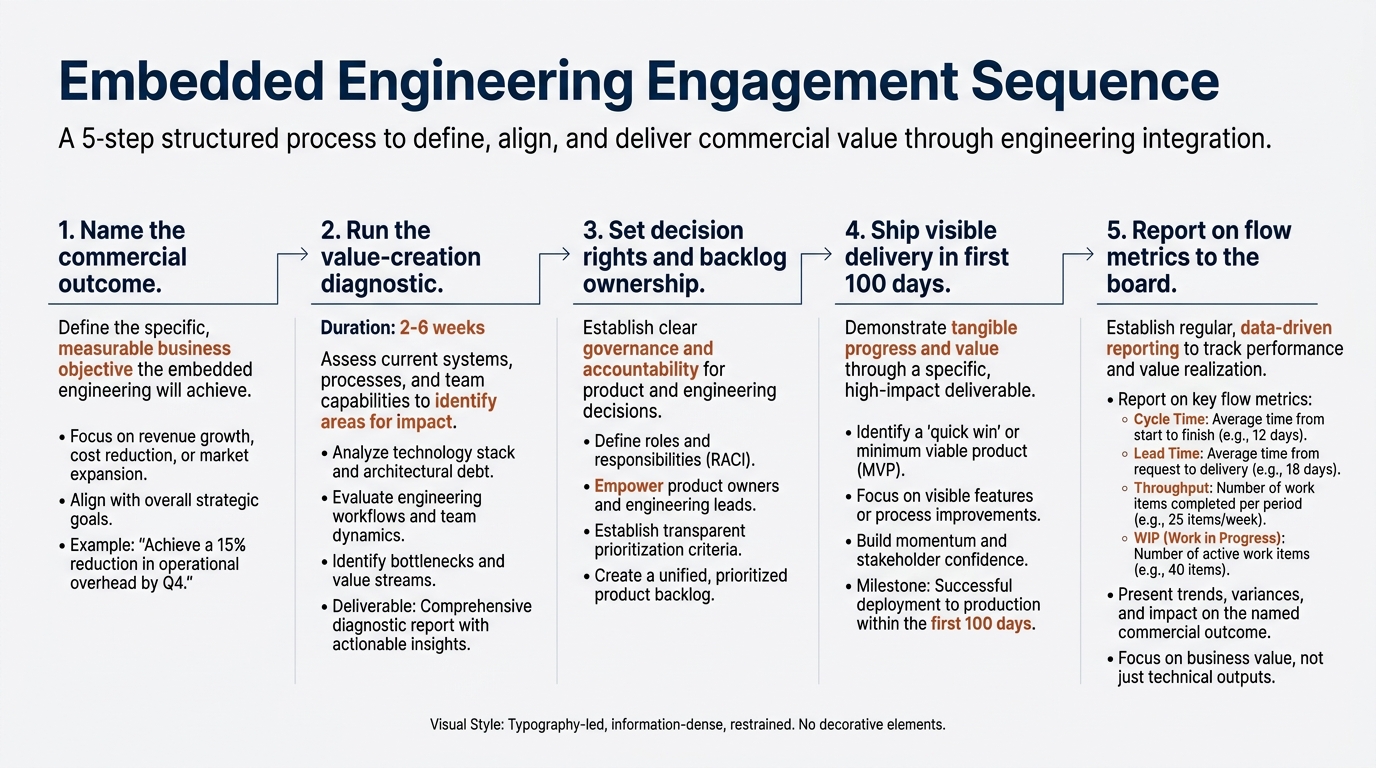
1. Name the problem the team is being hired to solve
Before scoping headcount, write down the commercial outcome the capacity is meant to move. The three most common triggers are a roadmap that has stalled against the value-creation plan, an add-on that requires systems integration the internal team cannot absorb, and a technical debt load that is slowing every release. Each of those points to a different team shape.
A stalled roadmap needs delivery throughput. An add-on needs integration engineers who have done data and system consolidation before. A debt problem needs people who can refactor without breaking the revenue-generating parts of the product. Naming the outcome first keeps the conversation off hours and tickets, which is where these engagements quietly fail.
2. Decide whether the gap is capacity, capability, or leadership
An embedded team is the right tool for a capacity or capability gap. It is the wrong tool for a leadership gap. If the real problem is that the CTO cannot prioritize, cannot say no, or cannot produce a credible plan, adding engineers underneath that person will burn budget and produce the same drift at a higher run rate.
A useful test during diligence is to ask the technical leader for the current sprint plan and the last three release notes. If those documents are thin or absent, the gap is upstream of headcount. Our own review of technology due diligence for portfolio companies repeatedly surfaces this: the code is fine, the prioritization is not.
3. Set the decision rights before anyone writes code
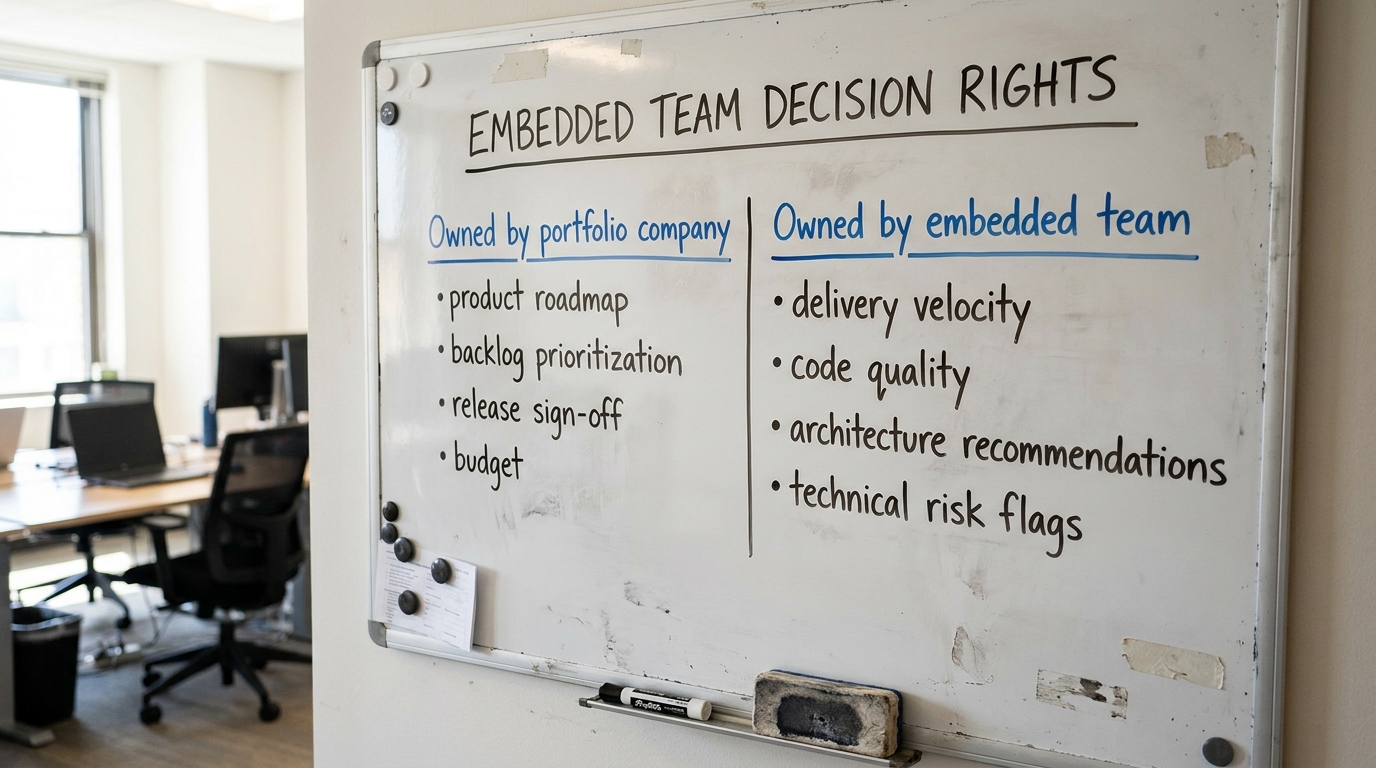
The single most expensive mistake is leaving decision rights ambiguous. Write down who owns the roadmap, who approves architecture changes, who can reprioritize a sprint, and who signs off on production releases. An embedded team should own delivery velocity and code quality against an agreed backlog. It should not own product strategy unless the portfolio company genuinely has no product function, in which case that is a separate, larger decision.
Keep the backlog owner inside the company. The embedded team executes and advises on sequencing and technical risk. When the vendor owns both the backlog and the delivery, you lose the ability to hold anyone accountable to the plan.
4. Scope the team to the value-creation plan, not to a headcount number
Vendors will quote you a number of engineers. That is the wrong unit. Scope backwards from the workstreams in the value-creation plan and the dates they are due. If the plan calls for a billing system replacement before the next audit and a customer data consolidation ahead of an add-on, those are two workstreams with different skill mixes and different critical paths.
A typical embedded retainer in this market runs $15,000 to $50,000 or more per month depending on team size and seniority. The way to judge whether that number is right is to tie it to enterprise-value movement: faster integration, a lifted release cadence, reduced diligence risk at exit. Bain’s annual private equity report has documented for years how operational value creation has replaced multiple expansion as the primary return driver, which is exactly why engineering throughput now sits on the value-creation plan rather than in the IT budget. You can read Bain’s ongoing work in its Global Private Equity Report.
5. Judge the team on leading indicators, not activity
Hours logged, tickets closed, and features shipped are the vendor register that tells you nothing about whether the plan is moving. Ask instead for the metrics that predict delivery: cycle time from commit to production, deployment frequency, change failure rate, and the percentage of committed sprint scope actually delivered. These are standard, they are hard to game, and they surface a slipping team weeks before a missed milestone does.
McKinsey and other firms tracking software delivery performance have consistently pointed to those flow and stability measures as the ones that correlate with business outcomes. You can find McKinsey’s private capital and technology research for the broader operating context. The point for an operating partner is simple: if the monthly report shows activity and not flow, the team is managing you.
6. Insist on a value-creation diagnostic before you commit to a retainer
Standing up an ongoing embedded retainer before anyone has mapped the codebase, the architecture, and the delivery bottlenecks is how you end up paying senior rates to discover problems you could have priced in advance. A short diagnostic, typically a few weeks and $15,000 to $25,000 for a light pass or $45,000 to $75,000 for a full one, produces the baseline: what the debt actually costs, which systems block the add-on, and where the throughput is leaking.
That baseline is what lets you write a retainer scope with real dates and real accountability rather than a headcount and a hope. It is the same logic behind running an honest assessment of an ERP implementation before it breaks the forecast: measure the thing before you fund the fix.
7. Structure the engagement around the first 100 days
Whether the deal has just closed or you are mid-hold, the embedded team’s first stretch should map to the same milestones an operating partner already runs. The first 100 days is where you establish the baseline, agree the backlog, ship something visible, and prove the reporting cadence works before the first board meeting where you will be asked whether the technology risk is contained.
Front-load one or two deliverables that produce visible movement inside that window. A team that spends 100 days on discovery has not been scoped correctly, and the board will read that as a red flag whether or not it is fair.
8. Keep the exit in view from the start
The embedded team solves today’s roadmap and shapes what a future buyer’s diligence will find. Code quality, documentation, key-person risk, and architecture decisions all show up when the bankers arrive. A team that ships fast but leaves the codebase dependent on three contractors nobody can replace has created value on the P&L and destroyed it in the data room.
Build the exit standard into the engagement early. Tie the throughput work to the same criteria a technology exit readiness assessment uses, and the two efforts reinforce each other instead of colliding two years later. Reducing key-person dependency is often as valuable to the multiple as any new feature, a point worth reading against the way firms discuss technical debt elimination in private equity.
9. Compare an embedded team against the alternatives honestly
An embedded retainer is not automatically the right answer. Direct hiring gives you permanent capacity and full control but is slow and hard to reverse if the thesis shifts. A staff-augmentation shop is cheaper per head but rarely owns outcomes. A full outsourced build hands over too much for a company that needs to own its product at exit.
The embedded model earns its place when you need senior throughput quickly, want the team accountable to delivery metrics rather than seat time, and expect the internal team to absorb the capability over the hold. If none of those hold, one of the alternatives is cheaper. The judgment of the partner behind it matters as much as the model, which is the case made in this guide to judging a technical value creation partner and its companion on judging a digital value creation partner.
10. Watch the failure modes that hide in the monthly report
Three patterns show up in engagements that drift. The first is scope creep, where the backlog quietly expands until velocity looks flat despite full effort. The second is overservicing dressed as partnership, where the team does more work than the outcome requires because nobody is holding the line on priorities. The third is a reporting layer that shows hours and features rather than flow and milestones, which lets a slipping engagement look healthy for a quarter.
PitchBook and S&P Global both track how operational underperformance in portfolio companies drags returns; their data is worth reading against your own portfolio in PitchBook’s research and S&P Global Market Intelligence. The operator’s defense against all three failure modes is the same: a baseline, agreed milestones, and a report built on leading indicators.
11. The decision checklist before you sign
- The commercial outcome the team must move is written down and tied to the value-creation plan.
- The gap is capacity or capability, not a leadership gap dressed up as one.
- Decision rights are explicit: the portfolio company owns the roadmap and backlog, the team owns delivery.
- Scope is built backwards from workstreams and dates.
- A diagnostic has produced a real baseline before the ongoing retainer starts.
- The monthly report leads with flow and milestone metrics. Hours and tickets appear in the appendix, tagged to the objectives they support.
- The first 100 days include at least one visible deliverable before the first board meeting.
- Exit-readiness standards for code quality and key-person risk are built into the engagement now.
- The embedded model has been compared honestly against hiring, staff augmentation, and full outsourcing.
Run that list before the contract, not after the first quarter. Every item on it is easier to enforce when it is a condition of engagement than when it is a complaint in a board deck. For the wider operating context, the DevriX private equity practice frames how engineering capacity ties to enterprise value, and operators approaching a sale should read what the exit readiness sprint actually requires an operating partner to decide.
12. Where to take the decision next
If the roadmap is slipping against the plan and the internal team cannot close the gap on the timeline the thesis needs, the next step is a baseline. Start with a value creation diagnostic that measures the codebase, the delivery bottlenecks, and the technical risk. Then scope embedded capacity against what it finds. Take the assessment to the DevriX private equity team to size the diagnostic and the retainer against your value-creation plan.