An operating partner inheriting a portfolio company that runs a high-traffic property, a consumer marketplace, a media network, a SaaS product serving millions of sessions, faces a specific problem in the first board meeting. The platform carries the revenue, the platform carries the risk, and the diligence deck rarely says which. High-traffic platform engineering in private equity is where enterprise value is quietly created or quietly leaks out, month after month, and most value-creation plans treat it as a cost line rather than a lever. This guide is for the executive standing up sales and revenue operations inside that company, or the operating partner sponsoring the work, who has budget and needs to decide what to fund, what to fix, and how to measure it.
The stakes are direct. When a platform serving heavy traffic drops conversion by a fraction, the revenue impact is measurable within a quarter and shows up in actual versus plan before the next board pack. Bain’s annual global private equity report has tracked how operational improvement, not multiple expansion or leverage, now carries the larger share of returns, and platform performance sits squarely inside that operational bucket.
1. Why platform engineering shows up on the value-creation plan
For a business where the product is the traffic, engineering quality is not an IT concern that a CFO can defer. Page speed, uptime, checkout reliability, and search rendering translate into conversion, retention, and acquisition cost, and those three translate into EBITDA. A one-second delay on a high-traffic checkout has a revenue consequence you can model, so the platform belongs on the same value-creation plan as pricing and sales headcount.
The mistake operating partners make is treating platform work as a maintenance retainer rather than a value lever with a return. The right frame is the one you already apply to private equity value creation everywhere else: what is the baseline, what is the target, who owns it, and what does closing the gap add to enterprise value at the current multiple.
2. Separate the two questions before you spend
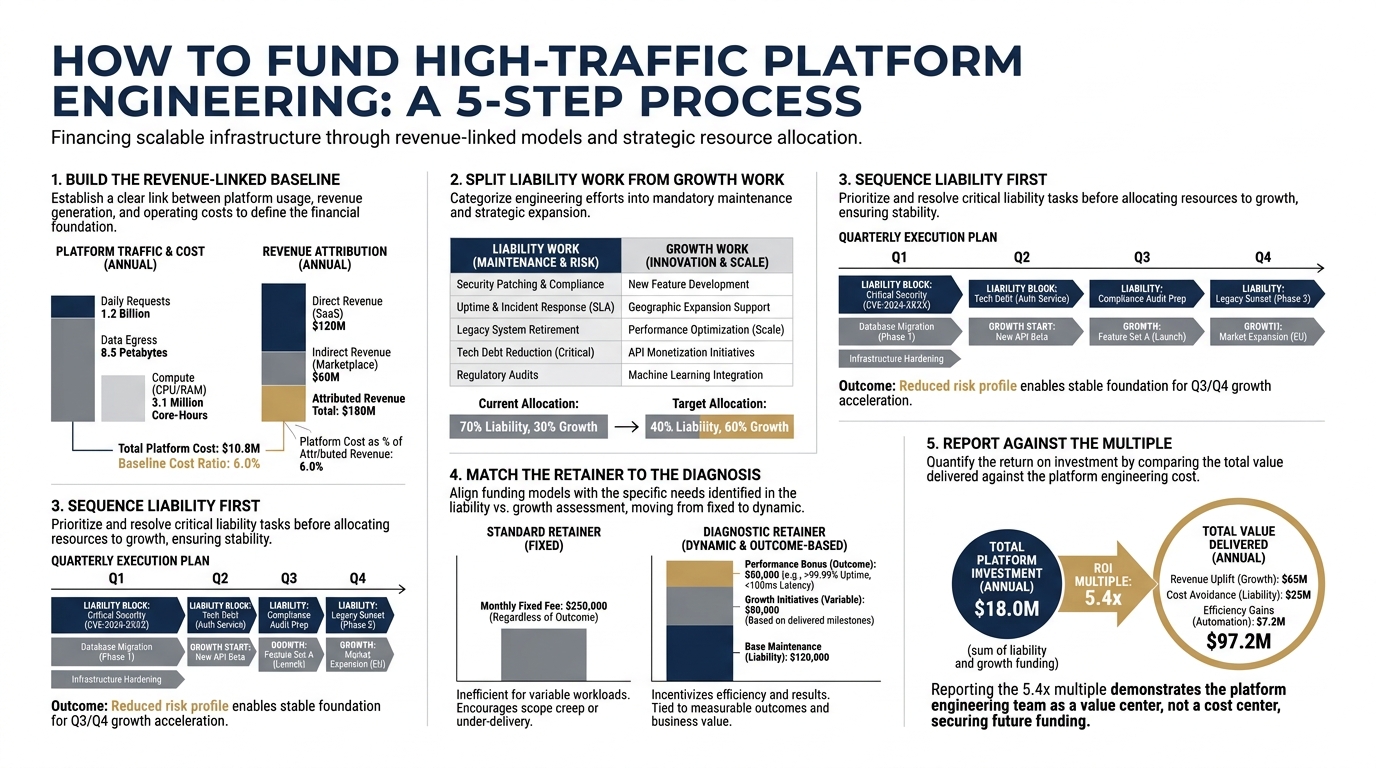
There are two distinct decisions hiding inside “the platform needs work,” and confusing them wastes budget. The first is whether the platform is a liability that threatens the forecast, a reliability and risk question. The second is whether the platform is an under-exploited asset that could grow revenue if engineered better, a growth question.
A liability shows up as outages, security exposure, slow load times, and a fragile deployment process that makes every change risky. An under-exploited asset shows up as flat conversion, a stalled experimentation program, and a backlog of revenue features that never ship because the team is busy keeping the lights on. Fund them differently, and sequence the liability work first, because you cannot grow revenue on a platform that keeps falling over.
3. Establish the baseline before anyone writes a roadmap
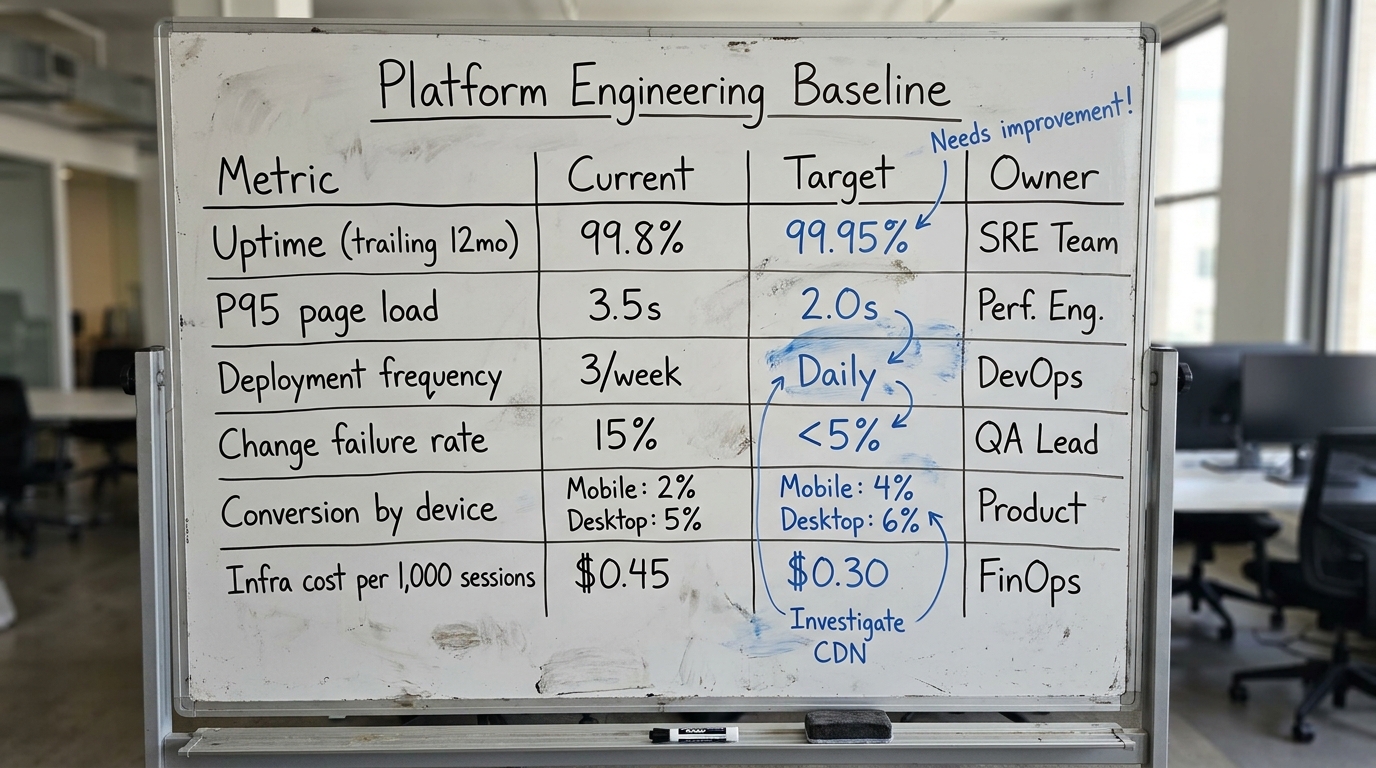
You cannot judge platform engineering without evidence, and the evidence is not the engineering team’s opinion of itself. Pull the numbers that connect to money: uptime over the trailing twelve months, page load times at the fiftieth and ninety-fifth percentile, deployment frequency and change failure rate, and conversion by device and by traffic source.
These are the same metrics a serious buyer will demand at exit, so building the baseline now serves two purposes. This is the technical half of what belongs in a proper exit readiness technology assessment, and running it early means you fix the findings on your own timeline rather than under a bidder’s.
4. Read the diligence you already have, then read what it missed
If the deal closed recently, the confirmatory diligence file already holds part of the answer. The technology due diligence report should cover architecture, key-person risk, security posture, and technical debt. What that report usually undersells for a high-traffic property is the link between engineering practice and revenue: whether the team can ship a pricing test in a week or a quarter, and whether traffic spikes cost money in lost sales or in over-provisioned infrastructure.
McKinsey’s private capital and digital research, published across its insights hub, has repeatedly made the point that the gap between diligence findings and executed value creation is where most of the promised upside is lost. Read the report for what it flags, then commission the revenue-linked view it left out.
5. Decide what “high-traffic” actually demands of the architecture
Traffic volume changes the engineering economics in ways a general IT assessment misses. At high volume, small inefficiencies in caching, database queries, and infrastructure provisioning compound into six-figure annual cost differences, and a fragile architecture turns a marketing win into an outage.
The questions worth asking the CTO
- What happens to cost and to reliability when traffic triples for a campaign or a seasonal peak?
- How long does a change take to reach production, and how often does a change cause an incident?
- What share of infrastructure spend is buying performance versus paying for inefficiency?
- Can the team run controlled experiments on live traffic, or does every test require a deployment risk?
The answers tell you whether you are funding a rebuild, a tuning exercise, or an experimentation capability. Those are three different budgets and three different timelines.
6. Match the engagement to the problem you diagnosed
An embedded engineering retainer in the $15,000 to $50,000-plus per month range earns its keep when the platform is central to revenue and the internal team cannot both keep it running and improve it. That is the common case for a high-traffic portfolio company, where the in-house team is fully consumed by operations and the growth backlog never moves.
Judge the partner the way you would judge any technical value creation partner in private equity: on whether they anchor their work to enterprise-value outcomes rather than ticket counts, and whether they can operate inside a portfolio company’s reporting cadence. A partner who reports hours and features, rather than conversion, cost, and reliability moved against a baseline, is selling activity.
7. Tie the work to the roadmap and the forecast
Platform engineering that is not connected to the IT roadmap and the financial forecast becomes an open-ended cost. You need the roadmap to decide sequence and dependency. You need the forecast to decide whether a given improvement pays for itself inside the hold period.
Get clear on what a portfolio-company roadmap is supposed to produce, because the framing differs from a standalone company. The guide on what an IT roadmap for a portfolio company has to deliver is worth reading alongside this one, and the same discipline that protects an ERP implementation from breaking the forecast applies to platform work: no line item without an owner, a baseline, and a modeled return.
8. Set the measurement so the board can see it
The board does not want a burndown chart. It wants to know whether platform investment is moving the numbers that move the multiple. Report platform work in the same terms as the rest of the value-creation plan: revenue enabled or protected, cost removed, risk reduced, each classified honestly as realized, run-rate, or forecast rather than blended into one optimistic figure.
PitchBook and S&P Global Market Intelligence both publish operational and value-creation research, at PitchBook and S&P Global respectively, that reinforces a simple point: the portfolio companies that report operational metrics with discipline are the ones that command the story at exit.
9. Time the work to the hold, not to the crisis
The trigger matters. Liability work belongs in the first 100 days, because a platform that threatens the forecast is not something to schedule around a board calendar. Growth work belongs earlier in the hold than most teams assume, since experimentation programs and conversion gains compound and need runway to show up in the numbers.
Exit-facing cleanup, the technical debt and documentation a buyer’s diligence will surface, belongs eighteen to twenty-four months before a planned sale, alongside the broader work covered in the exit readiness sprint. Leaving it to the year of sale means fixing findings under a bidder’s timeline and at a discount.
10. A checklist before you approve the spend
- Do you have a revenue-linked baseline (uptime, load times, deployment metrics, conversion) rather than an engineering self-assessment?
- Have you separated liability work from growth work and sequenced the liability first?
- Does every proposed line item have an owner, a target, and a modeled contribution to enterprise value at the current multiple?
- Is the engagement scoped to the diagnosis, a rebuild, a tuning exercise, or an experimentation capability, rather than an open-ended retainer?
- Does the partner report against the baseline in commercial terms, not hours and features?
- Is the platform plan connected to the IT roadmap and the financial forecast?
- Is exit-facing cleanup scheduled with enough runway before a planned sale?
If you can answer those seven, you can defend the budget in the board meeting and you can hold the partner to it. If you cannot, you are funding activity and hoping it becomes value.
When you are ready to scope the work against these questions and put a revenue-linked baseline in place, review the DevriX private equity value-creation offer and bring the platform onto the same footing as the rest of your value-creation plan.