An operating partner reaches the point where a diligence read or a value-creation plan needs an outside firm. West Monroe is on the shortlist because it is competent and known. The real question is not whether West Monroe is good. It is whether the assignment in front of the deal team, a confirmatory technology read, a post-close revenue-operations rebuild, a system migration that is blocking synergy capture, is best served by a large digital and management consultancy, or by a smaller embedded firm that owns the work through Day 100. This guide is for the person making that call with budget already allocated, and it lays out how to define the scope, weigh a West Monroe alternative, and judge either choice against enterprise-value outcomes rather than deliverables.
The stakes are commercial. A diligence engagement that produces a thick report and no owned remediation leaves the sponsor holding the risk. A value-creation retainer that bills activity without moving revenue or EBITDA burns fee and calendar the hold period does not have. So the selection criteria have to start from the outcome, not the brand.
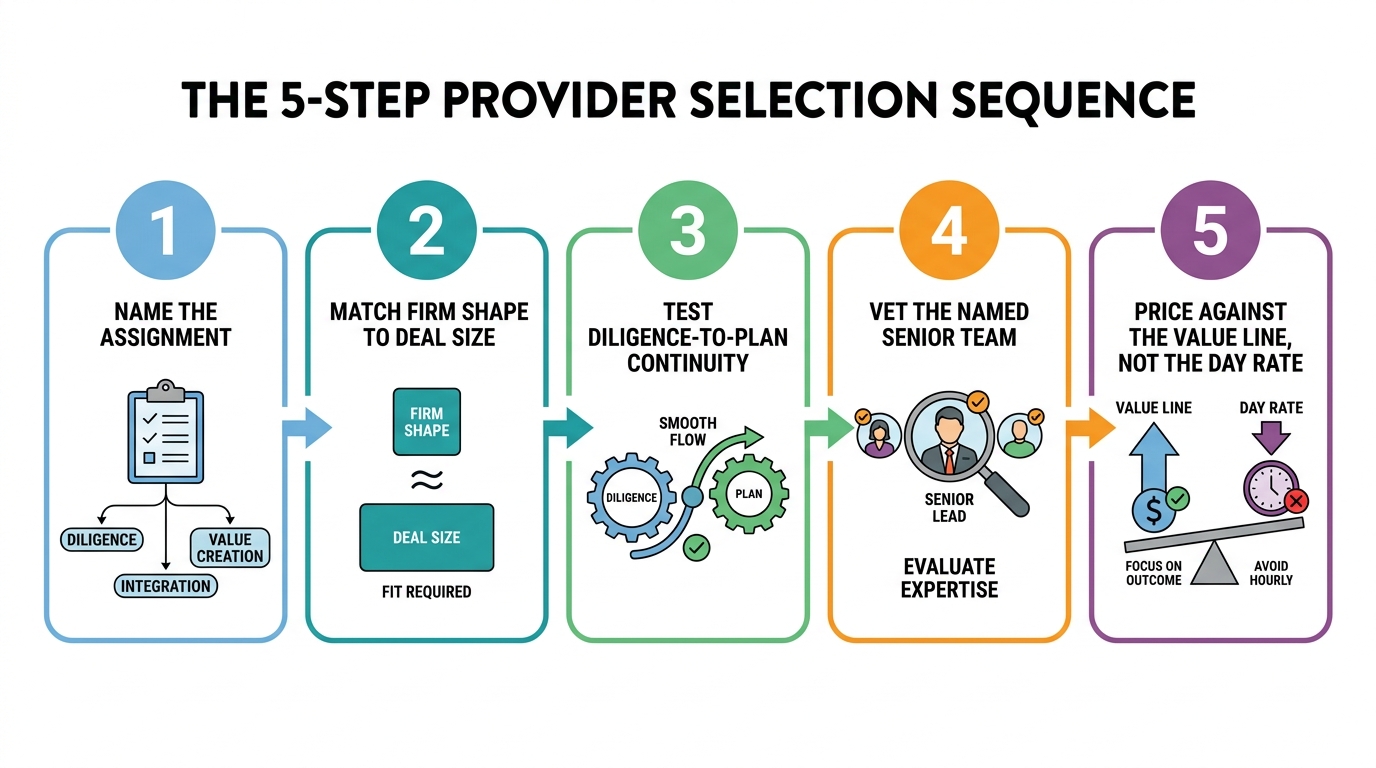
1. Name the assignment before you name the firm
Most selection mistakes happen because the buyer shops for a firm before defining the assignment. The three assignments that pull operating partners toward West Monroe and its peers are distinct, and they reward different providers.
- Confirmatory diligence. A pre-close read on technology, data and revenue systems, feeding the risk register and, ideally, the 100-day plan.
- Value-creation execution. Post-close work that owns a workstream to a financial result: a CRM rebuild, a pricing-data fix, a RevOps integration across acquired entities.
- Integration. Merging systems, teams and reporting after an add-on so synergy capture actually lands.
Write down which one this is, who holds the decision right, and what financial line it moves. That single paragraph does more to filter firms than any capabilities deck.
2. What West Monroe is strong at, and where the seams show
West Monroe is a large digital and management consultancy with a genuine PE practice. For a sponsor that wants a broad diligence sweep across a big target, or a multi-workstream transformation with a program-management layer, that scale is an asset. The seams show in two places operating partners feel directly.
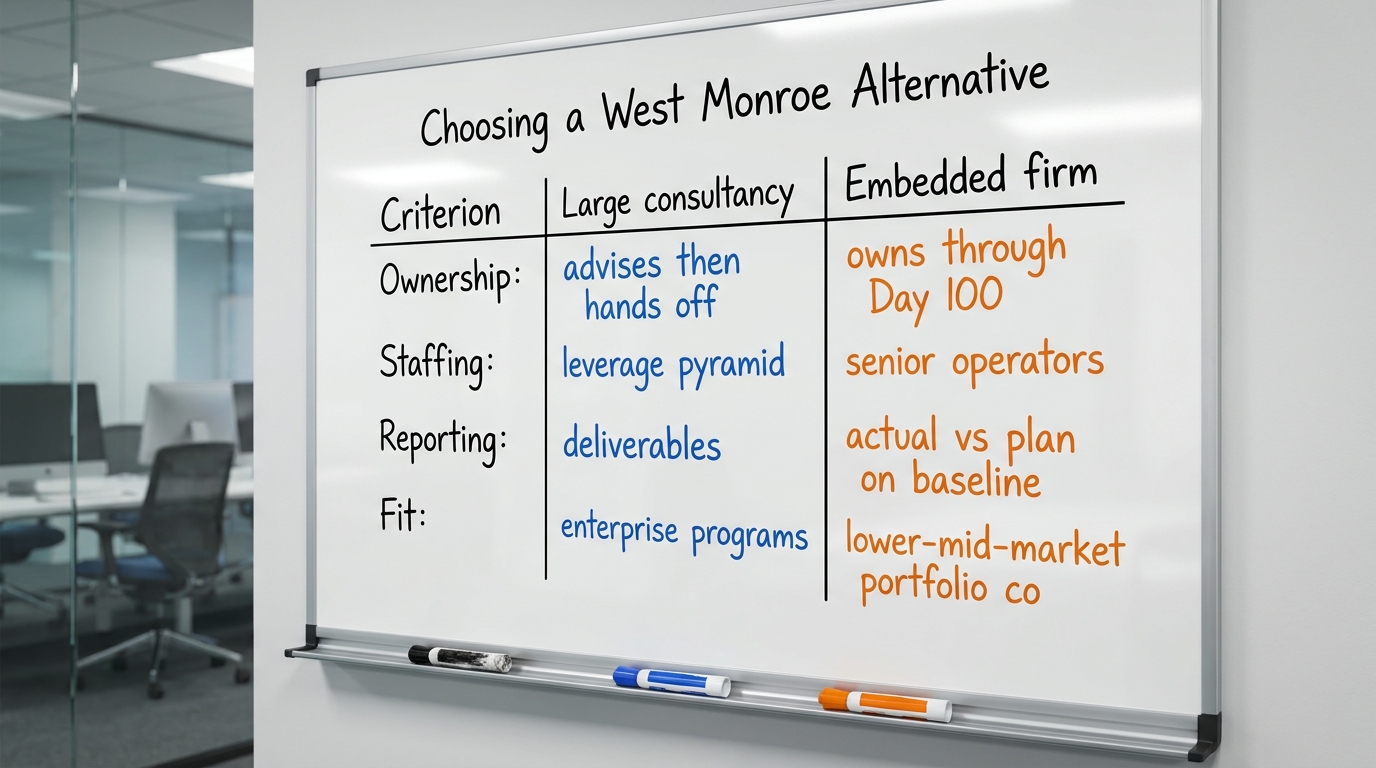
The first is ownership. Large consultancies are structured to advise and then hand off. When the recommendation lands but the remediation belongs to a rotating team, or to the portfolio company’s already-thin staff, the value leaks in the gap. The second is fee and pace relative to a lower-middle-market deal. A firm built for enterprise programs can be heavy for a $30M-revenue portfolio company that needs a senior operator inside the business for six months.
3. What a West Monroe alternative should be able to prove
A credible West Monroe alternative is not simply cheaper. It should be able to prove three things before you sign. It owns the work through implementation, not just the diagnosis. It staffs the engagement with senior operators who have stood up revenue operations inside a portfolio company, not a leverage pyramid of analysts. And it reports against actual versus plan on a financial baseline, so the board can see the number move.
This is the difference between buying activity and buying an outcome, a distinction worth being disciplined about when you hire a sales operations consultant for a portfolio company. Hours and tickets are the vendor’s register. Enterprise value is yours.
4. Match the firm shape to the deal size
The single most useful filter is deal size against firm shape. Bain’s annual private-equity report, published at the Bain Global Private Equity Report hub, has tracked for years how value creation has shifted from financial engineering toward operational improvement. That shift matters for provider selection: operational improvement in a lower-middle-market company is delivered by senior people inside the business, not by a large advisory footprint.
For a large-cap platform with many workstreams, a full-scale consultancy earns its fee. For a company in the $10M-100M revenue band, an embedded firm with a fixed senior team is usually the better economics and the faster path to a result. Research from firms such as McKinsey and BCG on private-capital value creation consistently points to operational levers and management capability as the durable drivers, which favors depth of ownership over breadth of coverage.
5. Judge the diligence read by whether it converts to a plan
A diligence report has one job beyond flagging risk: it must convert into an owned 100-day plan. The test is simple. Ask any candidate firm how their technology due diligence output feeds the first 100 days. If the answer is “we deliver the report and you take it from there,” the sponsor is buying analysis and keeping the execution risk.
The stronger providers, whatever their size, describe how each finding in the risk register maps to an owner, a workstream, and a date. That continuity is worth more than the depth of the report itself, because the value only shows up when the risk is retired.
6. Look hard at the staffing model
Who actually does the work
Ask for the named team, their seniority, and their allocation. A partner in the pitch and analysts in the delivery is the oldest pattern in consulting, and for embedded operating work it is the wrong one. The person configuring the CRM, cleaning the pricing data, and standing up the forecast should be the same seniority you met in the sale.
How the knowledge stays
Enablement is native to durable value creation. A firm that builds the playbook, trains the portfolio company’s team, and leaves capability behind produces a result that survives the engagement. This connects to how you think about when to outsource sales operations in a PE-backed company, and where the internal team eventually takes ownership.
7. Price the engagement against the value line, not the day rate
Comparing day rates is the wrong comparison. Price the engagement against the financial line it moves. A retainer in the $15K-50K per month band is expensive if it produces documents and cheap if it lifts run-rate revenue or removes a covenant risk. An embedded model that owns a RevOps rebuild and reports monthly against plan is buying a forecast the CFO can defend, not consulting hours.
The failure mode to avoid is the post-merger synergy that never lands because the revenue systems were never actually integrated. As covered in why post-merger synergies fail, the gap is almost always execution ownership, not strategy. A West Monroe alternative should be judged first on whether it closes that gap.
8. Watch the two failure modes that cost the hold period
Two failures recur regardless of which firm is chosen. The first is the report with no owner: sharp analysis, no remediation, risk left in place. The second is the activity retainer: high billing, healthy dashboards, no movement in revenue, EBITDA or forecast reliability. Both are avoidable, and both are visible in the first month if the operating partner insists on a baseline and an actual-versus-plan report from the start.
9. Bring the change management the tools do not
System and process work fails on adoption more than on configuration. A new CRM that the sales team routes around is a write-off. This is why the human layer matters: the same discipline that makes employee training actually stick makes a RevOps rollout stick. When a firm treats adoption and enablement as part of the engagement rather than the client’s problem, the technical work holds. When it does not, the sponsor pays twice.
10. A short checklist before you sign
- The assignment is written down as diligence, value creation, or integration, with the financial line it moves.
- The firm owns the work through implementation, not just the recommendation.
- The named senior team in the sale is the team in the delivery.
- Diligence findings map to owners, workstreams and dates in the 100-day plan.
- Reporting is actual versus plan on a stated baseline, not a deliverables log.
- Adoption and enablement are inside the scope, not assumed away.
- The fee is measured against the value line, and the firm shape matches the deal size.
Run any provider, West Monroe or an alternative, through this list. The firm that answers cleanly on ownership, staffing and reporting is the one worth the fee, whatever its logo.
11. Where to take the decision next
For an operating partner weighing a lower-middle-market engagement, the practical next step is to test the embedded model against the checklist above. DevriX runs private equity value-creation work as an embedded retainer with a senior team that owns the workstream through Day 100 and reports against a financial baseline. If the assignment is a diligence read that has to convert into an owned plan, or a RevOps rebuild that has to move the forecast, review the DevriX private-equity value-creation offer and map it directly against your risk register.