Six weeks after close, a mid-market services business misses its first monthly forecast under the new owner. Not because demand softened, but because the finance team spent 40 hours reconciling three order systems by hand, and the sales team booked deals into a CRM nobody trusts. The operating partner asks for a rolled-up pipeline number and gets three different answers. This is the moment process automation stops being an IT topic and becomes an enterprise-value topic. The question in front of the deal team is not whether the portfolio company should automate. It is which processes, in what order, tied to which line on the value-creation plan, and how to tell real EBITDA impact from a vendor selling hours.
This guide is for the operating partner or portfolio executive standing up revenue and back-office operations inside a newly acquired company. It assumes budget, a thesis, and a clock. It does not define standard terms. It lays out what to decide and how to judge the answer.
1. Start from the value-creation plan, not the tool
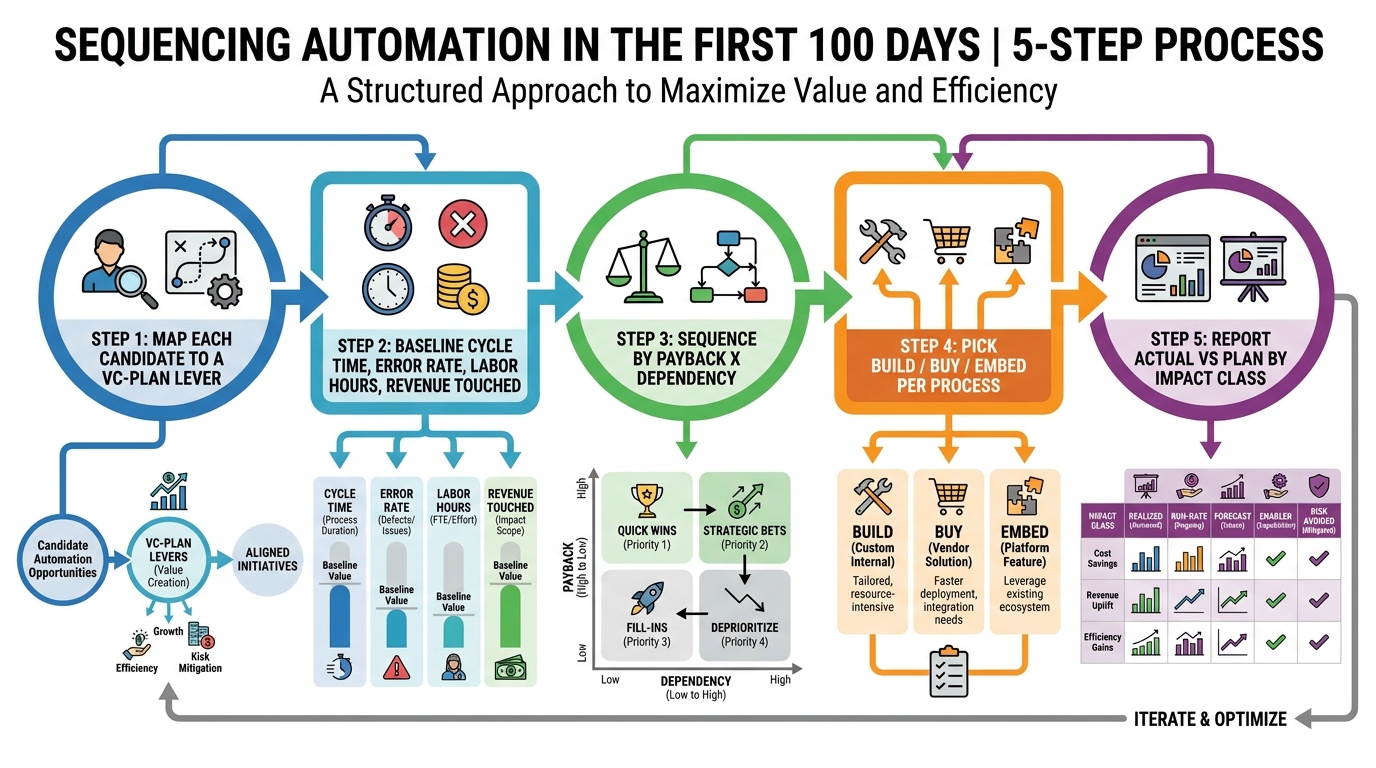
Process automation for portfolio companies fails most often when it starts as a technology initiative instead of a financial one. The buyer did not acquire a workflow engine. It acquired a thesis: margin expansion, a faster integration, cleaner management reporting, a shorter path to exit. Every automation candidate has to map to one of those.
Before any tooling conversation, force the mapping. If a proposed automation cannot be tied to a specific outcome, revenue captured that was leaking, headcount cost avoided, days pulled out of a close cycle, error rate that was inflating churn, then it belongs in a backlog, not a Day 1 plan. Bain’s annual Global Private Equity Report has consistently pointed to operational improvement, not multiple expansion or leverage, as the durable source of returns in the current cycle. Automation is one lever inside that, and only when it moves a number.
2. Separate the four kinds of automation the plan will contain
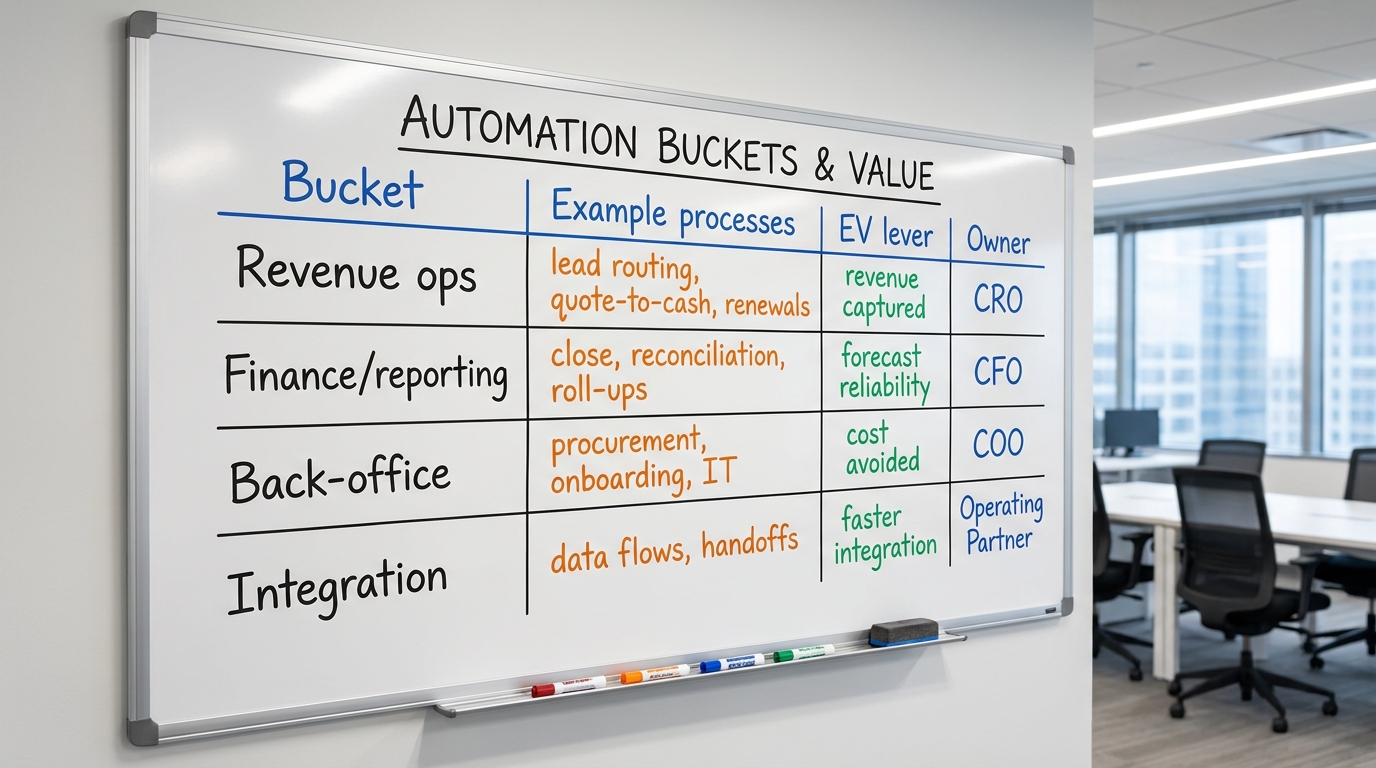
Lumping everything under “automation” hides where the value is. Sort candidates into four buckets so the board sees what each dollar buys.
Revenue operations automation
Lead routing, quote-to-cash, CRM hygiene, renewal triggers, commission calculation. This is where automation touches the top line directly, and where a portfolio company usually has the most avoidable leakage.
Finance and reporting automation
Order-to-cash reconciliation, close acceleration, management-reporting roll-ups across acquired entities. This is what makes the forecast trustworthy, which is what the CFO and the board actually feel.
Back-office and shared-services automation
Procurement, onboarding, IT provisioning, ticket routing. Cost-out plays, real but rarely thesis-defining on their own.
Integration automation
The data flows and process handoffs that let an add-on stop operating as a separate company. This is where automation earns its keep during a buy-and-build.
3. Baseline before you buy anything
An automation decision made without a baseline is a bet. For each candidate process, capture the current state in numbers the CFO recognizes: cycle time, error rate, fully loaded labor hours, revenue touched. Without that baseline there is no “actual vs plan” later, which means no way to prove the automation worked and no defense at the board meeting when someone asks what the spend returned.
This is the same discipline that separates a real technology due diligence from a tour of the tech stack. You are establishing evidence, not collecting screenshots. When the assessment happens pre-close, the automation roadmap can be priced into the value-creation plan instead of surfacing as a surprise in month three.
4. Sequence by payback and integration dependency
Order matters more than ambition. Two variables decide sequence: how fast the automation pays back, and what it unblocks downstream.
- Fast payback, no dependency: ship first. These fund credibility and often the next phase.
- Slow payback, high dependency: these are foundational, like a single source of customer and revenue data. Painful, unglamorous, and required before the flashy stuff works.
- Fast payback, high dependency: tempting to grab, but they break if you skip the foundation. Sequence them after.
- Slow payback, no dependency: backlog. Revisit at the next planning cycle.
Revenue operations automation frequently sits in the third box: quote-to-cash looks like a quick win but collapses if the underlying customer data is duplicated across the acquired entities. This is exactly the failure pattern documented in why post-merger RevOps synergies fail, teams automate on top of unreconciled data and lock the mess in place.
5. Decide build, buy, or embed
Three delivery models, three different risk profiles.
Buy configured SaaS
Fastest to stand up, weakest fit to nonstandard processes. Good for commodity workflows. The trap is buying a platform whose adoption the team quietly refuses, which turns a capex line into shelfware.
Build in-house
Best fit, highest key-person risk and slowest. Rarely the right call in a three-to-five-year hold unless the process is a genuine differentiator.
Embed an external operating team
An outside team owns the outcome, builds against the value-creation plan, and hands over a running process. This is the model behind the decision to outsource sales operations in a PE-backed company, and the judgment framework is the same: you are buying a result, not seat-time.
6. Judge the vendor by the number, not the activity
The single most common way portfolio companies waste automation budget is by paying for activity, tickets closed, workflows built, hours logged, while the P&L stays flat. When a partner or agency proposes work, the test is whether they will commit to a baseline and a target metric before they start.
The same buying discipline applies here as when you hire a sales operations consultant without buying activity: if the proposal describes what they will do rather than what will change, it is a red flag. A serious partner names the metric, agrees how it will be measured, and accepts that the engagement is judged on it. If you are weighing a large consultancy against a specialist shop, the same lens sorts them, covered in this look at judging a West Monroe alternative on fit.
7. Classify the impact honestly
Not all value is the same value, and the board can tell the difference. Before an automation goes into the plan, label what kind of impact it produces:
- Realized: the number already moved and it is in the actuals.
- Run-rate: the process is live and the monthly effect is now steady.
- Forecast: modeled, not yet delivered. Do not let this read as realized.
- Enabled: the automation makes a future play possible but captures nothing on its own.
- Risk avoided: a failure or leak that no longer happens.
An honest roadmap shows the mix. A vendor deck that presents forecast savings as if they were banked is the fastest way to lose the CFO’s trust and, eventually, the board’s.
8. Do not automate a broken process
Automating a bad process just makes the bad outcome arrive faster and cheaper to produce. Where a workflow is genuinely dysfunctional, redesign comes before automation. This is also where the human side gets underrated. A process nobody follows will not be saved by software, which is why adoption depends on enablement and, as the research on the science of motivation in employee training shows, on people understanding why the new way serves them. Automation changes who does what, and change that skips the people rarely sticks.
9. Watch the integration and data foundation
In a buy-and-build, the automation that matters most is usually the least visible: the data model and the integration layer that let acquired entities report as one company. Get this wrong and every downstream automation inherits the fracture. This is the same foundational judgment covered in application modernization for private equity, and it belongs in the diligence-stage view, not month six. Research from McKinsey and analysis on the Harvard Law School Forum on Corporate Governance has repeatedly flagged integration execution as where deal value is won or lost, and automation of the data spine is a large part of that execution.
10. Account for compliance and control risk
Automating a customer-facing or financial process changes the control environment. An automated revenue workflow that mishandles data, or a customer portal that fails accessibility standards, creates exposure that shows up in the next diligence, not this quarter. The considerations around accessibility compliance engineering apply directly here: automation must reduce operating risk, not quietly manufacture it. Treat control and compliance as an item on the risk register for every automation, with a named owner.
11. Tie the whole thing to a reporting cadence
Automation without a reporting rhythm drifts. Fold each live automation into the standard board and management pack, reported as actual vs plan against the baseline set in step three. When the effect is real it shows up in the forecast reliability the CFO reports, which is often the metric the board weights most heavily. Data providers like PitchBook and Preqin track holding periods and value-creation patterns across the industry, and the pattern is consistent: measurable operational improvement, reported cleanly, is what a future buyer pays for.
12. The operating partner’s decision checklist
- Every automation candidate maps to a named value-creation lever, or it goes to the backlog.
- A numeric baseline exists before any spend is committed.
- Candidates are sequenced by payback and integration dependency, not by enthusiasm.
- Build, buy, or embed is decided per process against fit, speed, and key-person risk.
- The delivery partner commits to a target metric, not a list of activities.
- Impact is labeled realized, run-rate, forecast, enabled, or risk avoided, with no forecast dressed as realized.
- Broken processes are redesigned before automation, and adoption is enabled, not assumed.
- The data and integration foundation is judged during the first 100 days, not later.
- Compliance and control risk carries a named owner on the risk register.
- Every live automation is reported as actual vs plan in the standard board cadence.
Run this before signing any automation statement of work. It converts a vague “we should automate” into a defensible sequence tied to the plan, and it gives the board a way to judge the return. For the broader operating context this sits inside, the full private equity value-creation approach connects automation to the rest of the hold-period plan.
If the portfolio company needs a partner that will own the outcome, baseline the metric, and build automation against the value-creation plan rather than bill for activity, route the engagement through the DevriX and GrowthShuttle PE offer and start with the highest-payback, lowest-dependency process on the list.