By the time an operating partner asks about technical debt, the cost is usually already showing up somewhere on the P&L. Release cycles that used to take days now take weeks. A key hire quits and the platform’s institutional knowledge walks out the door with them. An add-on closes and the two codebases refuse to talk to each other. None of these read as “technical debt” on a board deck. They read as missed forecast, slow integration, and a management team that cannot tell you why velocity dropped.
Technical debt elimination in private equity is not an engineering hygiene project. It is a capital allocation decision with a return profile, a payback window, and a set of risks that either shrink or grow the exit multiple. This guide is written for the person who has to approve that spend inside a portfolio company and then defend it at the next board meeting. It assumes budget authority, not curiosity about the topic.
1. Frame the problem as enterprise value, not code quality
The mistake that kills these programs is letting the engineering team scope the work. Left alone, they will produce a backlog of refactors ranked by how much they annoy the people writing the code. That is a legitimate craft priority and a poor investment thesis.
The operating partner’s job is to force a different question: which pieces of debt are actively suppressing revenue growth, margin, or the ability to integrate an acquisition, and which are simply inelegant? Debt that no customer or acquirer will ever feel does not compete for capital in a hold period. The frame Bain has documented across its Global Private Equity Report series applies here without modification: value creation now carries the return, so every discretionary dollar has to trace to it.
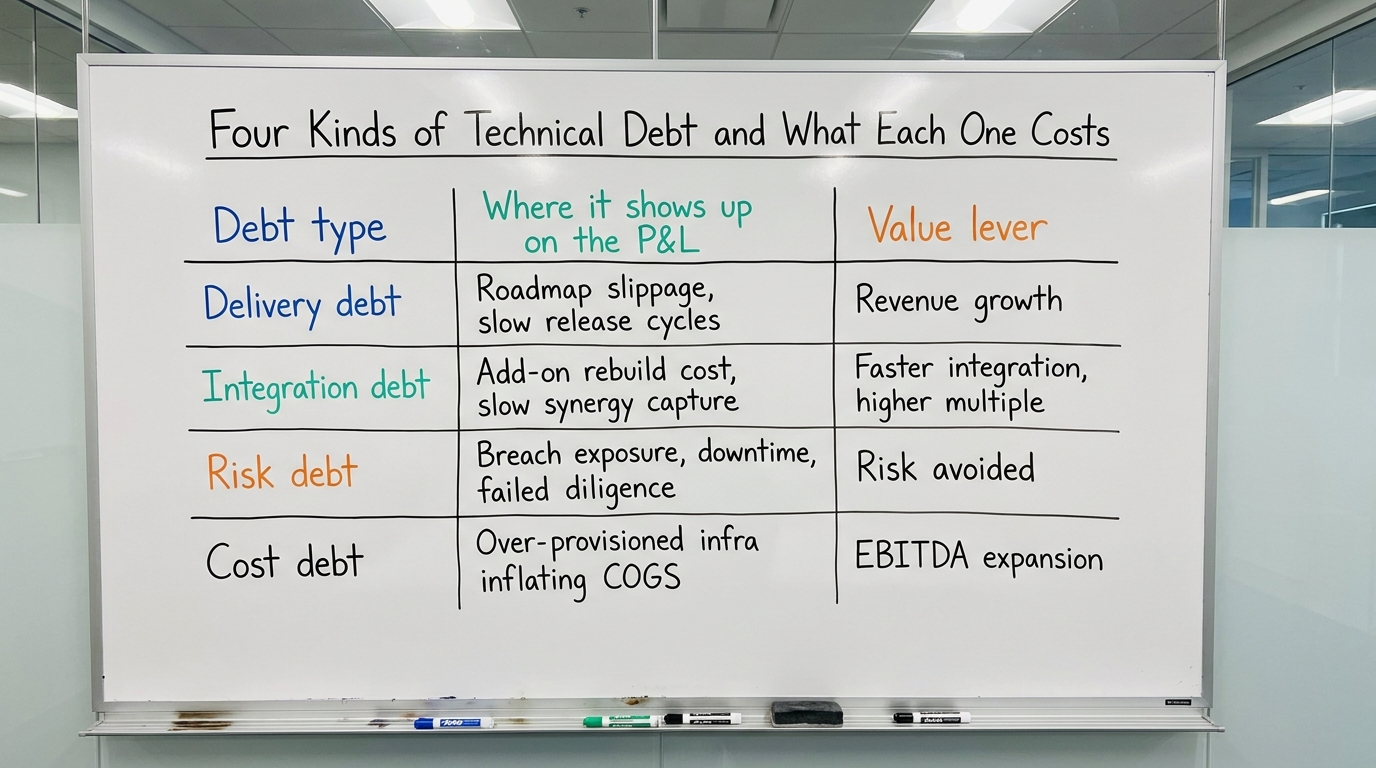
2. Separate the four kinds of debt before you price anything
Not all technical debt is the same asset class, and pricing it as one number is how sponsors overpay or underinvest. Break it apart first.
Delivery debt
Debt that slows how fast the team ships. Manual deploys, no test coverage, fragile build pipelines. This one shows up as roadmap slippage and directly caps new revenue.
Integration debt
Architecture that cannot absorb an add-on without a rebuild. In a buy-and-build thesis this is the most expensive category, because it taxes every future deal, not just this platform.
Risk debt
Security gaps, unpatched dependencies, single points of failure, no disaster recovery. This one does not cost you until it costs you everything.
Cost debt
Over-provisioned infrastructure and inefficient architecture that quietly inflates COGS. Often the easiest to attack for a fast EBITDA read.
3. Establish a baseline you can defend to the board
Before approving any spend, insist on a baseline that is measurable and owned. “The code is bad” is not a baseline. Deployment frequency, change failure rate, mean time to recovery, and cycle time from commit to production are. So is a dependency and end-of-life inventory, a cloud cost breakdown, and a named owner for each system.
This is where a rigorous technology due diligence read earns its fee. If you are still in diligence or confirmatory, the baseline should already be forming. If you are post-close, the first 30 days is when you set it. Without a baseline, you cannot tell the difference between progress and activity later, and you will be sold hours instead of outcomes.
4. Attach every remediation item to a value lever
Once debt is inventoried, each item gets tagged to exactly one of the levers that move enterprise value: revenue growth, EBITDA expansion, cash-flow improvement, faster integration, reduced operating risk, better management visibility, or a shorter path to exit. If an engineer cannot articulate which lever an item pulls, it drops down the stack.
This exercise usually cuts a raw backlog by half or more, and it changes the conversation from “we need to refactor the payments module” to “the payments module blocks us from launching the annual billing plan that adds run-rate revenue.” One is a cost. The other is an investment with a return.
5. Sequence the work against the hold clock, not the ideal
Engineers optimize for the correct end state. Sponsors optimize for the return inside a defined hold. These two goals rarely produce the same sequence.
Cost debt and risk debt tend to pay back fastest and belong early, often in the first 100 days when you have organizational permission to change things. Integration debt is timed to the add-on pipeline, so it moves earlier in an aggressive buy-and-build and later in a single-platform hold. Delivery debt is continuous and should be funded as a standing percentage of engineering capacity, not a one-time cleanup. The point BCG and McKinsey both make in their principal investor and private capital research holds here: value capture is a function of sequencing and timing, not just the size of the opportunity.
6. Decide build, retain, or outsource the remediation team
The staffing decision determines whether the program is fast or merely well-intentioned. Three options, each with a different risk profile.
- Use the existing team. Cheapest on paper, but the people who built the debt are often the wrong people to remove it, and they still owe the roadmap. Remediation loses every prioritization fight to feature work.
- Hire in. Right for a long hold and a platform you intend to scale, wrong when the clock is short, because senior engineering hiring takes months you may not have.
- Embed an outside team. The fit when you need dedicated remediation capacity that does not compete with the roadmap, tied to outcomes rather than headcount. This is the same logic that governs the decision on when to outsource sales operations in a PE-backed company: buy the outcome, hold the vendor to a baseline, and do not pay for activity.
7. Know where technical debt overlaps with modernization
Technical debt elimination in private equity is not a standalone workstream. It overlaps heavily with cloud and application modernization, and treating them separately doubles the disruption to the business.
If the platform is heading to the cloud anyway, some debt is retired as a byproduct of the move. The decisions there deserve their own read, and the site covers them directly in guides on cloud modernization in a private equity portfolio, the narrower question of cloud migration for a portfolio company, and application modernization for private equity. Where a remediation item and a modernization item point at the same code, they should be planned as one workstream with one owner.
8. Guard against the activity trap
The most common failure is a program that reports furiously and moves the business nowhere. Story points closed, tickets resolved, tests written. All real, none of it an outcome unless it maps back to the baseline from section 3.
The discipline for judging a vendor here mirrors the discipline for judging any embedded partner. The same standard laid out in hiring a sales operations consultant without buying activity applies to an engineering partner: contract against a defined change in the numbers, review against it monthly, and refuse a status report that leads with effort instead of result.
9. Build the risk register the CFO and the board will actually use
Risk debt is the category most likely to fail a re-trade or a confirmatory diligence at exit, so it needs a register that a CFO can read. Unpatched dependencies, missing recovery plans, concentration on a single engineer, and compliance gaps all belong here, each with an owner, a severity, and a remediation date.
Two adjacent workstreams often surface in the same review. Post-merger technology integration is where debt and synergy targets collide, a dynamic the site unpacks in why post-merger synergies fail. And regulatory exposure such as accessibility compliance engineering is risk debt with a legal deadline attached. On disclosure and governance expectations, the Harvard Law School Forum on Corporate Governance and the SEC are the reference points a CFO will recognize.
10. Price it against exit, and know when this matters
The final decision is whether the spend buys a better exit. Technical debt that a sophisticated buyer’s diligence team will find becomes a re-trade lever against you. Retiring it before the process starts protects the multiple. Sources that track deal quality and buyer behavior, including PitchBook and S&P Global Market Intelligence, consistently show that clean, well-documented technology assets clear diligence faster and with fewer valuation adjustments.
The triggers that should force this decision onto the agenda: signing an LOI on a platform with an unknown codebase, entering confirmatory diligence, Day 1 of a new hold, the first board meeting where roadmap slippage appears, a system migration, or the moment an add-on’s integration lands behind plan.
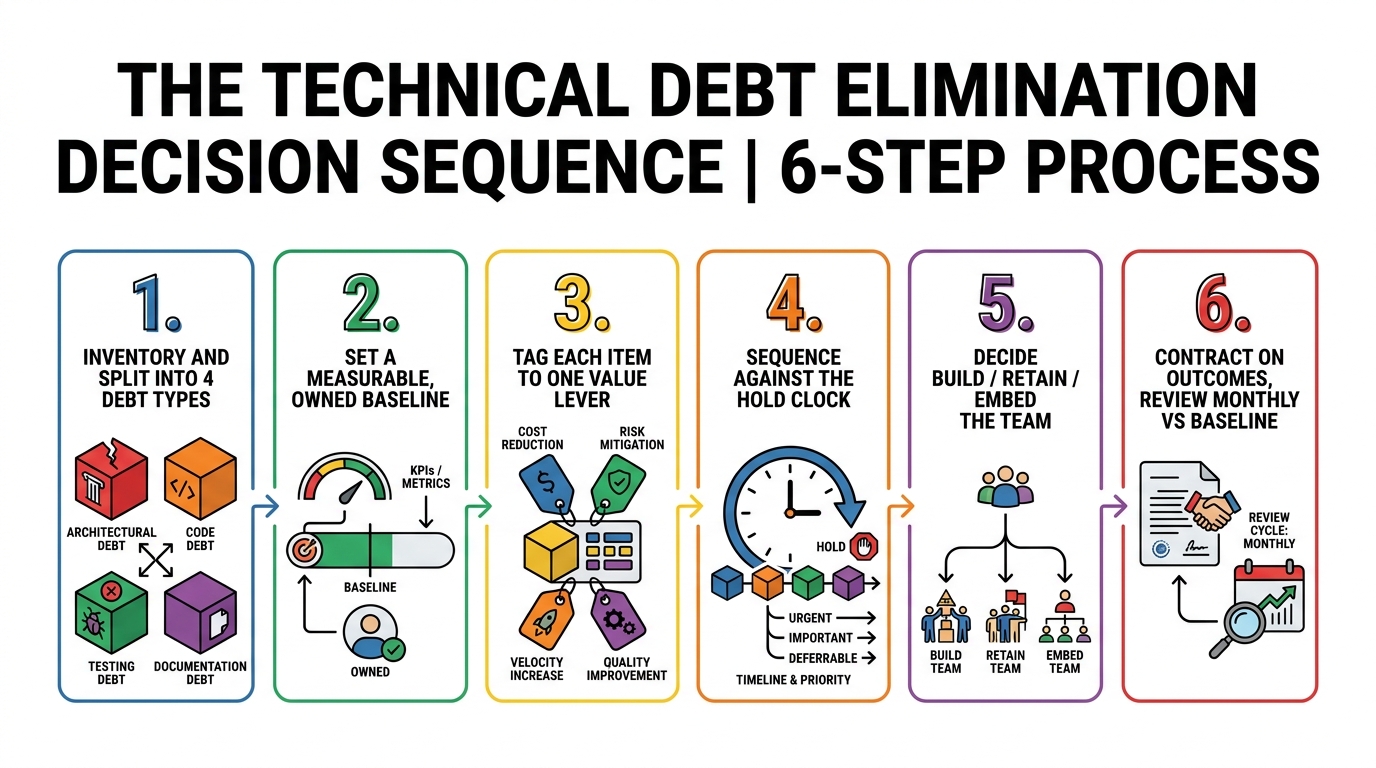
11. The decision checklist
Before approving a technical debt elimination program in a portfolio company, the operating partner or executive should be able to answer each of these:
- Is the debt inventoried and split into delivery, integration, risk, and cost categories?
- Does a measurable baseline exist, with named owners, that the board can read?
- Is every funded item tagged to a single enterprise-value lever?
- Is the sequence built against the hold clock, with cost and risk debt handled early?
- Has the build-versus-retain-versus-embed staffing decision been made deliberately, not by default?
- Is remediation planned as one workstream with any overlapping cloud or application modernization?
- Is the vendor or team contracted against outcomes, with monthly review against the baseline?
- Does the risk register carry owners, severities, and dates the CFO can defend at exit?
12. Where to take the decision next
If the platform’s technical debt is now a line item on your value-creation plan and you need it scoped, sequenced, and staffed against the hold clock rather than the engineering wish list, review the embedded technology value-creation offer built for private equity portfolio companies and bring the baseline and thesis into the first conversation.