An operating partner inherits a technology roadmap that reads like a wish list. Twenty initiatives, no sequencing, no cost of delay, and no line connecting any of them to the value creation plan the deal team underwrote. When the CFO asks which three of those items move EBITDA inside the hold period, nobody in the room can answer. A technology roadmap consultant for a portfolio company delivers value by producing a roadmap that survives the first board meeting with its priorities intact and its connection to the value creation plan clear, rather than one that requires a complete rebuild in month four because the board could not connect the work to the outcome.
This guide is written for the person standing up the roadmap decision inside a portfolio company: what you actually need to decide before you engage anyone, and how to judge the work once it starts. It assumes budget, a live thesis, and a management team that is already stretched.
1. Decide what the roadmap is for before you hire anyone
A roadmap is a sequence of investment decisions with owners, costs, and expected returns attached to a timeline that ends at exit. Before you engage a technology roadmap consultant for a portfolio company, write down the two or three outcomes the roadmap has to produce: a specific EBITDA lever, an integration dependency cleared, a diligence risk retired, or management visibility the current systems cannot deliver.
If you cannot state the outcome, you are buying an exercise that produces a binder. Bain’s annual research on private equity value creation has tracked how the burden has shifted from multiple expansion toward operational improvement, which means the roadmap has to name the operating result, not the technology.
2. Separate the roadmap from the diligence you already paid for
If you ran technology due diligence before close, you already have a baseline: what the systems are, where the technical debt sits, and which risks were flagged. The roadmap consultant’s job is to turn that baseline into a sequenced set of decisions, not to re-audit the estate and charge you again for findings you own.
Bring the diligence report to the first working session. A consultant who wants to start from a blank page is either padding scope or admitting the diligence was thin. Either answer is worth knowing early.
3. Judge the consultant on how they sequence, not on the list
Any competent firm can produce a list of thirty things a portfolio company should fix. The value is in the ordering. Ask a candidate to sequence a sample backlog and explain the reasoning: what has to happen first because everything else depends on it, what can wait, and what to kill outright because the payback lands after exit.
The tell of a real operator is that they will refuse to do all thirty. They will cut the roadmap to the handful of moves that change the number and defend the cuts. The parallel discipline in commercial diligence shows up in the go-to-market exit readiness work an operating partner should run before the bankers arrive, where the same instinct to prune separates a plan from a catalog.
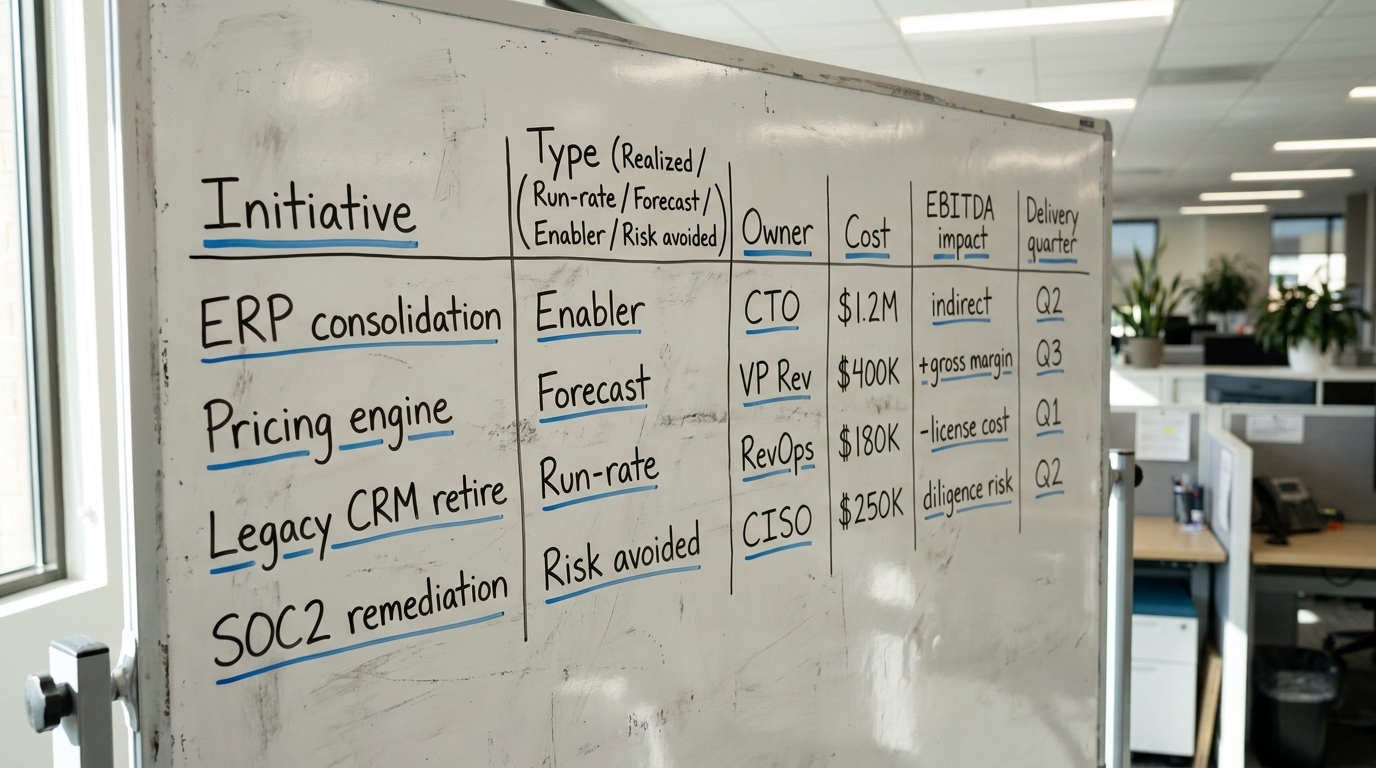
4. Tie every roadmap item to a financial classification
Each initiative on the roadmap should carry a label: realized value once delivered, run-rate savings, forecast upside, an enabler for a later move, or a risk avoided. Without that classification, a board deck full of green status dots tells you nothing about whether the money is being spent on things that move enterprise value.
Insist that forecast and enabler items are marked as such and never presented as realized. This is the single most common way a roadmap loses credibility with a CFO who has seen technology programs overpromise before.
5. Confirm the consultant writes to your stakeholders, not to a generic PE reader
A deal partner wants thesis, risk, and exit implications. A CFO wants cash, covenants, and forecast reliability. A CTO wants those translated back into diligence risk and delivery capacity. A roadmap that reads the same for all three is written for none of them.
Ask to see two artifacts from a prior engagement, redacted: the board-level summary and the working backlog the engineering team actually used. If the consultant only has one, they are missing half the job. This is also the fault line in what you are actually buying when you buy digital value creation services.
6. Decide who owns delivery after the roadmap ships
The most expensive failure in this category is a beautiful roadmap that no one is resourced to execute. Before you sign, decide whether the consultant hands off to your internal team, staffs the delivery themselves, or brings an embedded capability. Each choice has a different cost and a different risk of the plan sitting on a shelf.
If the portfolio company lacks the engineering bench, the roadmap has to account for that gap honestly. The mechanics of building that capacity are covered in how to build and judge an embedded engineering team for a PE-backed company, and the sourcing decision in how to choose an embedded technology partner.
7. Check the roadmap against the first 100 days and the exit
A roadmap that ignores timing is a technical document, not an investment plan. The early moves have to fit inside the first 100 days window when management attention and integration momentum are highest, and the later moves have to leave the estate in a state a buyer will pay for.
Run the draft roadmap against your exit thesis. If a $2M platform rebuild delivers its payback six months after your expected sale, it belongs to the next owner and should come off the plan. The exit lens is the same one applied in the exit readiness sprint decisions an operating partner has to make.
8. Price the engagement against the decision, not the deck
An embedded roadmap and delivery engagement in the mid-market typically runs in the $15,000 to $50,000 per month range depending on scope and whether delivery is included. That is defensible when the roadmap governs a multi-year capital program and the consultant stays accountable for actual versus plan. It is not defensible for a one-time slide deck that a strategy analyst could assemble.
McKinsey’s research on private capital and BCG’s work on principal investors both point to the same pattern: value creation depends more on execution discipline than on the quality of the initial plan. Price for the discipline the firm can demonstrate, because the document alone predicts nothing.
9. Watch for the activity-as-outcome tell
When a consultant reports progress in tickets closed, features shipped, or hours logged, and cannot connect any of it to the financial classification from section four, the engagement has drifted into a vendor relationship. Hours are an input. The board wants the output stated as a number with a date.
The discipline of separating activity from outcome is the core of judging a technical value creation partner and its commercial counterpart, judging a digital value creation partner.
10. Require the roadmap to update against actuals
A roadmap set at close and never revisited is worthless by the second board meeting. Require a standing cadence where each item shows plan versus actual on cost, timing, and expected impact, with a documented reason for every slip. That cadence is what turns a plan into a management instrument the CFO can defend to the fund.
This is also where an IT roadmap for a portfolio company earns its keep, and where a poorly governed ERP implementation quietly breaks the forecast before anyone catches it in a status meeting.
11. Verify the risk register is live, not a slide
Every roadmap carries execution risk: a vendor dependency, a key-person gap, a data migration that could slip a quarter. A serious consultant maintains a risk register that names each risk, its owner, the trigger that would escalate it, and the mitigation. Guidance from the Harvard Law School Forum on Corporate Governance on board oversight reinforces why this belongs in front of the board rather than buried in the delivery team.
If the risk register is a single slide that never changes between meetings, it is decoration.
12. A short checklist before you sign
Use this to judge a technology roadmap consultant for a portfolio company before the engagement letter goes out:
- The two or three business outcomes the roadmap must produce are written down and agreed.
- The consultant starts from your existing diligence baseline and uses it as the known fact base for the roadmap work.
- They will sequence the backlog and defend what they cut, not deliver a list of thirty items.
- Every initiative carries a financial classification and named owner.
- The engagement produces both a board summary and a working backlog.
- Delivery ownership after the roadmap ships is decided, resourced, and priced.
- Early moves fit the first 100 days; late moves respect the exit timeline.
- Reporting is stated in plan versus actual, tracking variance against the agreed baseline and the committed schedule.
- The roadmap updates on a fixed cadence against actuals.
- The risk register is live and reaches the board.
For the market context on why operational execution now carries the return, PitchBook’s private capital research tracks the same shift Bain and McKinsey report: the plan matters less than whether anyone holds it to actuals through the hold.
If you are standing up this decision inside a portfolio company and want a partner who sequences the roadmap, classifies every item to enterprise value, and stays accountable to plan versus actual through delivery, review the DevriX private equity value creation offer.