An operating partner sits down two weeks after close with a portfolio company that runs on four ERPs, a homegrown order system nobody documented, and an MSP contract that auto-renews in ninety days. The value creation plan assumes an add-on inside eighteen months and a systems consolidation that supports it. None of that is possible unless someone makes real IT sourcing decisions, quickly, and can defend them to the deal team and the board. This is the live problem: strategic IT sourcing in private equity is not a procurement exercise, it is a set of decisions that either protect or blow the integration timeline, the synergy case, and the margin the thesis promised.
This guide is written for the person standing up sales, revenue, and IT operations inside a portfolio company. It walks through what actually has to be decided, in what order, and how to judge whether a sourcing choice is helping or quietly draining EBITDA. It assumes a buyer with budget, not a beginner.
1. Why IT sourcing is a value-creation lever, not a cost line
The mistake that shows up on the first board deck is treating IT sourcing as a spend-reduction exercise. Cut the MSP, renegotiate the licenses, move to cheaper hosting. That saves money and misses the point. In a PE-backed company the sourcing decision sets the ceiling on integration speed, management visibility, and how fast the next add-on can be absorbed.
Bain’s annual global private equity report has tracked for years how much of the return now depends on operational improvement rather than multiple expansion. IT is where a lot of that improvement is either enabled or blocked. A sourcing model that gives you clean data and fast onboarding is a growth asset. One that locks you into a rigid vendor with a five-year contract is a liability that shows up when you try to sell.
Judge every sourcing decision against one question: does this shorten the path to the thesis, or does it just lower this quarter’s invoice?
2. Establish the baseline before you source anything
You cannot source against a target you have not measured. Before any RFP or vendor conversation, the operating partner needs a baseline that names, for each core system: the owner, the actual annual cost, the contract end date, the integration dependencies, and the risk if it fails. This is the same discipline that technology due diligence should have started, and if diligence was thin, the first 100 days is where the gap gets closed.
What the baseline has to capture
- Total cost of ownership per system, not headline license price.
- Contract renewal and exit terms, so you know your real optionality.
- Which systems the revenue engine depends on, and which are back-office only.
- Single points of failure, including key-person and undocumented builds.
Without this, sourcing becomes vendor-led. With it, you negotiate from evidence.
2. Separate the four sourcing decisions instead of blurring them
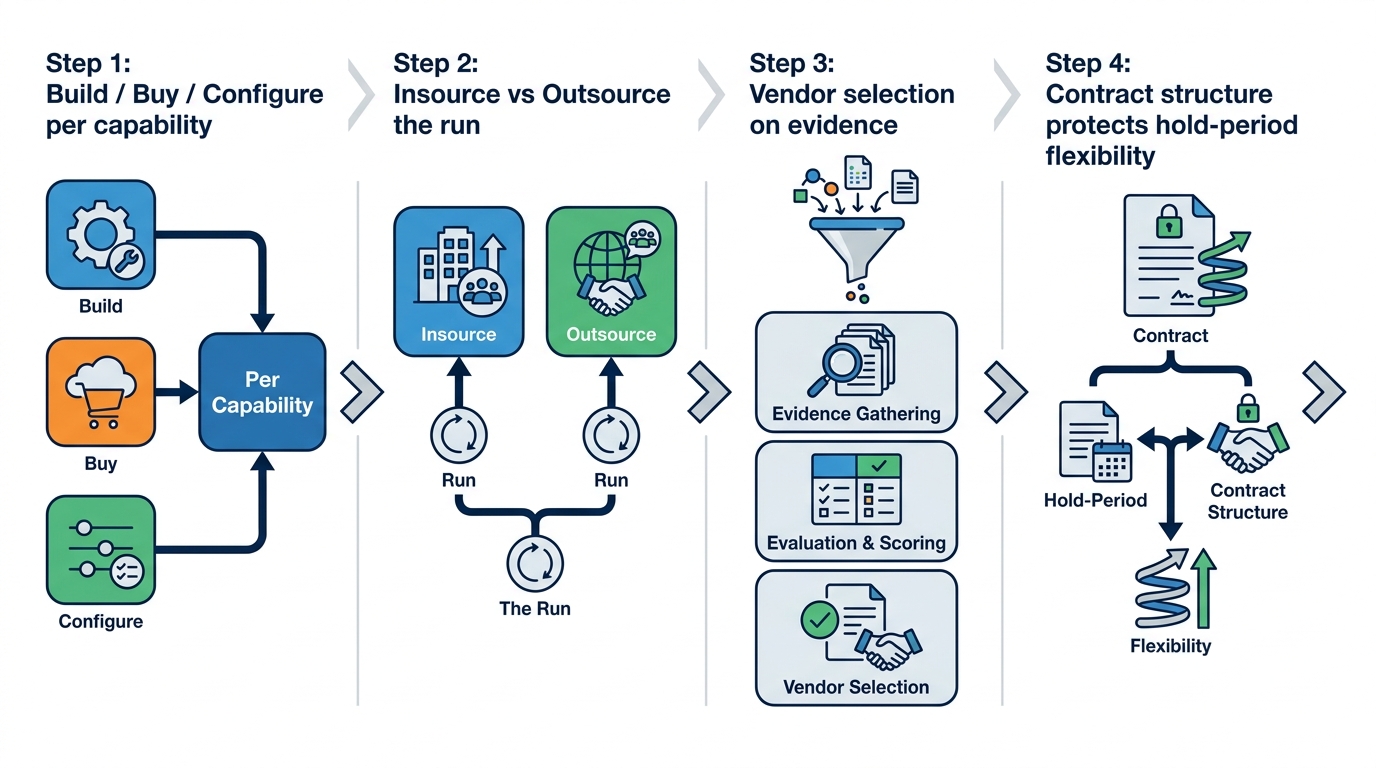
Operators lose control when they treat “IT sourcing” as one decision. It is four, and they should be decided in sequence.
- Build, buy, or configure for each capability the thesis needs.
- Insource or outsource the run and support of it.
- Vendor selection, once the model above is set.
- Contract structure, which decides your flexibility for the hold period.
Blur these and you end up buying a vendor’s preferred bundle before deciding whether you even wanted to outsource. Keeping them separate is what preserves your decision rights.
3. Match the sourcing model to the hold thesis
The right model depends on what the deal is trying to do. A platform pursuing a buy-and-build needs an IT operating model built for repeatable integration, which usually means standardizing on a small set of platforms and a partner who can absorb add-ons fast. A single-asset margin play may not need that at all and is better served keeping IT lean and stable.
This is the same logic that governs application modernization decisions for private equity: modernize what the thesis actually depends on, and leave the rest alone until it becomes a constraint. Sourcing follows the thesis, not the other way around.
4. Decide insource versus outsource on evidence, not instinct
The insource-versus-outsource call is where money and speed are won or lost. The default reflex, either “we need our own team” or “outsource everything,” is usually wrong because it skips the analysis.
Outsource when
- The capability is not a differentiator and does not touch the thesis directly.
- You need capacity faster than you can hire it, which is most of the first 100 days.
- The work is variable, so a fixed internal team would sit idle between projects.
Keep it in-house when
- The capability is core to how the company makes or protects revenue.
- Institutional knowledge would walk out the door with a vendor exit.
- You need daily control and the feedback loop has to be tight.
The same reasoning applies inside revenue operations. The site’s guide on when to outsource sales operations in a PE-backed company walks the identical logic on the commercial side: outsource capacity and repeatable playbooks, keep the decisions and the data.
5. Buy outcomes, not activity
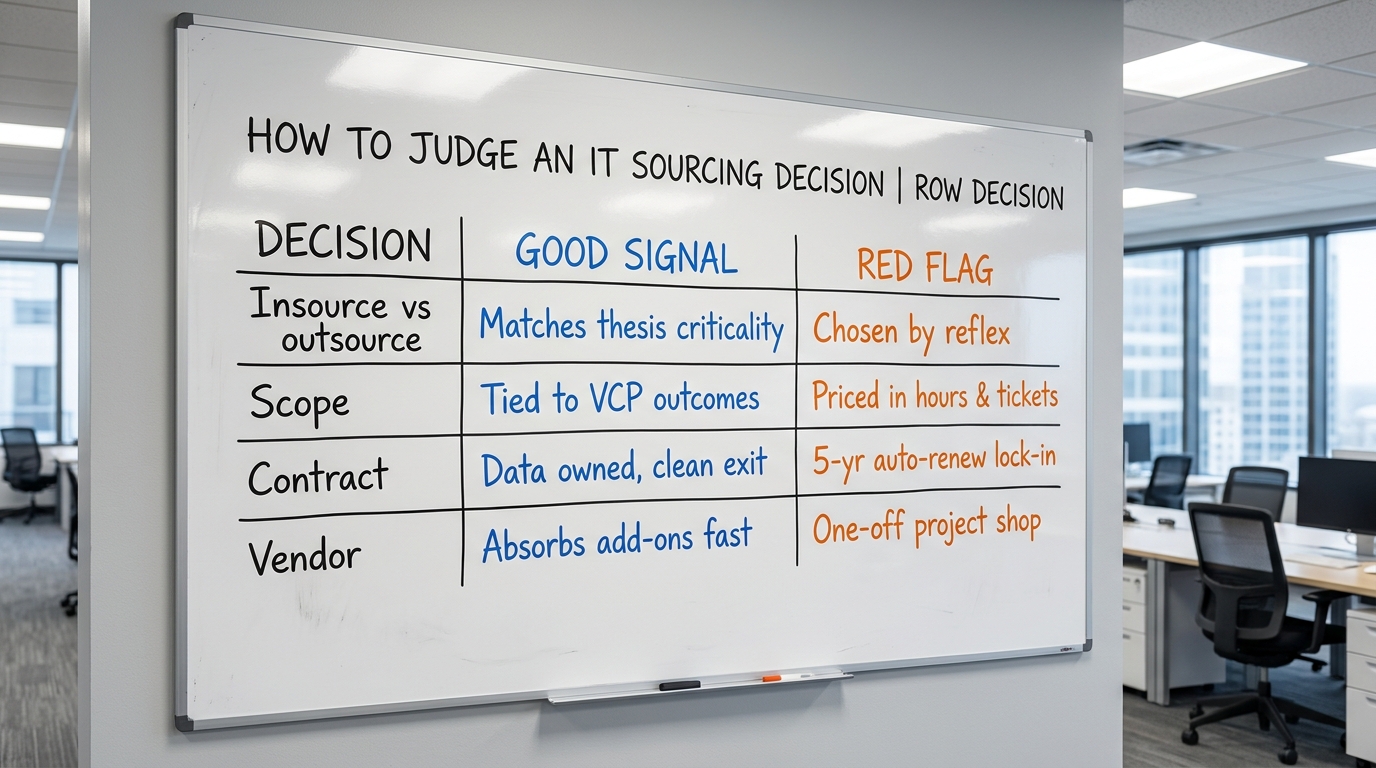
The most common way IT sourcing destroys value is by buying hours and tickets instead of results. A retainer measured in headcount or tickets closed rewards the vendor for volume, not for moving the business forward. The operating partner should insist that the sourcing agreement is scoped against outcomes tied to the value creation plan: a working consolidated order system by a named date, a reporting layer the CFO trusts, an add-on integrated within the promised window.
This is the exact trap the site’s piece on hiring a sales operations consultant without buying activity names, and it holds for IT sourcing word for word. If the invoice describes effort rather than enterprise-value movement, the sourcing model is wrong regardless of how good the vendor’s people are.
6. Structure contracts to protect the exit
A five-year, auto-renewing, single-vendor contract signed in year one is a problem a buyer will find in diligence at exit. Sourcing decisions have a shelf life measured against the hold period. The operating partner should structure agreements so that the company retains its data, its documentation, and a clean path to switch vendors or bring capability in-house.
Guidance from the Harvard Law School Forum on Corporate Governance has repeatedly flagged how contractual and governance choices made early in a hold shape what a later buyer will pay for and what they will discount. Treat every long-term IT contract as something a future acquirer will scrutinize, because they will.
Contract terms worth fighting for
- Data and documentation ownership, in writing, with export in usable formats.
- Exit and transition assistance clauses so switching is not a hostage situation.
- Scope tied to outcomes with defined acceptance, not open-ended time and materials.
- Break points aligned to the hold, not the vendor’s revenue plan.
7. Judge vendors on integration capability, not brochures
Once the model is set, vendor selection should be judged on the thing the thesis needs most, usually the ability to integrate systems and absorb add-ons without drama. A vendor that builds beautiful one-off projects but cannot support a repeatable integration playbook is the wrong partner for a platform strategy.
When comparing a large advisory firm against a specialist execution partner, the criteria matter more than the logo. The site’s breakdown of judging a West Monroe alternative on operator fit lays out how to weigh those trade-offs. And where the integration is post-merger, the reasons synergies fail, covered in the site’s piece on RevOps integration and why post-merger synergies fail, are almost always sourcing and ownership failures dressed up as technical ones.
8. Sequence sourcing against the first 100 days
Timing is a decision too. Not everything can or should be sourced at once. The first 100 days should stabilize what is at risk, close the diligence gaps, and lock the sourcing decisions that block the thesis, while deferring the ones that can wait without cost. McKinsey’s private capital research has made the case repeatedly that value in the early hold comes from disciplined sequencing, not from doing everything simultaneously. Sourcing follows the same rule.
9. Build the internal capability to govern the vendor
Outsourcing does not remove the need for internal ownership, it changes what that ownership does. Someone inside the company has to own the vendor relationship, hold the outcomes, and read the reporting critically. That is a real role and it needs the right skills. This is where enablement earns its place: the internal owner needs both the technical literacy to challenge a vendor and the judgment to manage the relationship, the exact balance of soft and technical skills that governs any vendor-facing role.
10. The sourcing decision checklist
Before signing anything, the operating partner should be able to answer yes to each of these.
- There is a documented baseline of cost, owner, contract terms, and risk for every core system.
- The four sourcing decisions have been made in order, not bundled.
- The insource-versus-outsource call was made on thesis criticality, not reflex.
- The agreement is scoped to value-creation outcomes, not hours or tickets.
- The contract protects data ownership and a clean exit within the hold.
- The vendor was judged on integration and add-on capability, not brand.
- Sourcing is sequenced against the first 100 days and the deal timeline.
- An internal owner is named and equipped to govern the relationship.
If any answer is no, the sourcing decision is not ready to sign, and the risk register should say so before the next board meeting.
11. Where to take this next
Strategic IT sourcing in a portfolio company is decided on evidence, sequenced against the thesis, and judged on enterprise-value movement rather than invoice size. Get the baseline, separate the four decisions, buy outcomes, and protect the exit, and IT sourcing becomes a lever instead of a leak. For the broader operating model that connects sourcing, modernization, and integration, including how these choices feed the value creation plan, see the wider view on tech-led value creation across the operating partner’s modernization decisions in a portfolio company. PitchBook and S&P Global Market Intelligence both publish the deal and operating data worth watching as sourcing patterns across the market shift.
To scope and execute IT sourcing against a specific hold thesis, with the outcomes tied to enterprise value rather than activity, work with the embedded operating partners at the DevriX private equity practice.