When a portfolio company’s product roadmap slips two quarters behind plan and the internal engineering team is too thin to close the gap, the operating partner has a decision to make. Outsourced product and engineering for a portfolio company is one of the fastest levers to move build velocity without a long hiring cycle, but the version that ships fast and the version that quietly adds risk look nearly identical in a pitch deck. The difference shows up later, usually in a missed forecast or a diligence flag at exit. This guide is for the operating partner or portfolio executive who has budget approved and needs to make that decision.
Start from the value-creation gap, not the vendor
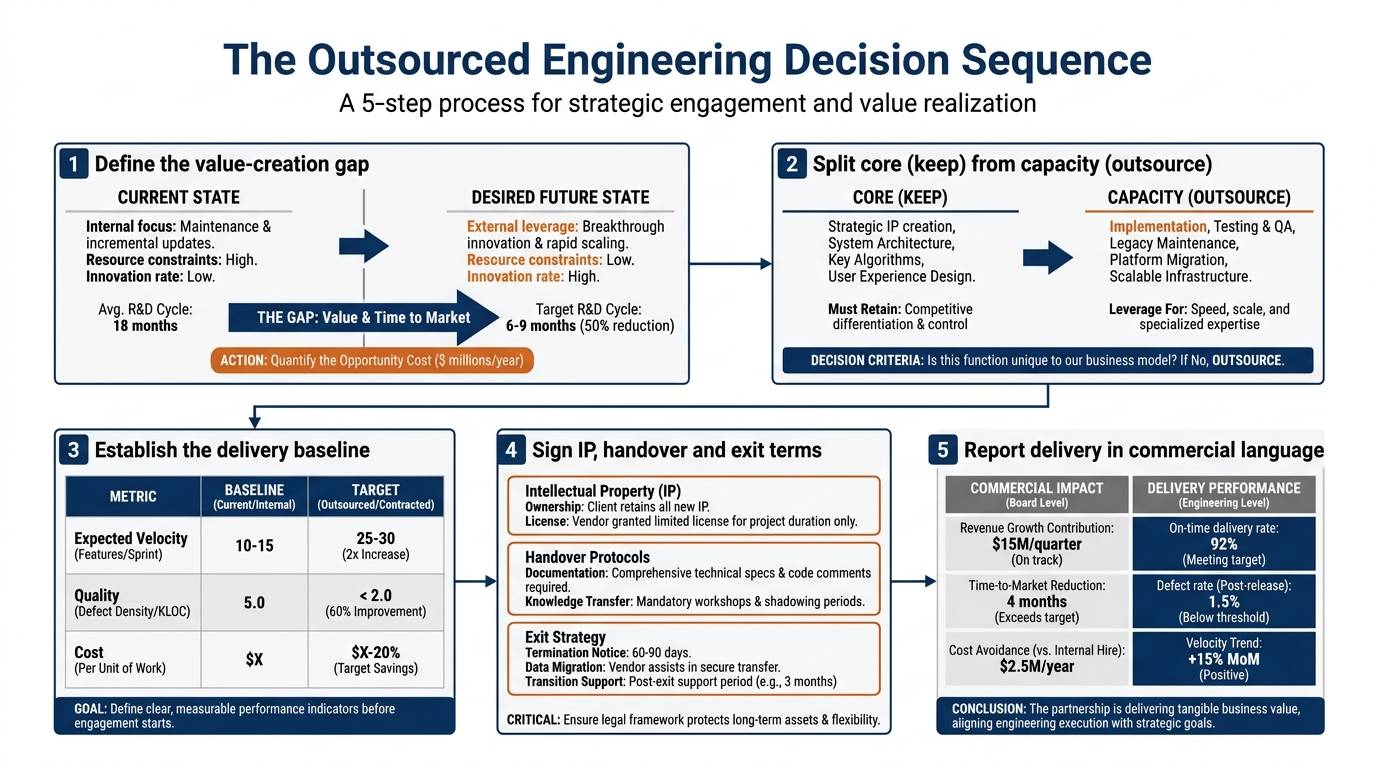
The first mistake is scoping the engagement around headcount (“we need eight developers”) rather than the enterprise-value problem the build is supposed to solve. A portfolio company that is behind on a product release tied to a pricing change has a revenue-timing problem. A company carrying technical debt that blocks an add-on integration has an integration-dependency problem. Those two need different partners, different contracts, and different reporting.
Write down the outcome first, in the language the investment committee uses: the revenue the build unlocks, the EBITDA the automation protects, or the diligence risk it removes. If you cannot state the outcome, you are buying activity, and activity is the failure mode that shows up as spend without measurable movement.
Decide what stays inside and what goes out
Not everything should leave the building. The rule most operating partners settle on is that anything defining the product’s competitive edge, the core domain logic, the data model, the decisions that shape the roadmap, stays with people who report to the CEO. What goes out is capacity: feature delivery against a defined spec, platform hardening, migration work, integration plumbing, and the engineering that scales after the direction is set.
The distinction matters at exit. A buyer’s technology due diligence team will ask who owns the code, who understands it, and whether the company can function if the vendor walks. If the answer is that an outside firm holds the only working knowledge of a core system, that is a valuation issue that will surface in the quality of earnings.
Match the engagement model to the stage of the deal
The right structure depends on where you are in the hold.
During diligence and the first 100 days
Early on, you usually want an assessment before a build. A diagnostic that maps the current architecture, the team’s real capacity, and the gap between roadmap commitments and delivery capability gives the deal team something to underwrite. This is the moment to spend on judgment, not throughput. The first 100 days are where you decide whether to fix, replace, or augment, and getting that decision wrong is expensive to unwind.
Mid-hold, when the thesis needs execution
Once the direction is set, an embedded retainer model, a stable team working inside the company’s tooling and rituals, tends to outperform project-by-project contracting because it removes the ramp cost of every new engagement. For deeper treatment of how to scope this, the guide on what to buy when you buy digital value creation services in private equity is worth reading before you sign anything.
Insist on a baseline before any work starts
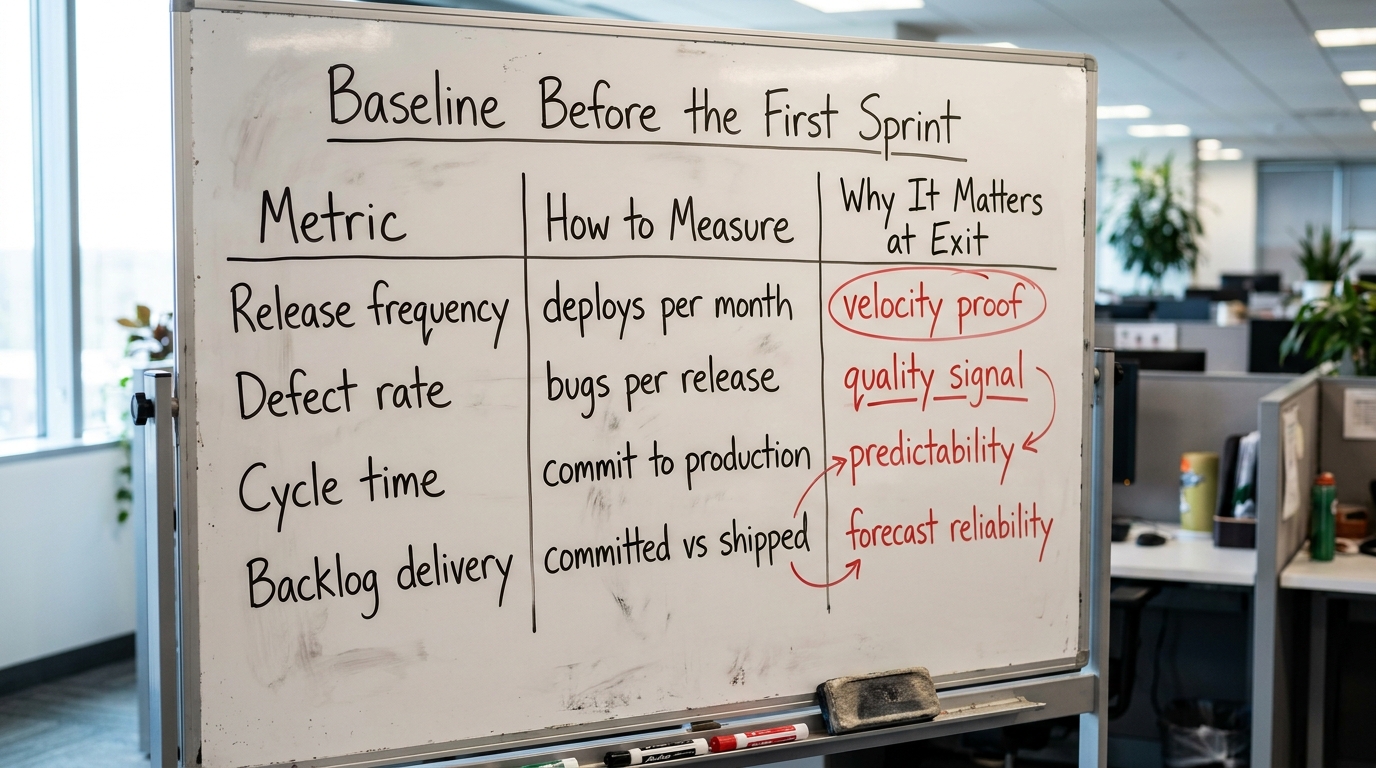
You cannot judge a partner without a baseline, and most portfolio companies do not have one. Before the first sprint, capture current release frequency, defect rate, cycle time from commit to production, and the backlog of committed features versus delivered ones. If the partner resists helping you establish this, that is information. A firm confident in its delivery wants the baseline because it makes their improvement legible.
Bain’s annual Global Private Equity Report has documented how much of the industry’s return now depends on operational improvement rather than multiple expansion, which is precisely why measurable delivery gains matter more than they did a decade ago. You can review the current edition through Bain’s private equity research hub.
Judge the partner on ownership, not staffing
A capacity shop bills hours and hands you tickets. A value-creation partner takes ownership of a delivery outcome and reports against it in the language of the business. The tell is what shows up in the monthly review: a capacity vendor reports tickets closed and hours burned, while a partner worth the retainer reports release velocity, uptime, and progress against the value-creation plan the deal team wrote.
The detailed criteria for this evaluation are laid out in the guide on how to judge a technical value creation partner in private equity, which pairs well with the companion piece on how to judge a digital value creation partner for private equity when the mandate spans both product and go-to-market.
Contract for the things that hurt at exit
The contract terms that seem procedural in month one become the terms a buyer’s counsel reads line by line at exit. Three deserve attention up front.
- IP assignment. Every line of code, design asset, and infrastructure configuration produced under the engagement should assign to the company on creation, with no ambiguity about work-for-hire status.
- Knowledge transfer. The contract should require documented handover as a deliverable, not a favor requested when the relationship ends.
- Exit and transition rights. You want the right to bring the work in-house or move it to another provider without penalty, with a defined transition period and cooperation obligation.
McKinsey’s private capital research has repeatedly noted that value leakage often traces to execution details set early and revisited too late; their broader work on the topic is available at McKinsey’s insights hub.
Set the reporting cadence the board will actually use
The reporting has two audiences with different needs. The portfolio company’s technical leadership needs sprint-level detail. The board and the operating partner need the delivery translated into commercial terms: is the revenue-linked feature on track, is the integration dependency clearing, is the run-rate cost of the team justified by the value it protects or creates.
Set this cadence before Day 1. Aligning the engineering plan with the broader technology plan matters here, and the guide on what an IT roadmap for a portfolio company has to deliver covers how to keep the two in sync so the board sees one coherent story rather than two disconnected ones.
Watch for the two failure patterns
Overservicing that hides scope creep
A partner that keeps adding effort without a corresponding change in the plan is either absorbing your poorly defined scope or padding the retainer. Both distort the actual-versus-plan picture the deal team relies on. Tie every scope change to a documented decision and a revised outcome.
Quality debt that surfaces during a system migration
Fast delivery that skips testing shows up when the company attempts an ERP change or a platform migration, and the untested code breaks under the new load. The related risk on the enterprise-systems side is covered in the guide on how to judge an ERP implementation for a portfolio company before it breaks the forecast, and the pattern is the same: the corners cut early become the forecast miss later.
Tie the decision to exit readiness from the start
The way you structure outsourced product and engineering for a portfolio company in year one determines how the code base reads to a buyer in year four or five. Concentrated vendor dependency, unassigned IP, and undocumented systems are all diligence flags that shave value or slow a sale. Building the transition rights and documentation discipline in early costs almost nothing; retrofitting them under time pressure before a sale costs real money and negotiating leverage.
For the wider view of what an exit-focused technology review examines, see the exit readiness technology assessment and the operator-level walkthrough in the exit readiness sprint. BCG’s principal investors practice publishes related material on operational value creation across the hold, available through BCG’s private equity hub.
The decision checklist
Before you approve the engagement, confirm each of the following:
- The outcome is stated in enterprise-value terms: revenue growth, EBITDA expansion, or reduced operating risk, with the headcount change shown as a supporting input.
- Core product decisions and domain knowledge stay with people who report to the CEO.
- A delivery baseline exists and the partner helped build it.
- Monthly reporting shows velocity, uptime, and value-plan progress, with ticket and hour counts available as supporting detail.
- IP assigns to the company on creation, with clean work-for-hire language.
- Documented knowledge transfer is a contracted deliverable.
- Exit and transition rights let you move the work without penalty.
- The engineering plan is reconciled with the company’s broader technology roadmap.
- Scope changes are tied to documented decisions, recorded in the risk register or the integration log, and surfaced to the deal team when they affect cash or timeline.
If more than two of these are unresolved, the engagement is not ready to sign, regardless of how strong the delivery pitch sounds.
Where this sits in the broader value-creation program
Outsourced engineering is one component of a technology value-creation plan that also spans go-to-market systems, data, and enterprise applications. Treat it as part of that plan rather than a standalone procurement, and the reporting, the contracts, and the exit story hold together. Treat it as an isolated staffing decision, and each of those threads has to be repaired later. The framing across the full program is covered in the broader private equity resource set, and go-to-market readiness specifically in the go-to-market exit readiness assessment.
If you want a structured read on whether your current arrangement creates value or quietly adds diligence risk, and a scoped path to fix it, review the DevriX private equity value-creation offer and start with a diagnostic before you extend or replace an engagement.