Somewhere in the confirmatory diligence pack there is a line item that reads “legacy platform, modernization required.” It arrives with no baseline, no owner and no dollar figure, and it lands on the operating partner’s desk as a vague liability. Left unpriced, it becomes the reason the integration slips, the reason the CFO’s forecast misses in quarter three, and the reason the exit multiple gets a haircut two years out. Application modernization for private equity is not an IT hygiene project. It is a value-creation decision with a spend attached, and the person standing up sales and revenue operations inside the portfolio company is usually the one who feels the consequences first when the underlying applications cannot support growth.
This guide is written for that buyer: the operating partner, portfolio CTO, or revenue-operations lead who has budget and needs a defensible way to decide what to modernize, when, and how to judge whether the money produced enterprise value or just activity.
1. Frame the problem as value at risk, not technical debt
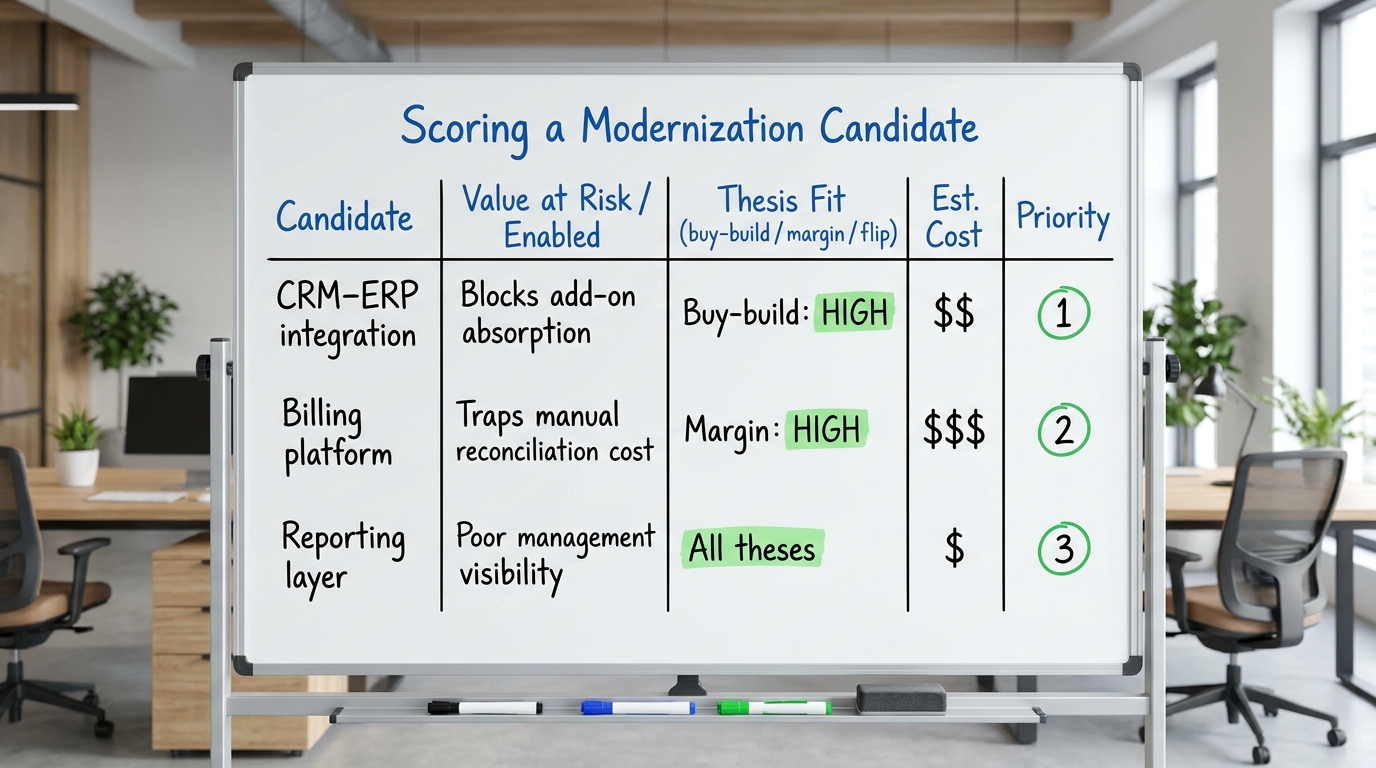
“Technical debt” is a phrase that means everything and commits to nothing. It does not tell a deal team what growth is blocked, what integration is stalled, or what cost is trapped. Reframe every modernization candidate as value at risk or value enabled, and force each one to name the commercial consequence.
Three questions cut through most of the noise:
- What revenue growth is the current application blocking? (Onboarding delays, pricing rigidity, channels the system cannot support.)
- What cost or risk is it trapping? (Manual reconciliation, licensing, a single engineer who understands the codebase, a compliance exposure.)
- What integration or add-on does it prevent? (A bolt-on that cannot be absorbed because the CRM and ERP do not reconcile.)
If a modernization candidate cannot answer at least one, it goes to the bottom of the list regardless of how old the technology is.
2. Get the baseline before the diligence window closes
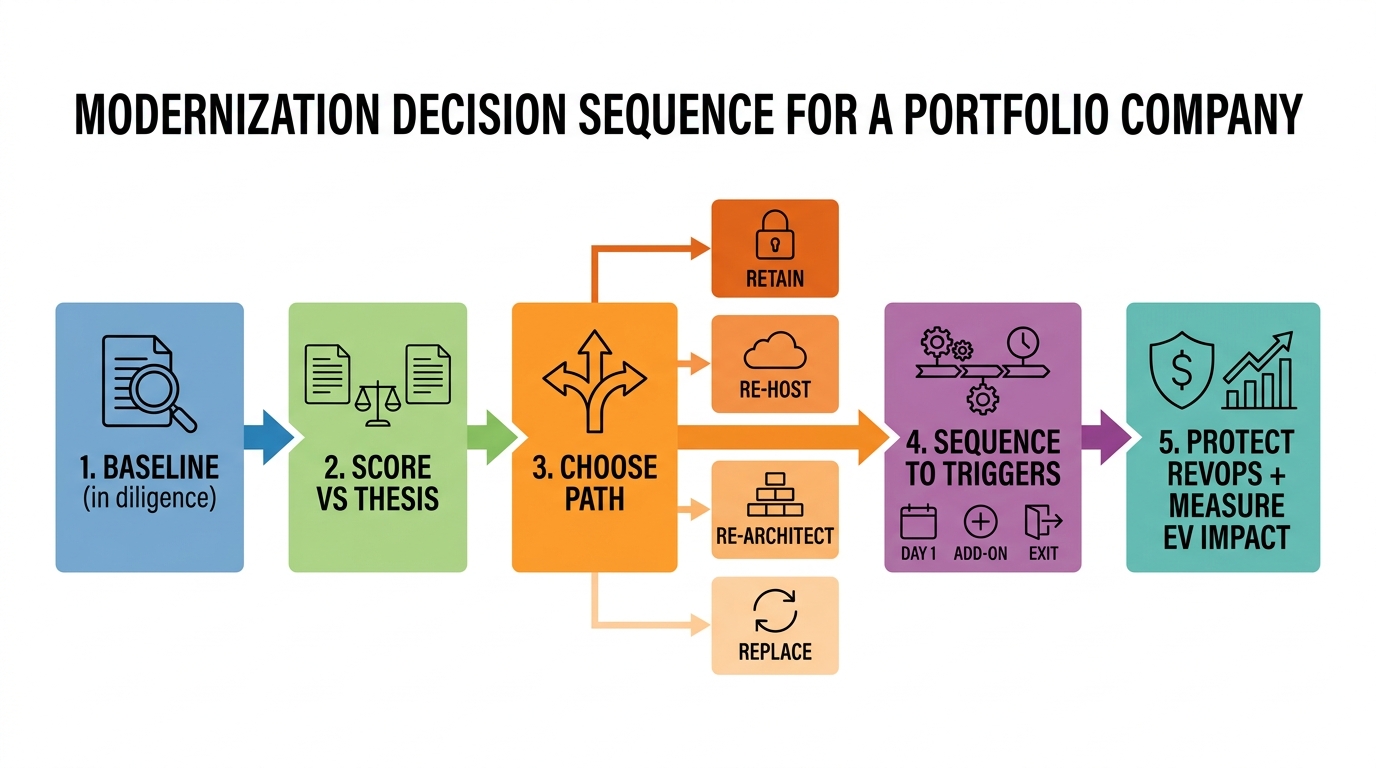
Every modernization decision needs a documented starting point: what runs today, what it costs to keep running, who owns it, and where it breaks under load. That baseline belongs in the technology due diligence workstream, not in the first board meeting, because by the board meeting the price is set and the leverage is gone.
Bain’s annual private equity report has repeatedly tracked how value creation has shifted toward operational improvement rather than financial engineering. That shift raises the stakes on knowing exactly what state the applications are in before close. You can read the current view in the Bain Global Private Equity Report, and McKinsey’s private capital research reaches a similar conclusion on where returns now come from.
3. Score candidates against the investment thesis, not against best practice
A modernization backlog written by engineers will optimize for engineering elegance. The operating partner’s job is to reorder it against the thesis. If the thesis is buy-and-build, integration capability wins. If it is margin expansion, cost-trapping systems win. If it is a fast flip, the answer is often to modernize almost nothing and spend the money on growth.
This is the same discipline that separates outcome from activity in every operating decision. The reasoning that governs how to hire a sales operations consultant without buying activity applies here directly: rank the work by the enterprise value it moves, then fund it.
4. Choose the modernization path deliberately
Not everything needs a rebuild, and rebuilds are where budgets die. Sort each candidate into one of a small number of paths and be explicit about the tradeoff.
The paths worth naming
- Retain, leave it alone; the value at risk does not justify spend.
- Re-host or re-platform, move it with minimal change to reduce operating cost and risk quickly.
- Re-architect, restructure to unblock growth or integration; higher cost, higher return.
- Replace, buy or rebuild when the application actively caps enterprise value.
The mistake operating partners fund is defaulting every item to “replace” because it feels decisive. Most portfolio value comes from re-hosting the cheap wins and re-architecting the one or two systems that genuinely block the thesis.
5. Sequence the work against the first 100 days and beyond
Timing is a commercial variable. Some modernization has to happen before a system migration or a Day 1 cutover; most does not and should be staged so it never blocks revenue. Map each candidate to a trigger: LOI, Day 1, the first add-on, a covenant test, the exit prep window.
The first 100 days plan should carry only the modernization work that unblocks something urgent. Everything else belongs on a dated roadmap tied to the value it enables. BCG’s principal investors and private equity practice has written extensively on why front-loading operational change into the first months tends to outperform a slow-drip approach, provided the work is sequenced to commercial triggers rather than technical convenience.
6. Protect the revenue operations layer during the change
Application modernization most often breaks the thing the growth thesis depends on: the flow of data from lead to cash. When a CRM is re-platformed or a billing system replaced, pipeline visibility, forecasting accuracy and rep productivity all sit in the blast radius. This is precisely where post-merger integrations quietly bleed value, as covered in why post-merger RevOps synergies fail.
The team standing up revenue operations should own a data continuity plan for every modernization touching a revenue system: what breaks, who reconciles it, and how forecast reliability is protected through the cutover. Skip that, and the CFO’s forecast miss will get blamed on sales when the cause was an application migration nobody ring-fenced.
7. Decide the build-versus-buy for delivery capacity
Portfolio companies rarely carry the engineering bench to modernize on the thesis timeline. The choice is to hire, to pull from an internal platform team, or to bring in an embedded partner. The same test that governs when to outsource sales operations in a PE-backed company applies: judge the capacity by the outcome it is accountable for, not the hours it logs.
An embedded delivery model earns its retainer when it is measured against enterprise-value milestones, integration completed, cost removed, growth unblocked, rather than tickets closed. If the arrangement is priced on activity, the incentives are wrong before the work starts.
8. Insist on management visibility as a modernization output
One of the most reliable returns from modernization is not speed or cost, it is visibility. Legacy applications that cannot produce clean, current numbers cost the sponsor at every board meeting and again at exit, when a buyer discounts what it cannot verify. Treat reporting and data integrity as a first-class modernization outcome, not a byproduct.
Governance-minded readers will find the reporting and control expectations useful context in the Harvard Law School Forum on Corporate Governance, and the AICPA and CIMA materials are a sound reference for the financial-data integrity that quality-of-earnings work depends on.
9. Attach a value classification to every claimed benefit
When the modernization roadmap is presented, force each benefit into an honest category so nobody reads a forecast as money already in the bank:
- Realized, cost already removed or revenue already booked.
- Run-rate, annualized effect now in motion.
- Forecast, expected but not yet delivered.
- Enabled, growth or integration now possible, not yet captured.
- Risk avoided, a downside that no longer threatens the plan.
This one habit prevents the most common credibility failure in value-creation reporting: a deck full of “enabled” value dressed up as realized EBITDA. Sponsors who track this discipline, the kind PitchBook and Preqin data describe across the value-creation cycle, hold their operating teams to the distinction. See PitchBook research and Preqin alternative assets data for the broader context on how value creation is now measured and reported.
10. Prepare the modernization story for exit
Whatever gets modernized becomes part of the exit narrative. A clean, integrated, well-documented application estate supports a higher multiple and a faster confirmatory diligence on the sell side. A half-finished re-platform with no documentation becomes a diligence finding that a buyer prices down. Decide early which modernization work is meant to show up as an exit asset, and keep the evidence, baselines and outcomes documented from Day 1 so the story is provable rather than asserted.
11. The decision checklist
Before funding any application modernization program in a portfolio company, the operating partner and revenue-operations lead should be able to answer:
- Is there a documented baseline of current state, cost and ownership?
- Does each candidate name the revenue, cost, risk or integration it moves?
- Is the backlog ranked against the investment thesis, not engineering preference?
- Has each item been assigned a path, retain, re-host, re-architect, replace, with the tradeoff stated?
- Is the work sequenced to real triggers (Day 1, add-on, migration, exit) rather than convenience?
- Does a data continuity plan protect forecast reliability through every revenue-system change?
- Is delivery capacity accountable to enterprise-value milestones, not hours?
- Is every claimed benefit classified as realized, run-rate, forecast, enabled or risk avoided?
- Is the modernization evidence being documented for the exit story?
Nine questions. If the program cannot answer them, it is not yet a decision, it is a wish list with a budget attached. For the wider operating context, the private equity value-creation hub connects modernization to the rest of the operating agenda, and S&P Global’s market intelligence is a useful reference for benchmarking where portfolio value is being created across sectors.
12. Turn the decision into an execution plan
The gap between a scored roadmap and a captured return is delivery. That is where an embedded model that owns modernization work against enterprise-value milestones, integration completed, cost removed, visibility delivered, growth unblocked, earns its place in the operating budget.
To move from decision to execution, route your modernization roadmap and its value case into the DevriX private equity execution offer and have the work priced against the enterprise value it is accountable to produce.