A modernization request rarely arrives labeled as a financial decision. It shows up as an engineering ask: the platform is on an unsupported framework, the monolith slows every release, a cloud migration is “overdue.” By the time it reaches the operating partner, the number attached to it is large and the rationale is technical. The problem is that a portfolio company executive cannot approve a multi-quarter rebuild on the strength of an architecture diagram. They have to know what changes for revenue, EBITDA, integration speed, and exit readiness, and whether the spend is defensible against every other use of the same capital.
This guide is for the operating partner or portfolio company executive standing between an engineering team that wants to rebuild and an investment committee that wants a return. The window that matters is usually the same one where sales and revenue operations are being stood up: right after close, during the first 100 days, or the moment a forecast starts missing because the system underneath it cannot support the plan. The task is not to learn what modernization is. It is to judge whether this modernization, at this company, at this price, buys enterprise value.
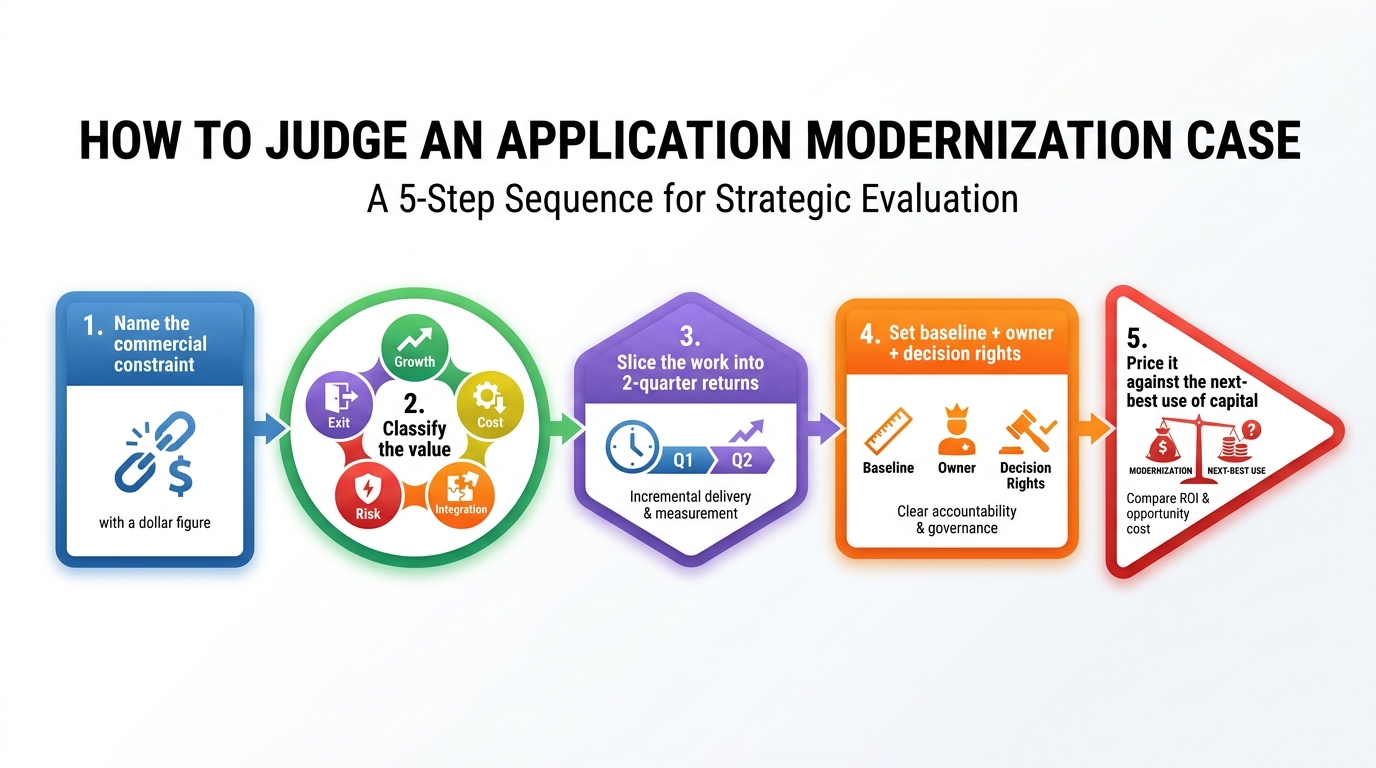
1. Name the commercial problem before you name the technology
Every credible modernization case starts with a business constraint the current system imposes, not a technology the team wants to adopt. The useful question is: what can the company not do today that costs it money? Common answers in a portfolio setting: onboarding a new customer takes weeks of manual configuration, the platform cannot support a pricing change the growth thesis depends on, an acquisition cannot be integrated because two systems will not reconcile, or downtime during peak periods is losing bookings.
If the team cannot map the rebuild to a specific constraint with a dollar figure, the request is activity, not outcome. That distinction is the same one that separates a real sales operations engagement from a stream of billed hours. Modernization deserves the same discipline.
2. Classify the value the work is supposed to create
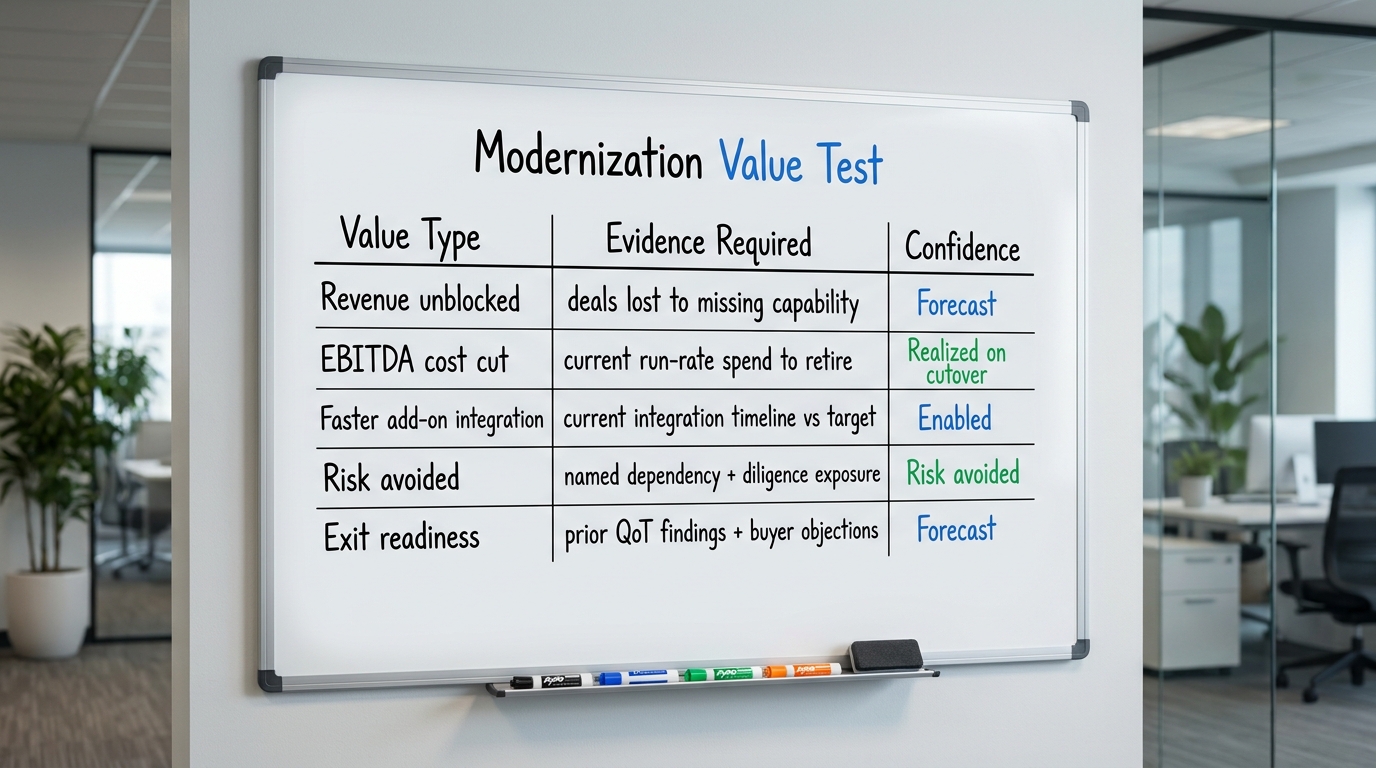
Before approving spend, force the case into one of five categories, because they carry very different confidence:
- Revenue growth the platform currently blocks (a feature or pricing model the sales team cannot sell today).
- Cost reduction that hits EBITDA (retiring license fees, reducing infrastructure spend, cutting manual labor).
- Faster integration for the buy-and-build thesis (each add-on lands quicker onto a common platform).
- Risk avoided (an unsupported dependency, a security exposure, a single point of failure that would surface in the next diligence).
- Exit readiness (a technical estate a buyer’s technology due diligence will not discount).
Note which of these is realized on completion versus merely enabled. A migration that “allows” faster onboarding is not the same as one that has demonstrably shortened it. Do not let enabled value get presented as banked value in a board deck.
3. Decide the shape of the work, not just the yes or no
Approving “modernization” is meaningless. The operating partner has to decide the shape. The two failure modes are the full rewrite that runs eighteen months before it returns anything, and the endless refactor that never reaches a point of value. Between them sits the sequenced approach: modernize the part of the system tied to the highest-value constraint first, ship it, prove the return, then fund the next slice.
Prefer thin slices with a return attached
Ask the team to name the smallest piece of work that delivers a measurable commercial result inside two quarters. If they cannot, the plan is too coupled to be governed and too risky to fund in one tranche. Slicing also protects the sales and revenue operations build happening in parallel, because a slow, monolithic rebuild tends to freeze the very workflows the go-to-market team depends on.
4. Establish the baseline you will measure against
No baseline, no proof. Before work starts, record the current state of the metrics the case rests on: deployment frequency, mean time to onboard a customer, infrastructure cost per month, incident hours, the specific manual steps to be removed. These are the actual-versus-plan lines the first board meeting after approval will ask for. If nobody captured the baseline, the project will finish and no one will be able to say whether it worked, which is exactly how modernization spend earns its reputation as a black hole.
5. Set the decision rights and the owner
Modernization crosses engineering, finance, and the commercial team, so it needs a single accountable owner and clear decision rights on scope changes. Who signs off when the estimate grows? Who decides to cut a feature to hold the date? Without this, scope creep is guaranteed, and the project quietly doubles. The same governance failure sinks post-merger technology work, which is why so many post-merger synergies fail on integration rather than on thesis.
6. Judge whether to build it inside or bring in a partner
A portfolio company’s own team often cannot run a modernization and keep the product moving at the same time. That is a capacity and risk question, not a competence one. The build-versus-buy call here mirrors the logic of when to outsource sales operations: keep what is core and differentiating in-house, bring in an outside team for the heavy, time-boxed lift where speed and specialist depth matter and where you do not want to hire permanent headcount you will not need after cutover.
When judging an outside firm, apply the same test you would to any advisor: do they lead with the business outcome or with a technology stack? A firm that opens with EBITDA impact and integration speed is thinking like an operator. The rest of that judgment is laid out in this guide to judging the fit of an operating-partner-grade firm.
7. Price the work against the alternative uses of the capital
Modernization competes with every other value-creation lever: a pricing initiative, a sales hire, an add-on acquisition. Bain’s Global Private Equity Report has tracked for years how much return now depends on operational improvement rather than multiple expansion or leverage, which is precisely why capital allocation inside the portfolio has to be defended lever against lever. Research from firms like McKinsey and BCG on value creation makes the same point: the operating budget is finite and technology has to earn its slice on the same terms as everything else.
The discipline: express the modernization case as a return the investment committee would recognize, with a payback horizon and a downside. If the honest answer is “we spend heavily and prevent a future problem,” say that plainly and classify it as risk avoided, not growth.
8. Watch the dependencies that break the go-to-market build
Application modernization inside a portfolio company almost never happens in isolation. The same period usually involves standing up a CRM, cleaning revenue data, and building the reporting the CFO’s forecast depends on. If the modernization freezes the systems those workflows sit on, the commercial gains you promised the board stall. Two dependencies deserve a place on the risk register from day one: data integrity across the migration, and any accessibility and compliance obligations that a rebuilt front end must carry forward rather than quietly drop.
9. Protect the team through the change
A modernization program stresses the people running the current system while they support the new one. That is a training and enablement problem as much as an engineering one, and it is where preparing teams for disruption and holding the balance between technical and operational skill pay off directly. A cutover that lands technically but leaves the operations team unable to run the new workflows has not created value. It has moved the bottleneck.
10. Set the exit lens now, not later
Whatever gets built will be inspected by a future buyer’s diligence. Governance research on the Harvard Law School Forum on Corporate Governance and deal analysis from Harvard Business Review both underline how much of exit value hinges on a clean, credible operating story. Treat the modernization as something you will have to defend in a data room: documented, measured against its baseline, and framed as enterprise-value improvement rather than as engineering effort. Sources like PitchBook and S&P Global Market Intelligence are where the market context for that story ultimately gets read.
The decision checklist
- Is the modernization tied to a named commercial constraint with a dollar figure, not a technology preference?
- Which of the five value types does it create, and is that value realized, enabled, or forecast?
- Can the work be sliced so the first return lands within two quarters?
- Is the baseline captured before work starts?
- Is there one accountable owner and clear decision rights on scope changes?
- Build inside or bring in a time-boxed partner, and does that partner lead with outcome or with stack?
- Does the case beat the next-best use of the same capital?
- Are data integrity, compliance, and the go-to-market build on the risk register?
- Is the team being enabled to run the new system, not just handed it?
- Will the result survive a buyer’s diligence?
An operating partner who can answer these ten questions has turned an open-ended engineering request into a governed value-creation decision. That is the whole job here: not to evaluate the architecture, but to judge whether this spend, at this company, buys enterprise value the investment committee and a future buyer will both recognize.
If application modernization is on the table across your portfolio and you want it scoped, sequenced, and measured as an enterprise-value program rather than a rebuild, review how the private equity team structures embedded technology value creation and take that conversation to the DevriX / GrowthShuttle PE hub.