When a portfolio company runs on a single overloaded engineering lead, or when the founder-CTO has agreed to roll off after close, the operating partner faces a staffing gap that shows up fast in the value creation plan. Hiring a full-time CTO takes months the deal timeline does not have, and a $350K base plus equity is hard to justify for a $30M-revenue business that needs technical judgment more than a permanent executive. A virtual CTO for private equity closes that gap on a retainer, but the quality varies enormously, and the wrong choice costs a year of the hold. This guide is for the operating partner or portfolio company executive deciding whether to buy that capacity and how to judge the person in front of them.
1. Name the gap before you shop for the role
A fractional technology executive solves several different problems, and buyers who skip this step pay for the wrong one. Common gaps include no senior technical owner after a founder exit, an engineering function that ships but cannot be measured, a technology due diligence report full of findings that nobody inside the company is accountable for closing, and a buy-and-build thesis that depends on integrating systems the current team has never touched.
Write down which of these describes the company, and the commercial consequence attached to it. A fractional CTO hired to stabilize delivery is a different engagement, with different success measures, than one hired to assess two add-on targets per quarter. If the operating partner cannot name the gap in one sentence, the retainer will drift and the invoices will keep arriving.
2. Decide what the operating partner needs versus what the CEO needs
These two readers want different things from the same person, and the engagement has to serve both. The deal team and operating partner want the technology risk register maintained, the roadmap tied to the EBITDA bridge, and clear reporting into the board. The portfolio company CEO wants someone who can run the engineering function day to day, make hiring calls, and keep the product shipping without constant escalation.
A good retainer defines decision rights for both. State which decisions the virtual CTO owns outright, which require CEO sign-off, and which go to the board. Ambiguity here is the single most common reason these arrangements fail inside the first two quarters.
3. Separate the fractional retainer from the advisory add-on
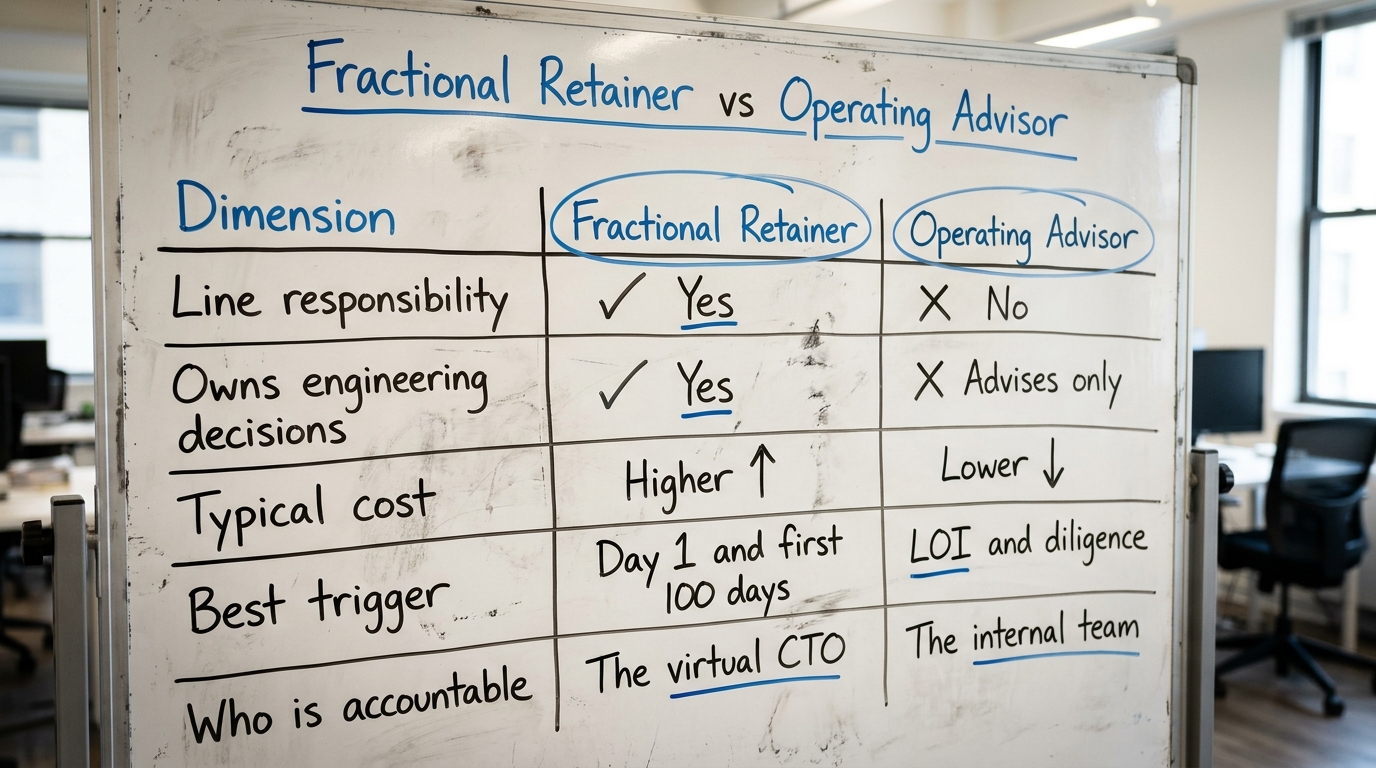
Buyers conflate two commercial shapes. A fractional retainer buys a named executive for a committed number of days per month, with line responsibility for the technology function. An operating advisor buys judgment and access without line responsibility, which suits a company that already has a capable engineering manager but no one to hold them to a plan.
Price and expectation differ accordingly. The retainer costs more and carries real accountability for outcomes; the advisory arrangement costs less and holds the internal team accountable instead. Decide which you are buying before the first proposal, because a vendor will happily sell you either under the same title.
When the distinction matters most
At LOI and through confirmatory diligence, an advisor who can read a code base and a cap table of technical debt is usually enough. From Day 1 and through the first 100 days, when decisions have to be made and owned, the retainer with line responsibility is what actually moves the plan.
For the broader question of how technology work connects to enterprise value, the piece on what technology transformation for portfolio companies actually has to deliver sets the standard a retainer should be held to.
4. Tie the engagement to the value creation plan, not to a task list
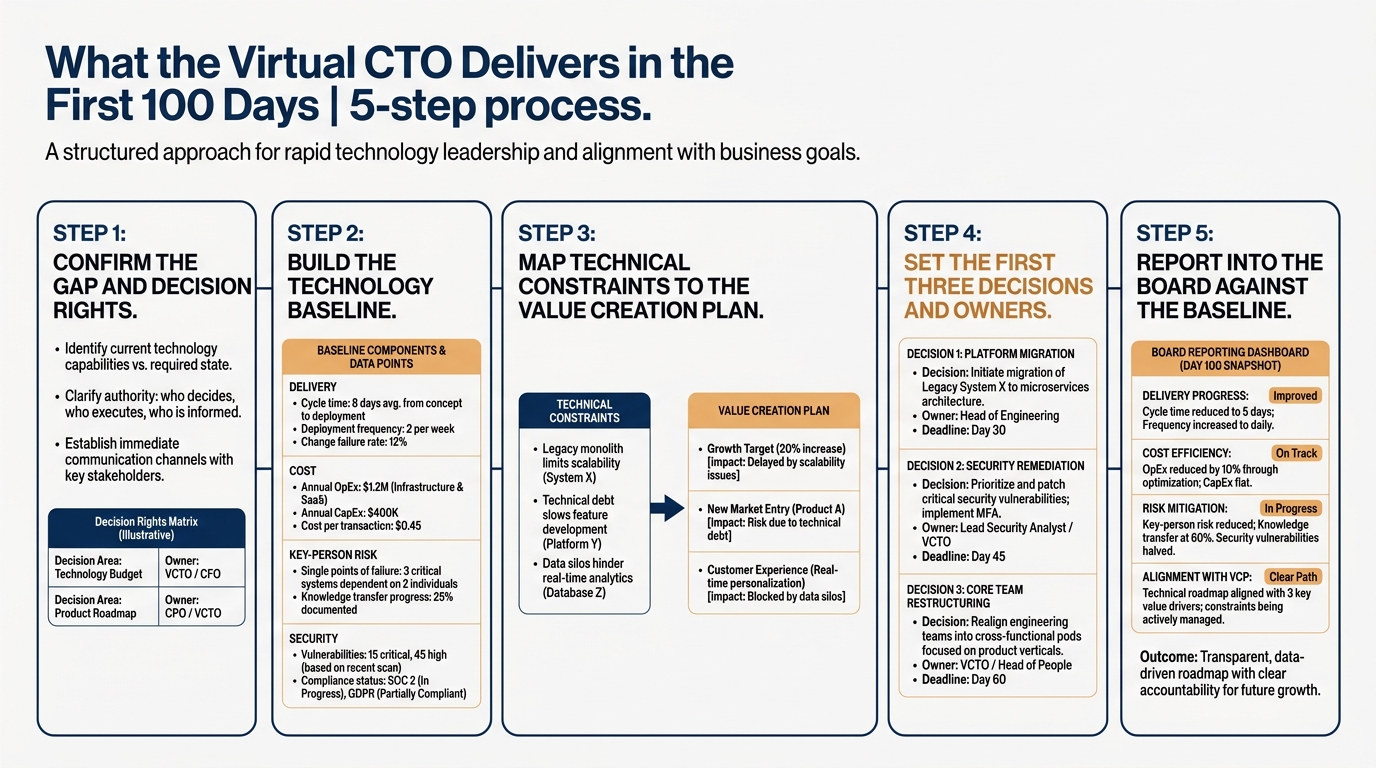
The test of a virtual CTO for private equity is whether the work maps to the value creation levers the deal was underwritten on. A retainer that produces architecture diagrams and hiring plans but never connects to revenue growth, margin, or integration speed is activity, not outcome.
Ask the candidate to restate the value creation plan in technical terms before you hire them. They should be able to say which systems constrain the growth target, which technical risks threaten the forecast, and what the first three decisions are. If they cannot do this from the diligence materials and one call with the CEO, they are not ready to own the function. The guidance on how to judge value creation plan services for a mid-market portfolio company applies directly here.
5. Judge the candidate on evidence, not on résumé titles
Former CTO of a large company is a weak signal for this role, because running a 200-person engineering org is a different job than fixing a 12-person one on a retainer. Stronger evidence is a track record of walking into mid-market portfolio companies, establishing a baseline quickly, and leaving a function measurably better run.
Ask for two specific things. First, a redacted example of a technology baseline they produced in a prior engagement, so you can see how they think about measurement. Second, a reference from an operating partner, not just a CEO, who can speak to whether the reporting into the deal team was useful. The companion guide on how to hire and judge a technology value creation consultant in private equity covers the reference questions worth asking.
6. Set the baseline in the first thirty days
A virtual CTO who cannot tell you the current state of the engineering function within a month is not earning the retainer. The baseline should cover delivery predictability, the real cost of the technology stack, key-person risk, security posture, and the difference between what the roadmap commits to and what the team can ship on the current runway.
This baseline is what every later board conversation measures against. Without it, the operating partner is relying on the vendor’s own account of its progress, which is the position the engagement was supposed to replace.
7. Make reporting into the board a condition, not a courtesy
The operating partner needs technology translated into terms the board uses: EBITDA impact, cash timing on capital spend, diligence risk on an exit, and management visibility. A virtual CTO who reports in engineering language forces the operating partner to do the translation, which defeats part of the reason for hiring one.
Agree the reporting cadence and format up front. A one-page monthly summary that shows actual versus plan on the technology workstreams, with the risk register attached, is usually enough. Anything that requires the operating partner to interpret velocity charts for the board is reporting that has not been finished.
8. Handle the buy-and-build case explicitly
If the thesis depends on add-ons, the virtual CTO’s role in evaluating and integrating targets has to be written into the engagement. Bain’s annual Global Private Equity Report has tracked for several years how large a share of mid-market value creation now comes from buy-and-build, and integration quality is where that value is won or lost.
Decide whether the retainer covers target technical assessment, post-close integration planning, or both, and price the days accordingly. A fractional executive stretched across the core company and three integrations will do none of them well. For the structural question underneath this, see the guidance on how to structure outsourced product and engineering for a portfolio company.
9. Test for AI and data judgment without buying the hype
Portfolio company boards now expect a point of view on AI, and a weak virtual CTO will either dismiss it or oversell it. The useful version decides what to fund based on the business model and what to defer. Research from firms including McKinsey and BCG on private capital has documented how uneven the realized return on these investments has been across portfolios.
A candidate worth hiring can tell you which AI or data investment would move this specific company’s numbers and which is a distraction. The pieces on how operating partners should judge generative AI value creation and agentic AI for portfolio companies and how to decide what to fund set the bar for that judgment.
10. Plan the exit from the engagement on Day 1
A retainer that never ends is a sign the function never got built. Decide at the start what good looks like: a permanent CTO hired and onboarded, an engineering manager grown into the role, or the function stabilized enough to run on an advisory cadence. Analysis on the Harvard Law School Forum on Corporate Governance on governance through a hold period reinforces why a defined off-ramp beats open-ended dependency.
If exit readiness is near, the data and systems story has to hold up under a buyer’s diligence, which is a separate workstream worth planning early. The guidance on data readiness for an exit portfolio company and how to judge it covers what that requires.
11. A checklist before you sign
- The gap is named in one sentence, with the commercial consequence attached.
- Decision rights are written for both the operating partner and the CEO.
- The commercial shape is chosen deliberately: fractional retainer with line responsibility, or operating advisor without it.
- The candidate restated the value creation plan in technical terms before hire.
- A technology baseline is contracted for delivery inside thirty days.
- Board reporting format, cadence, and language are agreed up front.
- Buy-and-build responsibilities, if any, are scoped and priced separately.
- The candidate has a defensible point of view on what AI and data to fund here.
- The exit from the engagement is defined before it starts.
- At least one reference is an operating partner, not only a CEO.
Run this list against the proposal on the table. A credible provider will answer most of it without prompting; one that resists the baseline, the decision rights, or the off-ramp is selling hours rather than enterprise value.
12. Where this fits in the technology plan
A virtual CTO is one instrument among several, and the right sequence depends on the deal. Many portfolio companies need the roadmap set before the executive who owns it, which the guide on how to hire and judge a technology roadmap consultant for a portfolio company addresses. Others need the diligence decisions settled first, covered in what to decide in middle market private equity due diligence before the data workstreams close.
If the next step is scoping a fractional technology executive against a specific value creation plan, review how DevriX structures this work for private equity portfolio companies and bring the diligence findings to the first conversation.