When an operating partner inherits a portfolio company with a software stack nobody in the deal team fully understands, the first question is whether the technology can carry the growth the investment thesis already promised the LPs. A technology value creation consultant in private equity exists to answer that question in commercial terms, and the decision to hire one usually lands at an awkward moment: right after close, when the forecast is set, the budget is tight, and the first board meeting is sixty days out. This guide is for the person who has to make that hire and then defend the spend.
The buyer here is not learning the field. The buyer is deciding what to contract for, how to scope it, and how to judge whether the work moved enterprise value or just produced slides. Those are the three decisions this piece is built around.
1. Start with the enterprise-value problem, not the technology problem
A portfolio company CTO will describe technical debt, a stalled migration, or a team that cannot ship. None of that is what the fund is buying when it engages a consultant. The fund is buying a measurable improvement in revenue growth, EBITDA, cash conversion, integration speed, or the credibility of the forecast that supports the exit multiple.
The first thing to pin down is which of those the engagement is meant to move. An ERP consolidation that reduces working capital is a cash-flow case. A commerce replatform that lifts conversion is a revenue case. A security remediation that removes a diligence red flag is a risk-avoided case. If the consultant cannot name the lever before scoping, the engagement will drift toward activity, and activity is not the thing the investment committee asked for.
2. Decide whether you need a diagnostic or embedded delivery
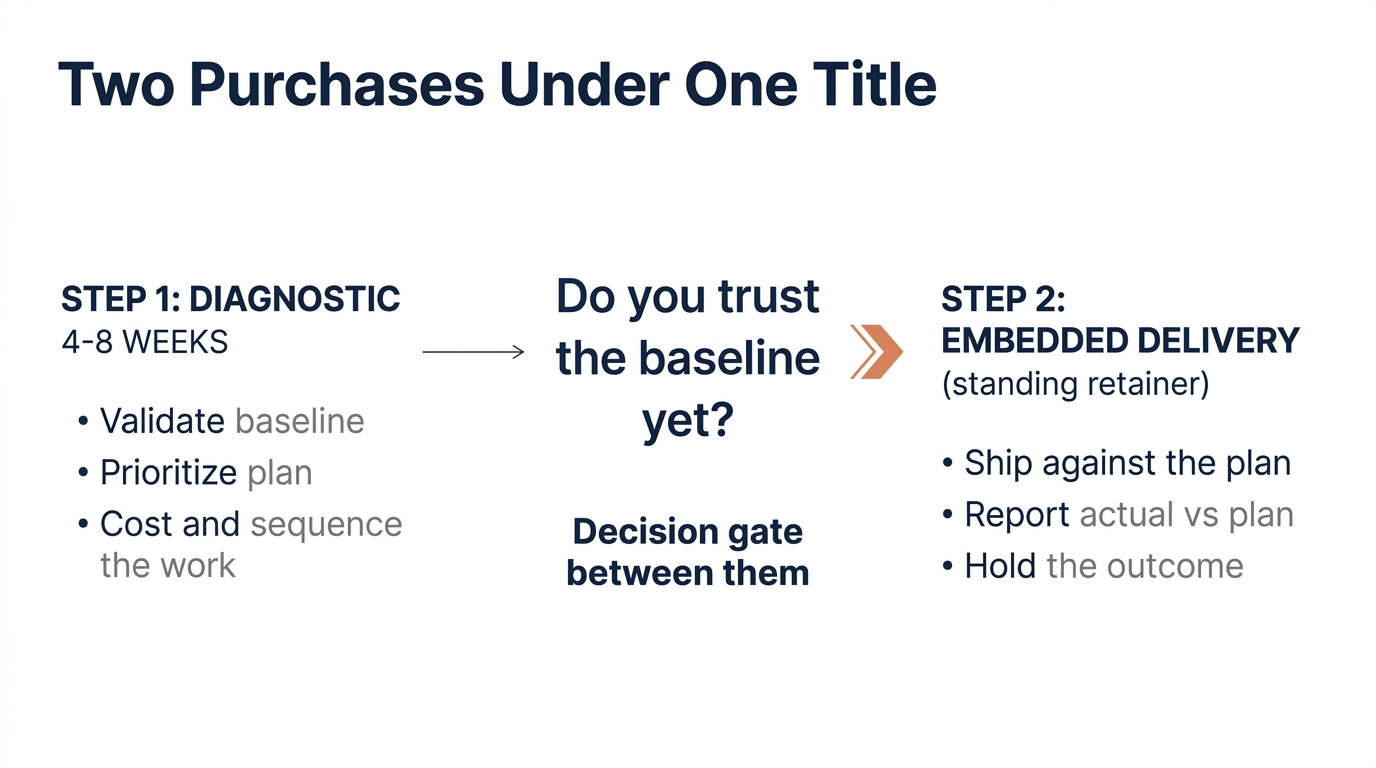
There are two distinct purchases hiding under the same job title, and conflating them wastes money.
A diagnostic answers “what is true and what should we fund.” It is bounded, usually four to eight weeks, and it produces a prioritized plan with cost, sequence, and expected financial effect. Embedded delivery answers “do the work and hold the outcome.” It is a standing capability that ships against the plan and reports against a baseline. You buy the diagnostic when you do not yet trust the picture. You buy embedded delivery once you do.
Most portfolio situations need the diagnostic first. Running the full engagement before anyone has validated the baseline is how a value creation program ends up optimizing the wrong system.
3. Tie the engagement to a real trigger
The timing matters more than most deal teams admit. The strongest engagements are anchored to a specific event rather than a general sense that technology needs attention.
During confirmatory diligence, the work is to confirm or price a risk before the money moves, which overlaps with structured technology due diligence. In the first 100 days, the work is to establish the baseline and sequence the quick wins that fund the harder ones. Before a system migration or an add-on, the work is to protect the forecast from an integration dependency nobody scoped. Bain’s annual global private equity report has tracked how value creation has shifted from financial engineering toward operational levers, and technology sits inside most of those levers now.
4. Separate the consultant who advises from the firm that delivers
A strategy adviser who writes a roadmap and leaves hands the portfolio company a document with no one to execute it. The portfolio company then has to find someone to build it, which is a second procurement and a second delay.
For most mid-market companies the practical model is a partner who can both diagnose and deliver, because the gap between the plan and the people who execute it is where value creation programs quietly die. If the two are genuinely separate, the decision right for sequencing and the accountability for the outcome must be assigned explicitly, in writing, before work starts. The detail of how that delivery capability gets stood up is covered in the guide on choosing an embedded technology partner for portfolio companies.
5. Judge the consultant on how they build a baseline
The single most revealing test is whether the consultant insists on a baseline before promising anything. A baseline is the current, evidenced state of the metric the engagement is meant to move: current conversion, current cycle time, current infrastructure cost, current release cadence.
Without it, every later claim of improvement is unfalsifiable. A consultant who leads with a target before establishing the starting number is selling optimism. One who spends the first fortnight instrumenting the system and arguing about what counts is doing the work. McKinsey’s research on private capital has repeatedly pointed to measurement discipline as the difference between programs that report value and programs that deliver it.
6. Make them classify the value they claim
Not all value is the same, and a serious consultant will not let you treat it as such. Ask that every projected impact be labeled as one of the following.
- Realized: already in the actuals, with a before-and-after number.
- Run-rate: in effect now and annualizing forward.
- Forecast: expected if the plan executes on schedule.
- Enabled: made possible but dependent on a later decision or spend.
- Risk avoided: a cost or loss removed from the register.
The failure mode is a deck where forecast and enabled value are presented as if they were already in the bank. When that happens in a board pack, the first missed quarter exposes it, and the consultant’s credibility goes with it.
7. Insist on a prioritized plan with sequence and cost
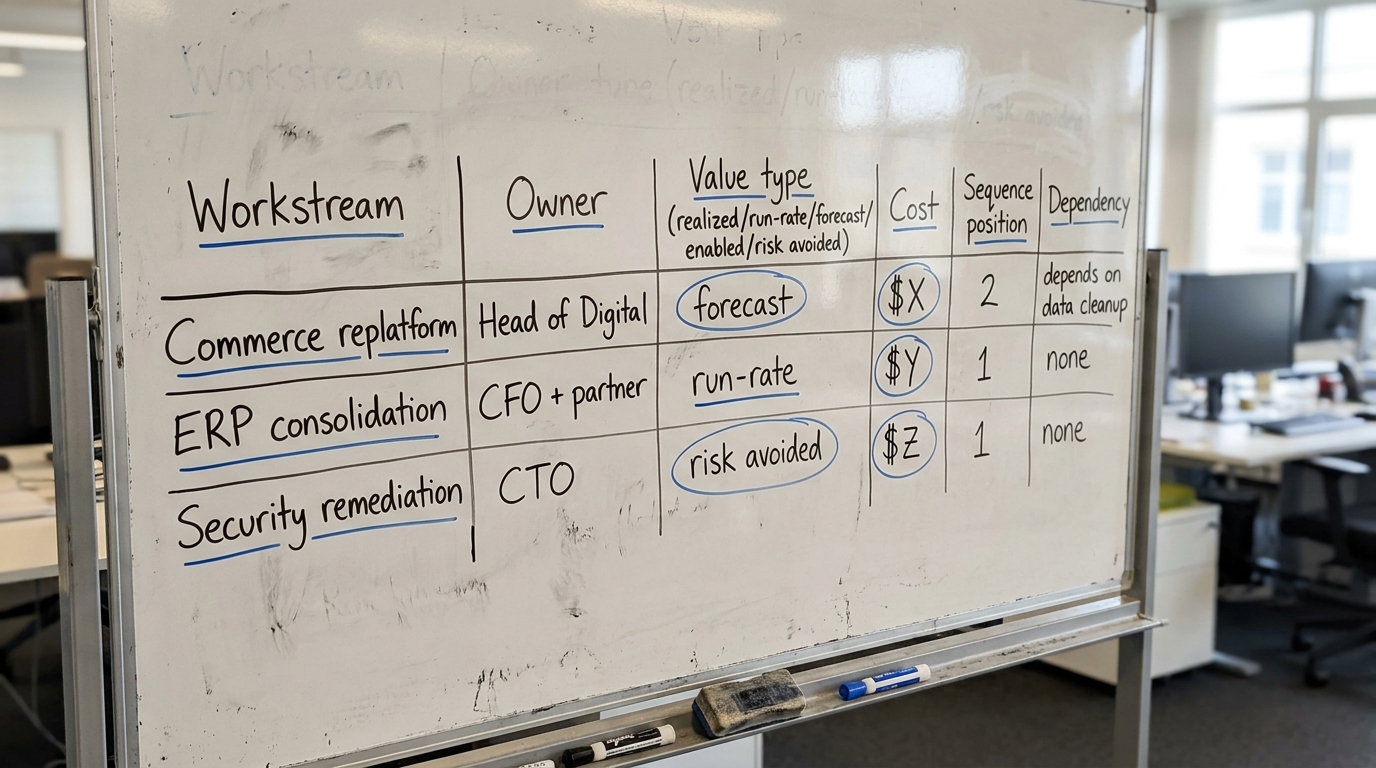
A ranked list of initiatives with no cost, no sequence, and no dependency map tells the operating partner which problems exist but not how to solve them. What the operating partner needs is a short set of workstreams, each with an owner, an expected financial effect, a cost, and its position relative to the others.
Sequence is where most of the value and most of the risk sits. Quick wins that generate cash early can fund the structural work that takes longer. A data cleanup that has to happen before any analytics investment pays off is a dependency, and if the plan does not name it, the analytics spend will stall. The related reading on data readiness for an exit portfolio company covers how often that one dependency is missed.
8. Scope the money against the mandate, not the rate card
Pricing follows the two-purchase split. A light diagnostic that validates a baseline and ranks initiatives for a single company runs in the lower tens of thousands; a full diagnostic across a more complex estate, with instrumentation and an executable plan, runs higher. Embedded delivery is a monthly retainer sized to the delivery load, which for a mid-market company typically starts in the mid five figures per month and scales with the number of active workstreams.
The number itself matters less than whether it is tied to a mandate. A retainer with no named outcome and no baseline is an open-ended cost. A retainer that reports actual against plan every month is an investment the board can govern. The broader question of what you actually buy when you buy digital value creation services is worth reading before signing.
9. Check the reporting cadence against your governance calendar
The consultant’s reporting has to land inside the rhythm the fund already runs. Monthly operating reviews need a monthly actual-versus-plan readout. The quarterly board pack needs value classified and attributed. If the consultant reports in hours delivered, tickets closed, and features shipped, the deal team cannot translate any of it into enterprise value, and the engagement becomes a vendor relationship rather than a value-creation one.
BCG’s work on principal investors and private equity has made the same point about operating partners generally: the discipline that separates a real program from a report is attribution to the financial statement, repeated on the firm’s own cadence.
10. Pressure-test the team behind the title
A value creation consultant is only as good as the people who show up. Ask who specifically will do the diagnostic, who will lead delivery, and whether they have operated inside a PE-backed company under a hold period and an exit clock. A firm that staffs a portfolio engagement the way it staffs an enterprise transformation will move too slowly for the timeline the fund is working to.
If the engagement moves into standing delivery, the structure of that team becomes its own decision, covered in the guide on building and judging an embedded engineering team and, for product-heavy companies, structuring outsourced product and engineering.
11. Decide how AI and data fit before you fund them
Nearly every value creation pitch now includes an AI line. The useful consultant will tell you which of those ideas is fundable this hold period and which depends on data the company does not yet have clean. Treating that honestly is more valuable than the enthusiasm, and the decision framework in deciding what agentic AI to fund in portfolio companies is a good filter. The same realism applies to roadmap-level claims, which the guide on hiring and judging a technology roadmap consultant addresses directly.
12. A checklist before you sign
Run the engagement against these before the contract goes out.
- The engagement names a specific enterprise-value lever, not a technology problem.
- You know whether you are buying a diagnostic, embedded delivery, or a staged move from one to the other.
- It is anchored to a real trigger: diligence, the first 100 days, a migration, or an add-on.
- Accountability for the outcome is assigned, in writing, to a named owner.
- The consultant builds a baseline before promising any improvement.
- Every claimed impact is classified as realized, run-rate, forecast, enabled, or risk avoided.
- The plan has sequence, cost, owners, and named dependencies.
- Pricing is tied to a mandate, not a rate card.
- Reporting lands on your operating and board cadence, in financial terms.
- You have met the people who will actually do the work.
For companies where the value sits in high-traffic systems or an ERP under forecast pressure, two related judgments are worth making in parallel: what high-traffic platform engineering is worth in a deal and how to judge an ERP implementation before it breaks the forecast.
13. Where this fits in the broader value creation plan
A technology value creation engagement is one input to a plan the fund is building across the whole holding. It should connect to the IT roadmap the board has already approved, the detail of which is in the guide on what an IT roadmap for a portfolio company has to deliver. Treat the consultant’s output as something the deal team governs against a baseline, not as a finished answer handed over and filed.
If you are scoping either a diagnostic to validate the baseline or embedded delivery to hold the outcome, review how DevriX structures technology value creation for private equity portfolio companies and bring the specific lever and trigger you are working against.